
When preparing for the National Eligibility cum Entrance Test (NEET UG), one of the biggest traps aspirants fall into is resource hoarding—buying 10 different reference books for Physics and bulky modules for Biology, only to read none of them properly.
The reality of NEET is simple: 85% to 90% of the entire question paper is derived directly from NCERT textbooks.
To score 650+ marks and secure a Government Medical College (MBBS) seat, you do not need a mini-library. You need one primary conceptual book and one dedicated MCQ practice book per subject.
Here is the concise, high-yield booklist recommended by NEET toppers and senior medical faculties.
The Essential NEET Bookstack
Keep your desk clean and limit your resources to these proven core titles:
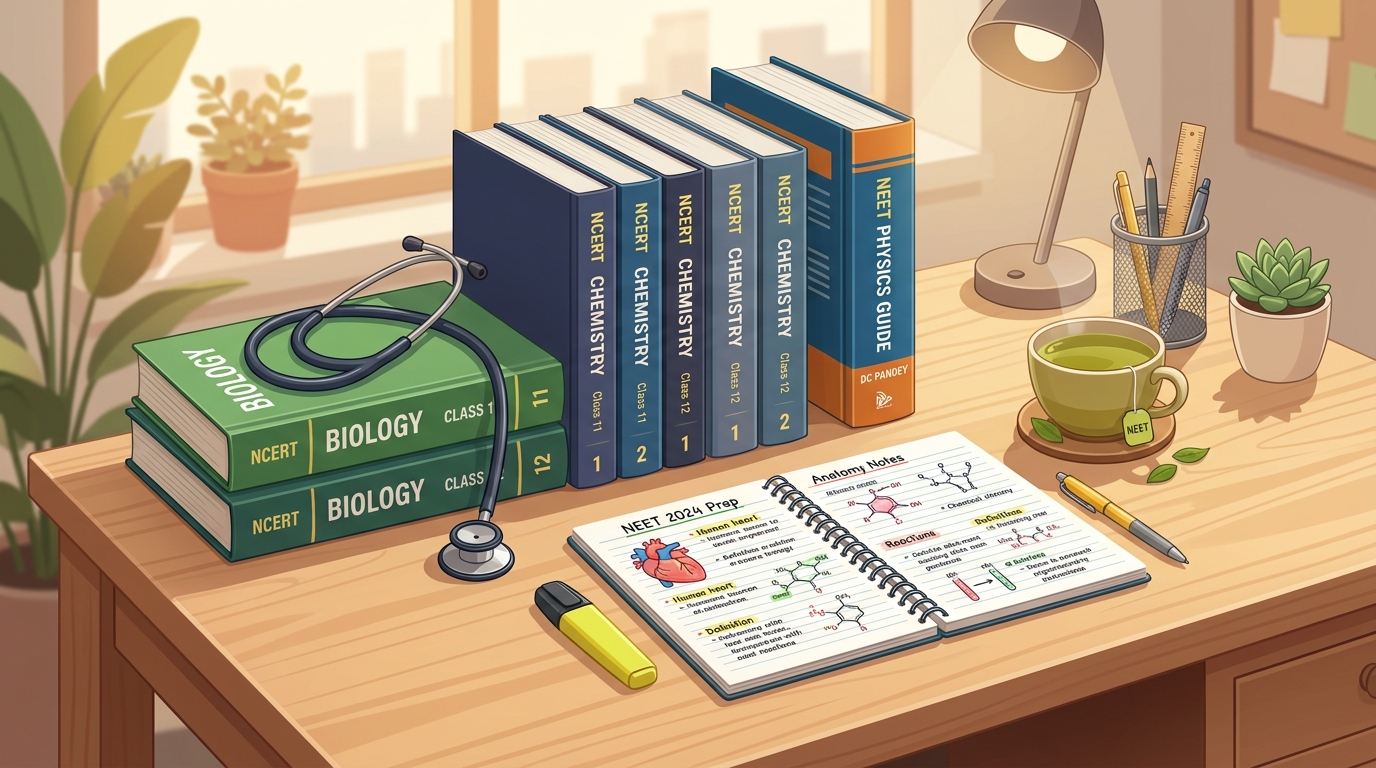
1. Quick Reference: Subject-Wise Core Booklist
| Subject | Primary Conceptual Book (Must Read) | Recommended Practice Book (MCQs) | Why It Works |
|---|---|---|---|
| Biology | NCERT Biology (Class 11 & 12) | MTG NCERT at your Fingertips OR Dr. Ali Objective Biology | NCERT covers 95% of questions directly. Practice books ensure line-by-line mastery. |
| Physics | NCERT Physics (Class 11 & 12) + Coaching Notes | Objective Physics by DC Pandey (NEET Edition) | DC Pandey offers graded numerical problems tailored specifically to the NEET difficulty level. |
| Physical Chemistry | NCERT Chemistry (Class 11 & 12) | N. Awasthi (Problems in Physical Chemistry for NEET) | Builds fast formula application and numerical calculation accuracy. |
| Inorganic Chemistry | NCERT Chemistry (Class 11 & 12) strictly | VK Jaiswal OR MTG Fingertips Chemistry | 100% of Inorganic questions come directly from NCERT tables, reactions, and exceptions. |
| Organic Chemistry | NCERT Chemistry (Class 11 & 12) | MS Chouhan (Elementary Problems in Organic Chemistry) | Clears reaction mechanisms, electrophilic additions, and named reactions. |
| All Subjects | 36 Years NEET Chapter-wise PYQs (MTG / Arihant) | — | Past Year Questions reveal repeating patterns and exact NTA framing. |
2. Subject-Wise Breakdown & How to Use Them
🧬 Biology (Target: 350+ / 360)
- The Core Bible: NCERT Class 11 & 12 Biology. Treat every line as a potential question. Pay extra attention to:
- Diagram labeling and captions
- Summary boxes at the end of each chapter
- Scientist biographies preceding each unit
- Practice Companion: MTG NCERT at your Fingertips. Solve the line-by-line fill-in-the-blanks and MCQs right after finishing an NCERT chapter.
- Pro Tip: Avoid heavy medical college reference books (like Trueman's) for theory. They contain unnecessary out-of-syllabus details that waste your time.
🧪 Chemistry (Target: 160+ / 180)
- Physical Chemistry: Read NCERT for definitions, but spend 80% of your time solving numericals from N. Awasthi or your coaching module. Maintain a dedicated Formula Notebook.
- Inorganic Chemistry: Strictly NCERT line-by-line. Highlight trends (atomic radii, ionization enthalpy) and anomalous behaviors with a colored pen.
- Organic Chemistry: Master GOC (General Organic Chemistry) and reaction mechanisms first. Use MS Chouhan to practice identifying products and reagents.
⚡ Physics (Target: 140+ / 180)
- Conceptual Clarity: Study from your class notes and NCERT. Read the "Points to Ponder" and summary sections at the back of each NCERT chapter.
- Problem Solving: DC Pandey (NEET Edition) or SL Arora. Start with Level-1 questions to build confidence, then move to Level-2 and previous years' questions.
- Concepts of Physics (HC Verma): Read select theory sections and solve Objective I & II questions for deep conceptual clarity in Mechanics and Electromagnetism.
3. The 3 Golden Rules of NEET Book Selection
- NCERT First, NCERT Last: Never touch a secondary reference book until you have read the corresponding NCERT chapter at least twice.
- One Theory Book + One Question Bank: Sticking to 1 book and revising it 4 times is infinitely better than skimming 4 different books once.
- Past 15 Years' PYQs Are Non-Negotiable: Solve at least 35 to 40 years of NEET/AIPMT chapter-wise previous year questions. Over 60% of Physics and Chemistry question types directly repeat!
Frequently Asked Questions (FAQs)
Is NCERT alone enough to score 650+ in NEET?
For Biology and Inorganic Chemistry, NCERT is nearly 100% sufficient. However, for Physics and Physical Chemistry, you need an additional practice book (like DC Pandey or N. Awasthi) to practice numerical problem-solving and time management.
Should I read HC Verma for NEET Physics?
Concepts of Physics by HC Verma is excellent for concept building, but its subjective problems are oriented towards JEE Advanced. For NEET, solve only the Objective I and Objective II questions from HC Verma.
Which is better: MTG Fingertips or coaching modules?
Both are great. If you are enrolled in a reputed coaching institute, their modules are sufficient. If you are self-studying, MTG NCERT at your Fingertips is the gold standard for line-by-line NCERT practice.