
Preparing for the National Eligibility cum Entrance Test (NEET UG) without an intimate knowledge of the official syllabus is like setting sail without a compass.
Every year, over 24 lakh medical aspirants compete for approximately 1.05 lakh MBBS seats across government and private medical colleges in India. With competition intensifying and cutoff scores pushing higher, smart syllabus prioritization is the single biggest factor separating qualifiers from top rankers.
The NEET examination is conducted by the National Testing Agency (NTA) based on the medical curriculum prescribed by the National Medical Commission (NMC). The syllabus covers the core disciplines of Physics, Chemistry, and Biology (Botany & Zoology) across Classes 11 and 12.
This comprehensive guide details the complete, officially updated NEET subject-wise syllabus, chapter-wise weightage, exam pattern, and high-yield scoring priorities.
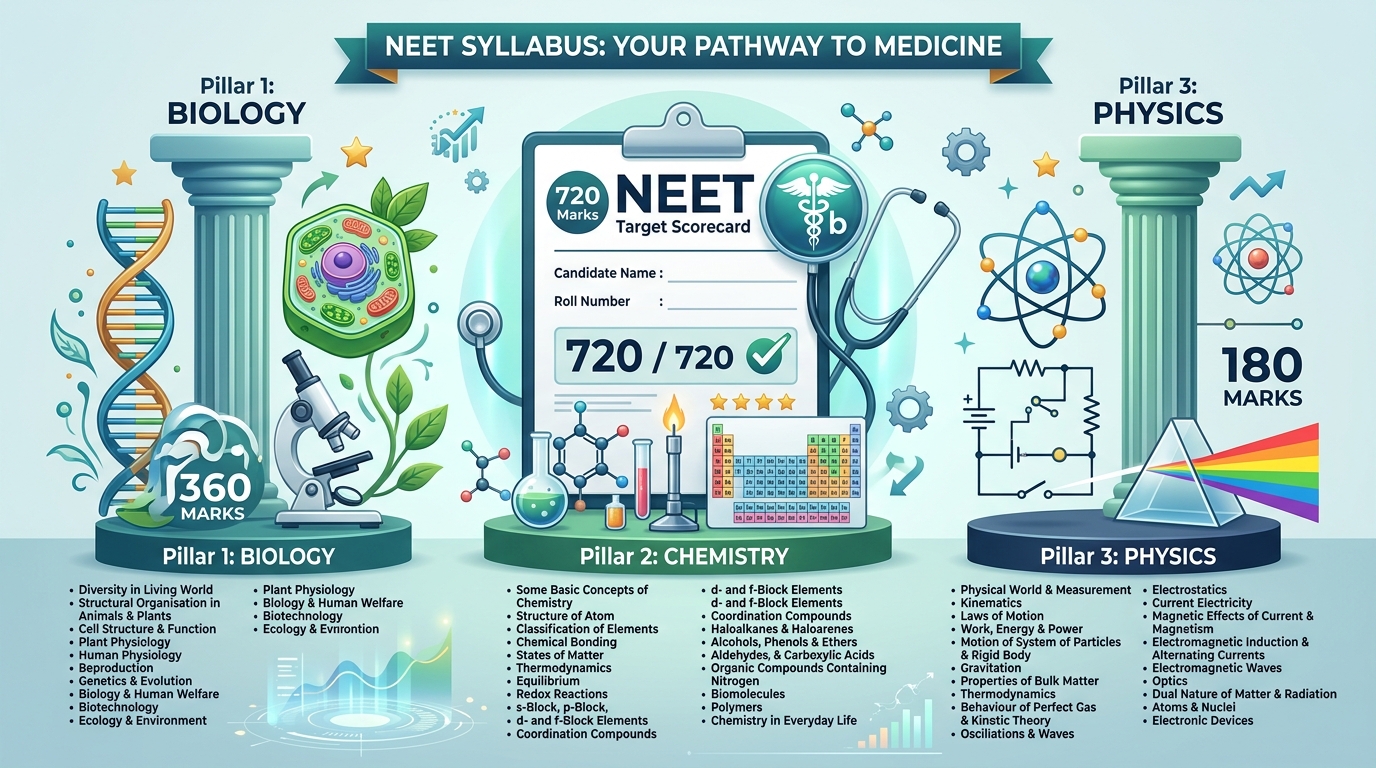
NEET Syllabus: Your Pathway to Medicine
Here is an illustrated architectural overview of the three pillars of the NEET UG curriculum:
1. NEET UG Exam Pattern & Marking Scheme
Before diving into individual chapters, understand how questions are distributed and evaluated:
| Subject | Section A (Mandatory) | Section B (Optional Choice) | Total Questions to Attempt | Total Marks |
|---|---|---|---|---|
| Physics | 35 Questions (140 Marks) | 15 Questions (Attempt any 10) (40 Marks) | 45 Questions | 180 Marks |
| Chemistry | 35 Questions (140 Marks) | 15 Questions (Attempt any 10) (40 Marks) | 45 Questions | 180 Marks |
| Botany | 35 Questions (140 Marks) | 15 Questions (Attempt any 10) (40 Marks) | 45 Questions | 180 Marks |
| Zoology | 35 Questions (140 Marks) | 15 Questions (Attempt any 10) (40 Marks) | 45 Questions | 180 Marks |
| Total | 140 Questions | 60 Questions (Attempt 40) | 180 Questions | 720 Marks |
Key Exam Specifications:
- Exam Mode: Pen and Paper (OMR-based offline exam).
- Exam Duration: 200 Minutes (3 Hours and 20 Minutes).
- Marking Scheme:
- +4 Marks for every correct answer.
- -1 Mark for every incorrect answer (negative marking).
- 0 Marks for unattempted questions.
- Section B Rule: In Section B of each subject, 15 questions are presented; you must attempt only 10 questions. If you mark more than 10, only the first 10 answered will be evaluated.
2. NEET Biology Syllabus (360 Marks / 90 Questions)
Biology carries 50% of the total NEET marks. Scoring 340+ in Biology is the non-negotiable foundation for getting into a top government medical college.
Class 11 Biology Units
| Unit | Chapters Included | High-Yield Concepts to Master | Approx. Questions |
|---|---|---|---|
| Unit 1: Diversity in the Living World | - The Living World<br>- Biological Classification<br>- Plant Kingdom<br>- Animal Kingdom | Taxonomic hierarchy, Monera/Protista/Fungi characteristics, Algae classification (pigments/stored food), Non-chordates & Chordates characteristics. | 8 – 10 Qs |
| Unit 2: Structural Organisation in Animals & Plants | - Morphology of Flowering Plants<br>- Anatomy of Flowering Plants<br>- Structural Organisation in Animals | Modifications of root/stem/leaf, floral formulas (Fabaceae, Solanaceae, Malvaceae, Cruciferae, Compositae, Gramineae), Plant tissues (xylem, phloem), Frog anatomy. | 5 – 7 Qs |
| Unit 3: Cell Structure and Function | - Cell: The Unit of Life<br>- Biomolecules<br>- Cell Cycle and Cell Division | Prokaryotic vs Eukaryotic organelles, Endomembrane system, Enzyme mechanisms, Phases of Mitosis and Meiosis (Prophase-I stages). | 9 – 11 Qs |
| Unit 4: Plant Physiology | - Photosynthesis in Higher Plants<br>- Respiration in Plants<br>- Plant Growth and Development | Light reaction, Calvin cycle (C3), Hatch-Slack (C4), Glycolysis, Krebs cycle, ETS, Plant growth regulators (Auxins, Gibberellins, Cytokinins, ABA, Ethylene). | 7 – 9 Qs |
| Unit 5: Human Physiology | - Breathing and Exchange of Gases<br>- Body Fluids and Circulation<br>- Excretory Products and Elimination<br>- Locomotion and Movement<br>- Neural Control and Coordination<br>- Chemical Coordination and Integration | Respiratory volumes & capacities, Cardiac cycle, ECG, Counter-current mechanism, Sliding filament theory, Reflex arc, Endocrine hormones and disorders. | 12 – 15 Qs |
Class 12 Biology Units
| Unit | Chapters Included | High-Yield Concepts to Master | Approx. Questions |
|---|---|---|---|
| Unit 6: Reproduction | - Sexual Reproduction in Flowering Plants<br>- Human Reproduction<br>- Reproductive Health | Microsporogenesis, Megasporogenesis, Double fertilization, Spermatogenesis, Oogenesis, Menstrual cycle, Embryonic development, ART techniques (IVF, ZIFT, ICSI). | 10 – 12 Qs |
| Unit 7: Genetics and Evolution | - Principles of Inheritance and Variation<br>- Molecular Basis of Inheritance<br>- Evolution | Mendel’s laws, Linkage & recombination, Genetic disorders (Pedigree analysis), DNA replication, Transcription, Genetic code, Translation, Lac Operon, Hardy-Weinberg principle. | 15 – 18 Qs (Highest Weightage Unit!) |
| Unit 8: Biology and Human Welfare | - Human Health and Diseases<br>- Microbes in Human Welfare | Pathogens (Malaria cycle, Amoebiasis, Typhoid), Immunity (Innate vs Acquired), AIDS & Cancer mechanisms, Sewage treatment, Biogas production, Biocontrol agents. | 5 – 7 Qs |
| Unit 9: Biotechnology | - Biotechnology: Principles and Processes<br>- Biotechnology and its Applications | Recombinant DNA tech, Restriction enzymes, Cloning vectors (pBR322), PCR, Gel electrophoresis, Bt crops, RNA interference (RNAi), Gene therapy (ADA deficiency). | 8 – 10 Qs |
| Unit 10: Ecology and Environment | - Organisms and Populations<br>- Ecosystem<br>- Biodiversity and Conservation | Population interactions (Mutualism, Commensalism, Parasitism), Ecological pyramids, Nutrient cycles, Species-area relationship, In-situ and Ex-situ conservation. | 9 – 11 Qs |
3. NEET Chemistry Syllabus (180 Marks / 45 Questions)
Chemistry in NEET is divided equally into Physical, Inorganic, and Organic Chemistry. Each branch requires a distinct preparation approach:
┌─────────────────────────────────────────────────────────────┐
│                 NEET CHEMISTRY DISTRIBUTION                 │
├─────────────────────────────────────────────────────────────┤
│ • PHYSICAL CHEMISTRY (approx. 15–16 Qs) → Numerical & Laws  │
│ • INORGANIC CHEMISTRY (approx. 14–15 Qs)→ 100% NCERT Lines  │
│ • ORGANIC CHEMISTRY (approx. 15–16 Qs)  → Mechanisms & GOC  │
└─────────────────────────────────────────────────────────────┘
Physical Chemistry Chapters
- Some Basic Concepts of Chemistry: Mole concept, molarity, molality, mole fraction, limiting reagent, empirical & molecular formulas.
- Structure of Atom: Bohr’s model, dual nature of matter (de Broglie), Heisenberg uncertainty principle, quantum numbers, electronic configuration.
- Chemical Thermodynamics: First law, internal energy, enthalpy, Hess’s law, entropy, Gibbs free energy ($\Delta G$), spontaneity criteria.
- Equilibrium: Chemical equilibrium ($K_p, K_c$, Le Chatelier's principle), Ionic equilibrium (pH calculation, buffer solutions, solubility product $K_{sp}$, common ion effect).
- Solutions: Raoult’s law, colligative properties (elevation of boiling point, depression of freezing point, osmotic pressure), van 't Hoff factor ($i$).
- Electrochemistry: Galvanic cells, Nernst equation, Kohlrausch’s law, Faraday’s laws of electrolysis.
- Chemical Kinetics: Rate laws, order and molecularity, integrated rate equations (zero and first order), Arrhenius equation, activation energy.
Inorganic Chemistry Chapters
- Classification of Elements & Periodicity: Modern periodic table, trends in atomic radii, ionization enthalpy, electron gain enthalpy, electronegativity.
- Chemical Bonding & Molecular Structure: Lewis structures, VSEPR theory, hybridization ($sp, sp^2, sp^3, sp^3d, sp^3d^2$), dipole moments, Molecular Orbital Theory (MOT), hydrogen bonding.
- p-Block Elements: Group-wise trends, anomalous behavior of first elements, allotropes, structures of oxoacids.
- d- and f-Block Elements: Electronic configuration, variable oxidation states, catalytic properties, magnetic properties, Lanthanoid contraction, preparation & properties of $\text{KMnO}_4$ and $\text{K}_2\text{Cr}_2\text{O}_7$.
- Coordination Compounds: Werner’s theory, IUPAC nomenclature, isomerism (structural and stereo), Valence Bond Theory (VBT), Crystal Field Theory (CFT), magnetic properties.
Organic Chemistry Chapters
- Purification & Characterisation of Organic Compounds: Qualitative and quantitative analysis, estimation of carbon, hydrogen, nitrogen, halogens.
- General Organic Chemistry (GOC): Inductive effect, resonance, hyperconjugation, aromaticity (Hückel’s rule), carbocations, carbanions, free radicals stability, acidity & basicity order.
- Hydrocarbons: Alkanes, alkenes (Markovnikov & anti-Markovnikov addition, ozonolysis), alkynes, benzene electrophilic substitution.
- Haloalkanes and Haloarenes: $S_N1$ and $S_N2$ mechanisms, stereochemistry, optical activity.
- Alcohols, Phenols, and Ethers: Hydroboration-oxidation, Lucas test, Reimer-Tiemann reaction, Kolbe’s reaction, Williamson ether synthesis.
- Aldehydes, Ketones, and Carboxylic Acids: Nucleophilic addition reactions, Aldol condensation, Cannizzaro reaction, Hell-Volhard-Zelinsky (HVZ) reaction, acidic strength.
- Organic Compounds Containing Nitrogen (Amines): Gabriel phthalimide synthesis, Hoffmann bromamide reaction, carbylamine test, Hinsberg test, Diazonium salts.
- Biomolecules: Carbohydrates (classification, reducing sugars), Amino acids and proteins (peptide bond, denaturation), Nucleic acids (DNA/RNA structure), Vitamins.
4. NEET Physics Syllabus (180 Marks / 45 Questions)
Physics is widely considered the rank-decider in NEET. Most questions test direct formula application, dimensional analysis, and proportional reasoning.
| Branch of Physics | Chapters Covered | Key High-Yield Focus | Typical Questions |
|---|---|---|---|
| Mechanics (Class 11) | - Units & Measurements<br>- Motion in a Straight Line<br>- Motion in a Plane<br>- Laws of Motion<br>- Work, Energy & Power<br>- System of Particles & Rotational Motion<br>- Gravitation | Vernier calipers & screw gauge errors, projectile motion, friction on banking of roads, work-energy theorem, moment of inertia formulas, orbital & escape velocity. | 12 – 15 Qs |
| Thermal Physics & Fluids | - Mechanical Properties of Solids<br>- Mechanical Properties of Fluids<br>- Thermal Properties of Matter<br>- Thermodynamics<br>- Kinetic Theory | Young's modulus, Bernoulli's principle, surface tension, terminal velocity, Carnot engine efficiency, first law of thermodynamics, molar heat capacities ($C_p, C_v$). | 5 – 7 Qs |
| Oscillations & Waves | - Oscillations (SHM)<br>- Waves | Time period of simple pendulum and spring-block system, equation of progressive waves, standing waves in organ pipes, beats. | 3 – 4 Qs |
| Electrodynamics (Class 12) | - Electrostatics & Potential<br>- Current Electricity<br>- Moving Charges & Magnetism<br>- Magnetism & Matter<br>- EMI & Alternating Current | Coulomb’s law, Gauss’s theorem, parallel plate capacitor with dielectric, Kirchhoff’s laws, Wheatstone bridge, Biot-Savart law, cyclotron/solenoid, Faraday’s law, LCR series circuit resonance. | 12 – 14 Qs |
| Optics & EM Waves | - Electromagnetic Waves<br>- Ray Optics & Optical Instruments<br>- Wave Optics | Total internal reflection (TIR), lens maker's formula, compound microscope & astronomical telescope, Young’s Double Slit Experiment (YDSE), Brewster's law. | 6 – 8 Qs |
| Modern Physics & Electronics | - Dual Nature of Matter<br>- Atoms & Nuclei<br>- Semiconductor Electronics | Photoelectric equation & stopping potential, de Broglie wavelength, Bohr’s hydrogen spectral lines, nuclear binding energy & mass defect, p-n junction diode forward/reverse bias, logic gates. | 8 – 10 Qs (Easiest & Most Scoring!) |
5. Experimental & Practical Skills Added in NEET
In recent syllabus updates, the National Medical Commission (NMC) explicitly emphasized practical laboratory skills:
- Physics Experiments: Vernier Calipers, Screw Gauge, Simple Pendulum, Metre Scale (moment of a couple), Young’s Modulus of elasticity, Surface Tension by capillary rise, Coefficient of Viscosity, Speed of sound using Resonance Tube, Resistance of wire using Metre Bridge, Half Deflection Method in Galvanometer, Focal length of spherical mirrors and lenses.
- Chemistry Practical Concepts: Detection of functional groups (hydroxyl, carbonyl, carboxyl, amino), Preparation of lyophilic and lyophobic sols, Titrimetric exercises (acid-base titration, redox titration with $\text{KMnO}_4$), Qualitative analysis of cations and anions.
6. The "80/20 Rule": High-Yield Chapters to Target First
If you are running short of time or want to maximize your score rapidly, focus on these top 10 chapters that yield over 300+ marks alone:
- Genetics and Evolution (Biology) $\rightarrow$ 15–18 Questions
- Human Physiology (Biology) $\rightarrow$ 12–15 Questions
- Reproduction (Biology) $\rightarrow$ 10–12 Questions
- Ecology & Environment (Biology) $\rightarrow$ 9–11 Questions
- Modern Physics (Atoms, Nuclei, Dual Nature, Semiconductors) (Physics) $\rightarrow$ 8–10 Questions
- Current Electricity & Capacitors (Physics) $\rightarrow$ 5–6 Questions
- Chemical Bonding & Molecular Structure (Chemistry) $\rightarrow$ 4–5 Questions
- General Organic Chemistry (GOC) (Chemistry) $\rightarrow$ 4–5 Questions
- Coordination Compounds (Chemistry) $\rightarrow$ 3–4 Questions
- Cell Structure and Division (Biology) $\rightarrow$ 9–11 Questions
Frequently Asked Questions (FAQs)
Are state board textbooks enough, or is NCERT mandatory for NEET?
NCERT is strictly mandatory. More than 90% of questions in Biology and Inorganic Chemistry are framed word-for-word from NCERT textbooks. State board books can be used for extra numerical practice, but NCERT is the ultimate reference.
Did NTA delete topics from the NEET syllabus?
Yes, the NMC rationalized the NEET syllabus to align with the rationalized NCERT textbooks. Several rote-heavy chapters (like Solid State, Metallurgy, Surface Chemistry, States of Matter, Digestion and Absorption, Reproduction in Organisms) were removed, while specific practical skills were emphasized.
How much weightage is given to Class 11 vs. Class 12?
The distribution is almost evenly balanced:
- Class 11 Syllabus: Approximately 48% to 50%
- Class 12 Syllabus: Approximately 50% to 52% Do not neglect Class 11, as foundational chapters like Mechanics, GOC, Chemical Bonding, and Cell Biology form the building blocks for Class 12.
Summary & Action Plan
- Download and Print the Syllabus: Keep this subject-wise checklist on your study wall.
- Focus on NCERT Line-by-Line: Master every diagram, table, and summary box in Biology and Inorganic Chemistry.
- Solve Topic-Wise PYQs: Complete the past 15 years' NEET question papers for every chapter immediately after finishing the theory.
- Take Full-Length Timed Mocks: Train yourself to manage 200 questions within the 200-minute window.
Master the syllabus systematically, track your accuracy, and march forward with confidence toward your medical career!