
Choosing the right books for UPSC preparation can feel surprisingly difficult.
Search online and you will find hundreds of recommendations. One person suggests five books for History, another recommends three for Polity, while someone else insists that you need a completely different set of notes and study materials.
The result? A growing bookshelf and very little revision.
The truth is much simpler: You do not need dozens of books to prepare for the UPSC Civil Services Examination. What you need is a carefully selected set of standard books, the right current-affairs sources, previous-year question papers, and, most importantly, enough revision.
For the UPSC CSE 2026–27 preparation cycle, this guide covers the most commonly recommended books for Prelims and General Studies Mains, explains what each book is actually useful for, and tells you how to use them without getting trapped in endless resource collection.
UPSC Essential Bookstack Overview
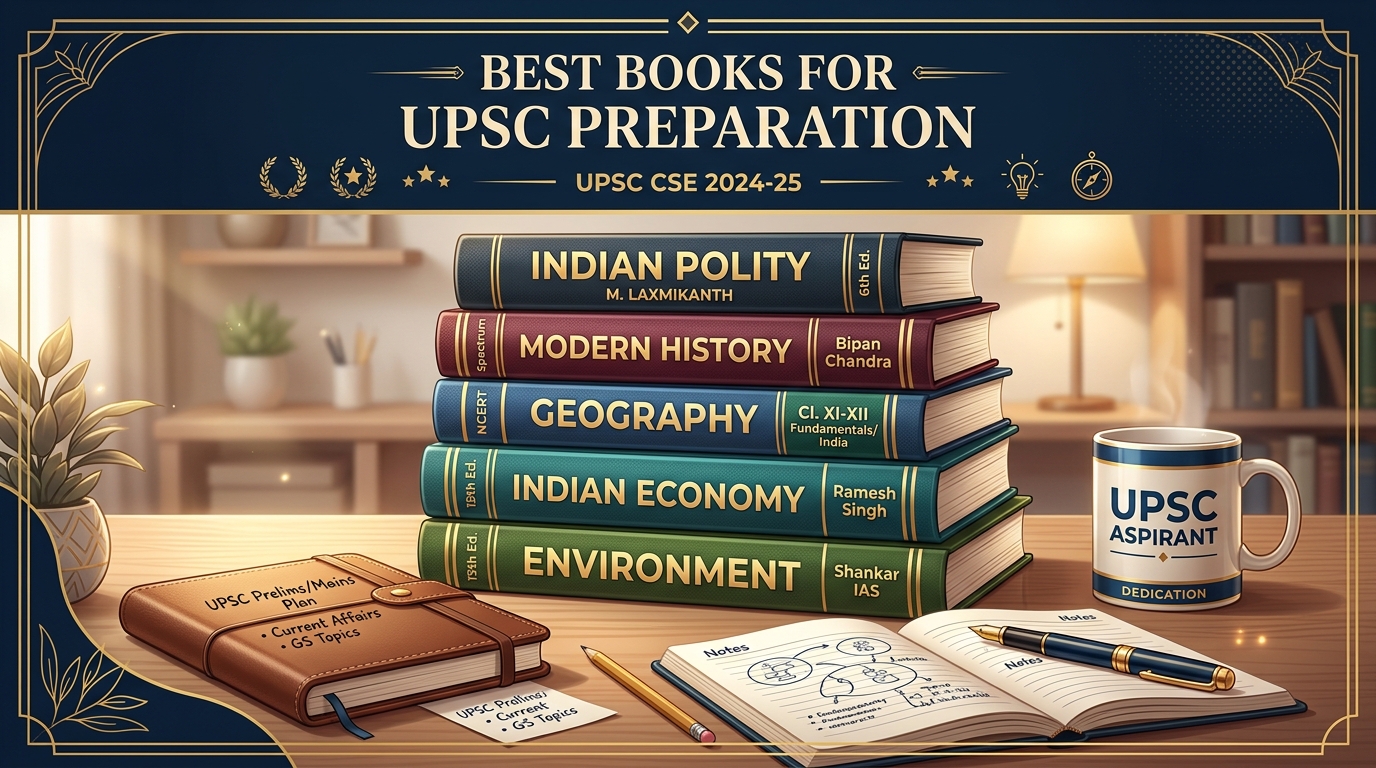
Here is an illustrated view of the standard core books that form the bedrock of successful Civil Services preparation:
Quick Answer: Which Books Are Best for UPSC?
If you are a beginner and want the short, high-yield version, start with this core booklist:
| Subject Area | Recommended Primary Book / Source | Key Focus & Scope |
|---|---|---|
| Foundation | Selected NCERTs (Class 6–12) | Basic conceptual clarity across History, Geography, Economy, and Science |
| Indian Polity | Indian Polity – M. Laxmikanth | Constitution, Parliament, Judiciary, and Governance (Prelims + GS-II) |
| Modern History | A Brief History of Modern India – Spectrum (Rajiv Ahir) | British expansion, 1857 revolt, Gandhian movements & freedom struggle |
| Ancient History | Old NCERT (R.S. Sharma) | Harappan civilization, Vedic period, Mauryans, Guptas, and cultural evolution |
| Medieval History | Old NCERT (Satish Chandra) | Delhi Sultanate, Mughals, Vijayanagara, Bhakti and Sufi movements |
| Art & Culture | Indian Art and Culture – Nitin Singhania | Architecture, sculptures, classical dances, paintings, and heritage |
| Geography | NCERTs (Class 11 & 12) + G.C. Leong | Physical, human, economic geography and worldwide climatic zones |
| Map Study & Atlas | Oxford Student Atlas for India | Mapping physical features, places in the news, and economic resources |
| Indian Economy | Indian Economy – Ramesh Singh + Budget/Survey | Macroeconomics, banking, inflation, fiscal policies, and agriculture |
| Environment & Ecology | Environment – Shankar IAS Academy | Ecosystems, biodiversity, climate change, conventions, and protected areas |
| Ethics & Integrity | Lexicon for Ethics, Integrity & Aptitude | Core ethical definitions, thinkers, probity, and case-study frameworks |
| Current Affairs | The Hindu or The Indian Express + Monthly Magazine | Daily conceptual linkage with static syllabus topics |
| Previous Year Papers | Official UPSC PYQs (Last 10–15 Years) | Understanding exam patterns, recurring themes, and question framing |
| CSAT (Aptitude) | Standard CSAT Manual + Official PYQs | Reading comprehension, logical reasoning, and basic quantitative aptitude |
Note: This is your core starting point. Your Optional Subject will require its own specialized booklist based on the discipline you select.
Why Choosing the Right UPSC Books Matters
The UPSC syllabus is enormous. The problem in modern preparation is not a lack of information; it is the exact opposite: information overload.
A truly good preparation book should help you do at least one of these things:
- Build fundamental concepts from scratch
- Cover the UPSC syllabus systematically without irrelevant filler
- Explain difficult socio-economic topics clearly
- Provide reliable examples, case laws, and facts
- Enable fast revision before Prelims
- Support structured Mains answer writing
- Offer a dependable base for connecting current affairs
Golden Rule of UPSC: A book that takes hundreds of hours to read but cannot be revised before the examination is a liability. One standard book revised 5 times is exponentially more useful than 5 books read once.
1. NCERT Books: The Foundation of UPSC Preparation
Before diving into heavy reference volumes, build your base. NCERT textbooks introduce concepts in straightforward, neutral language and fill crucial gaps in foundational knowledge.
You do not necessarily need to read every NCERT from Class 6 to 12 cover to cover. Prioritize them strategically:
Subject-Wise NCERT Priorities
| Subject | Recommended NCERT Classes | Key Value for UPSC |
|---|---|---|
| History | Class 6–8 (Overview) + Class 11–12 (Themes in Indian History I, II, III) | Chronology, cultural heritage, and socio-economic history |
| Geography | Class 6–10 (Basics) + Class 11 (Fundamentals of Physical Geography) + Class 12 (India: People & Economy) | Most critical NCERTs in UPSC; direct questions are asked regularly |
| Economy | Class 9–10 (Basic concepts) + Class 11 (Indian Economic Development) + Class 12 (Macroeconomics) | Foundational terminology: GDP, inflation, fiscal policy, balance of payments |
| Polity | Class 9–10 (Democratic Politics) + Class 11 (Indian Constitution at Work) | Conceptual understanding of democracy, rights, and institutions |
| Science | Class 6–10 (General Science) | Everyday scientific principles for Prelims General Science |
2. Indian Polity: M. Laxmikanth
If there is one book universally recognized across the UPSC community, it is Indian Polity by M. Laxmikanth.
It is widely considered the ultimate handbook for both Prelims and Mains GS Paper II because of its tabular format, chapter-wise breakdown, and comprehensive constitutional coverage.
What It Covers Best:
- Historical Underpinnings & Preamble
- Fundamental Rights, DPSPs, and Fundamental Duties
- Union & State Executives (President, Governor, PM, CM)
- Parliament and State Legislatures
- Integrated Judicial System (Supreme Court, High Courts, Subordinate Courts)
- Constitutional, Statutory, and Regulatory Bodies
- Local Government (73rd and 74th Amendments)
How to Study Laxmikanth:
- First Reading: Read smoothly like a novel to understand the flow without stressing over memorization.
- Second Reading: Highlight key constitutional articles, exceptions, majorities required, and institutional powers.
- Third Reading: Solve subject-wise Prelims PYQs immediately after finishing each unit to identify question traps.
- Mains Supplement: Complement Laxmikanth with landmark Supreme Court judgments, Law Commission recommendations, and contemporary governance issues from daily newspapers.
3. Modern Indian History: Spectrum
For Modern Indian History, A Brief History of Modern India (Spectrum by Rajiv Ahir) is the definitive standard. It consolidates sprawling colonial history into crisp, exam-oriented bullet points and chronological summaries.
Key Themes Covered:
- British expansion and administrative policies
- Early resistance and the Great Revolt of 1857
- Socio-religious reform movements (Raja Ram Mohan Roy, Arya Samaj, etc.)
- Growth of Indian Nationalism and the Early Congress phase
- Swadeshi Movement and the rise of revolutionary extremism
- Gandhian Mass Movements (Non-Cooperation, Civil Disobedience, Quit India)
- Constitutional developments and British Acts from 1773 to 1947
- Subhas Chandra Bose, INA, and the final transfer of power
Study Tip: At the end of every chapter in Spectrum, there is a one-page summary box. Use these summary pages during the final 30 days before Prelims for rapid-fire revision!
4. Ancient and Medieval Indian History
Ancient and Medieval history require a smart, high-yield approach. Rather than spending months on multiple scholarly books, stick to curated standard resources:
Core Sources:
- Ancient India: Old NCERT by R.S. Sharma (India's Ancient Past)
- Medieval India: Old NCERT by Satish Chandra (History of Medieval India)
- New NCERTs: Themes in Indian History (Part 1 & Part 2)
High-Yield Prelims Focus Areas:
- Terminology used for administrative posts, taxes, and land grants (e.g., Samaharta, Vishti, Agrahara)
- Buddhist and Jain councils, philosophies, and sects (Hinayana, Mahayana, Theravada)
- Indus Valley archaeological sites and characteristic artifacts
- Mauryan and Gupta inscriptions (Ashokan Edicts)
- Bhakti and Sufi saints, their philosophy, and literary works
5. Geography: NCERTs + G.C. Leong + Atlas
Geography combines scientific physical principles with spatial awareness.
1. NCERT Class 11: Fundamentals of Physical Geography
This is widely regarded as one of the single most important books in the entire UPSC syllabus. It provides rigorous clarity on:
- Earth's interior, plate tectonics, earthquakes, and volcanism
- Geomorphic processes, weathering, and landforms
- Atmospheric circulation, planetary winds, and monsoons
- Ocean currents, salinity, and tides
2. Certificate Physical and Human Geography – G.C. Leong
Essential for Part II: Weather, Climate, and World Climatic Regions. It clearly explains the Equatorial, Mediterranean, Savanna, Steppe, and Monsoon climatic zones with vegetation patterns and economic activities.
3. Oxford Student Atlas for India
Never study Geography without an atlas open beside you. Mark:
- Major mountain ranges, passes, and river tributaries in India
- National parks, tiger reserves, and Ramsar wetland sites
- Strategic straits, choke points, and conflict regions in international news
6. Indian Economy: Ramesh Singh + Economic Survey
Economy requires a balance between theoretical concepts and dynamic current updates.
Primary Book: Indian Economy by Ramesh Singh
Helps build conceptual foundations on:
- National Income Accounting (GDP, GNP, NNP)
- Inflation dynamics (CPI, WPI) and RBI's monetary policy tools (Repo, Reverse Repo, SDF)
- Banking sector reforms, NPAs, and IBC
- Union Budget concepts, fiscal deficit, and taxation
- Agriculture cropping patterns, MSP, and PDS reforms
Remember: Economy cannot be mastered from a static book alone. Always supplement your reading with the annual Union Budget and the Economic Survey, which provide the real-world statistical context and policy priorities evaluated by UPSC.
7. Environment & Ecology: Shankar IAS
Environment carries massive weightage in UPSC Prelims because the preliminary examination is shared with the Indian Forest Service (IFoS).
Primary Source: Environment by Shankar IAS Academy
Comprehensive coverage of static environment topics:
- Ecological principles, trophic levels, food webs, and succession
- Terrestrial and aquatic biomes
- Biodiversity hotspots in India and the world
- Protected area networks (National Parks, Wildlife Sanctuaries, Biosphere Reserves)
- Climate change mechanisms and international treaties (UNFCCC, Kyoto, Paris Agreement, COP summits)
- Environmental legislation (Wildlife Protection Act 1972, Forest Rights Act 2006, NGT)
8. Indian Art and Culture: Nitin Singhania
Primary Reference: Indian Art and Culture by Nitin Singhania
Valuable for Prelims and GS Paper I:
- Temple architecture styles (Nagara, Dravida, Vesara)
- Cave architecture (Ajanta, Ellora, Bhimbetka)
- Classical and folk dance forms (Kathak, Bharatanatyam, Kathakali, etc.)
- Classical music traditions (Hindustani vs. Carnatic)
- UNESCO World Heritage Sites and Intangible Cultural Heritage
Tip: Do not read Art and Culture end-to-end like a textbook. Study it topic by topic, cross-referencing visual photos of monuments, paintings, and sculptures for quick mental recall.
9. Ethics, Integrity & Aptitude: Lexicon
GS Paper IV (Ethics) is unique because books only teach the terminology; your answers require authentic reflection and structured ethical frameworks.
Primary Book: Lexicon for Ethics, Integrity & Aptitude
Helps with:
- Standard definitions of foundational civil service values (integrity, impartiality, objectivity, empathy)
- Moral philosophers and thinkers (Socrates, Plato, Kant, Gandhi, Ambedkar)
- Emotional Intelligence principles and applications
- Frameworks for solving administrative case studies
Preparation Advice: Maintain an "Ethics Diary" where you record real-world examples of inspiring civil servants, ethical dilemmas from news, and personal life experiences.
10. Current Affairs & Daily Newspapers
No single textbook can replace a consistent daily newspaper routine.
Recommended Newspapers:
- The Hindu OR The Indian Express (Choose one and read it consistently)
Monthly Current Affairs Compilations:
Select one standard monthly compilation from a reputed institute to review and consolidate your monthly current affairs. Avoid hoarding multiple magazines.
11. Previous Year Question Papers (PYQs): The North Star
Official UPSC previous-year question papers are the most valuable resource you will ever use.
Study 10 years of Prelims questions and 8 years of Mains GS papers to understand how theoretical book topics are transformed into analytical exam questions.
12. CSAT Preparation (Paper II)
CSAT requires systematic practice, not theoretical reading. You need 33% (66 marks) to qualify:
- Source: CSAT Manual by Arihant, McGraw Hill, or Pearson + 10 Years of Official CSAT PYQs.
- Focus:
- Solve at least 15–20 previous year CSAT passages.
- Master high-frequency math topics: Percentages, Ratios, Number Systems, Time & Work, Speed & Distance.
- Practice logical puzzles, syllogisms, and coding-decoding.
Subject-Wise UPSC Booklist Matrix
| Subject | Beginner Foundation | Standard Advanced Book | Essential Value-Addition |
|---|---|---|---|
| Polity & Governance | NCERT Class 9–11 | M. Laxmikanth | Landmark SC Judgments & PRS Legislative |
| Modern History | NCERT Class 8 & 12 | Spectrum (Rajiv Ahir) | Bipan Chandra (selected chapters) |
| Ancient & Medieval | Old NCERTs (Class 11) | R.S. Sharma & Satish Chandra | Tamil Nadu State Board Class 11 History |
| Art & Culture | NCERT Class 11 (Fine Arts) | Nitin Singhania | CCRT website & UNESCO listings |
| Geography | NCERT Class 6–12 | G.C. Leong | Oxford Student Atlas |
| Economy | NCERT Class 11 & 12 | Ramesh Singh | Economic Survey & Union Budget |
| Environment | Biology Class 12 (Last 4 Chapters) | Shankar IAS | Down to Earth & MoEFCC portal |
| Ethics (GS-IV) | NCERT Psychology (selected) | Lexicon | ARC 2nd Report (Ethics in Governance) |
| Current Affairs | Daily Newspaper | The Hindu / Indian Express | Monthly Current Affairs Review |
7 Common Mistakes Aspirants Make with UPSC Books
- Buying Too Many Books: Owning 50 books doesn't make you an officer. Mastering 10 books does.
- Constantly Switching Sources: Changing from one book to another midway resets your memory retention.
- Studying Without the Syllabus: Always keep the UPSC syllabus on your desk so you don't read unnecessary chapters.
- Neglecting Revision: First reading gives understanding; the third reading gives memory; the fifth reading gives exam speed.
- Treating Books as Novels: Always take brief notes, highlight keywords, and solve MCQs after reading.
- Ignoring PYQs: Reading books without checking PYQs is like driving without a destination.
- Neglecting CSAT Until the Last Month: CSAT has eliminated thousands of well-prepared candidates; practice it weekly.
Frequently Asked Questions (FAQs)
Which book is best for UPSC preparation?
There is no single book that covers the entire examination. A structured combination of NCERT textbooks for fundamentals, M. Laxmikanth for Polity, Spectrum for Modern History, Ramesh Singh for Economy, Shankar IAS for Environment, and G.C. Leong for Geography forms the most reliable standard booklist.
Are NCERTs alone sufficient to crack UPSC?
NCERTs provide conceptual clarity and build a strong foundation, but they are not sufficient on their own. You must supplement NCERTs with standard reference books, current affairs, and previous-year question papers.
How many times should I revise standard UPSC books?
Aim for at least 3 to 4 complete revisions of your core reference books before the examination. Your subsequent readings will take significantly less time than your first.
Is M. Laxmikanth enough for UPSC Polity Mains?
Laxmikanth is excellent for understanding the constitutional framework and statutory provisions. However, for GS Paper II in Mains, you must supplement it with recent Supreme Court judgments, Law Commission reports, government policies, and contemporary constitutional debates.
Can I clear UPSC through self-study without coaching?
Yes. Hundreds of successful candidates clear the exam every year through disciplined self-study using standard books, official previous-year papers, online mock tests, and regular answer writing practice.
Final Recommendation
The right UPSC booklist should make your preparation simpler, not more complicated.
Keep your resource collection strictly limited, stick to the standard sources outlined above, solve previous-year question papers consistently, and devote most of your study time to revision and practice.
Bookmark this booklist as your official guide for UPSC CSE 2026–2027 preparation!