
Every year, when the UPSC Civil Services Examination results are announced, one striking pattern emerges: a significant number of top rankers—including single-digit All-India Rank holders—prepared entirely from their homes through self-study, without spending lakhs on commercial coaching institutes.
Yet, a persistent myth remains: "Can an average student really crack IAS without joining a big coaching academy in Delhi or Hyderabad?"
The short answer is an unequivocal YES.
In the digital era, access to knowledge is no longer a monopoly of big coaching hubs. The entire UPSC syllabus, standard textbooks, authentic government reports, toppers' answer copies, and test series are readily accessible online—often completely free or at a fraction of offline coaching fees.
However, preparing without coaching requires something far more valuable than money: rock-solid self-discipline, structured planning, and an objective feedback loop.
This comprehensive guide is your step-by-step master plan to prepare for and conquer the UPSC Civil Services Examination through self-study.
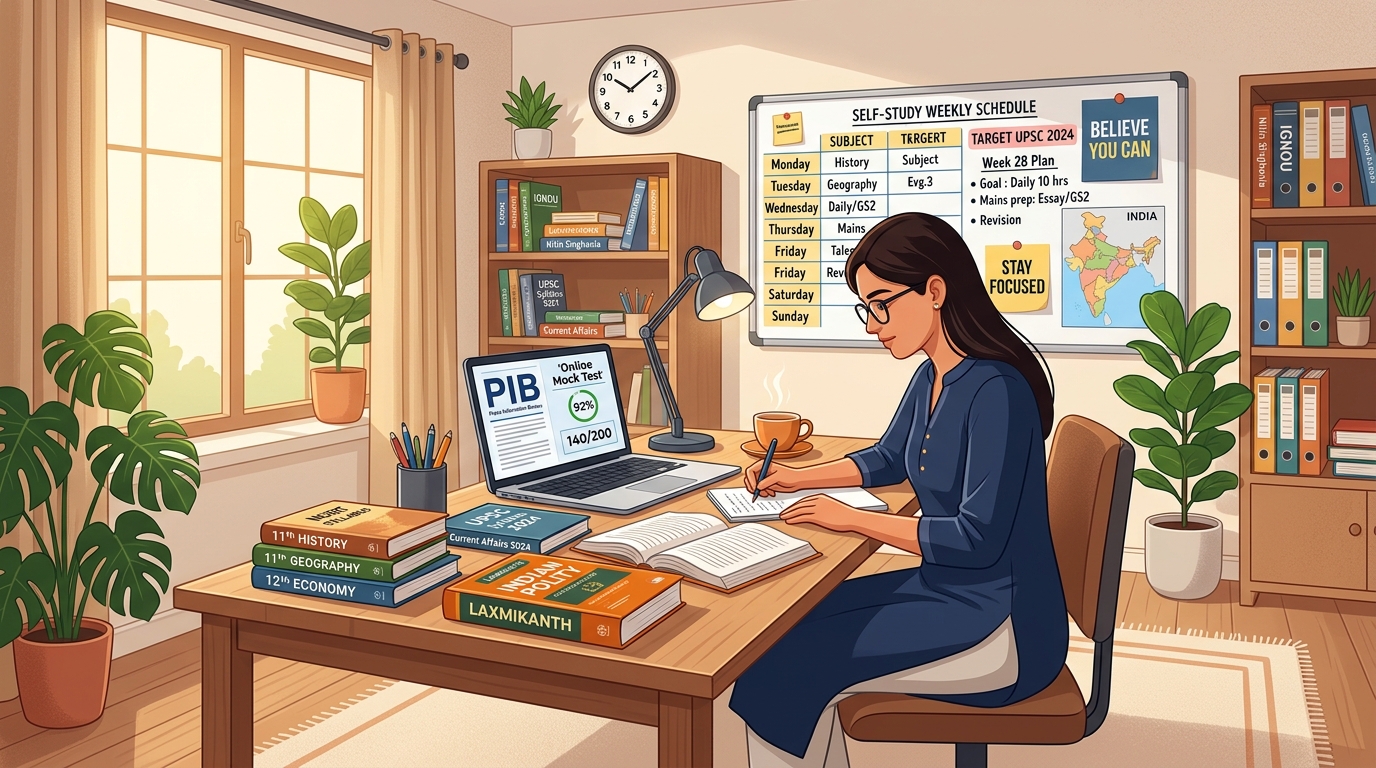
The UPSC Self-Study Workspace & Mindset
Preparing from home requires turning your personal space into an intentional, distraction-free command center:
1. Coaching Institutes vs. Self-Study: An Objective Comparison
Before making your choice, understand the exact trade-offs:
| Parameter | Commercial Coaching Institutes | Independent Self-Study | Winner / Verdict |
|---|---|---|---|
| Financial Cost | ₹1.5 Lakh to ₹3.0+ Lakhs (Tuition) + ₹2 Lakhs/year (Living/PG expenses) | ₹10,000 to ₹25,000 (Standard Books + Test Series + Internet) | Self-Study: Saves over ₹4–5 Lakhs |
| Time Efficiency | 4 to 6 hours daily spent commuting and attending passive lectures | 100% of study time dedicated to active reading, note-making, and revision | Self-Study: 0 wasted transit time |
| Syllabus Pacing | Dictated by the coaching batch schedule; often drags basic topics or rushes hard ones | Customized to your individual strengths and weaknesses; move fast where comfortable | Self-Study: Personalized velocity |
| Study Material | Re-packaged coaching booklets (frequently superficial or outdated) | Authentic standard books (Laxmikanth, Spectrum, NCERTs) + Primary Government Reports | Self-Study: Direct first-principles learning |
| Peer Group & Doubts | Readily available classroom peer circle and faculty access | Requires self-initiative via study groups, online communities, or test series mentoring | Coaching: Slightly easier social peer setup |
| Accountability | Enforced by class attendance and batch schedules | Must be entirely self-generated through daily tracking, habit trackers, and milestone targets | Depends on Student: Self-discipline is vital |
[!NOTE] Coaching institutes do not possess secret formulas. The UPSC question paper is set by university professors and seasoned civil servants, not coaching faculties. Every topper who attended coaching still had to sit alone at their desk and do the hard work of reading, memorizing, analyzing, and writing.
2. The 5 Pillars of Successful UPSC Self-Study
To build an unshakeable preparation architecture at home, anchor your daily routine to these five non-negotiable pillars:
| Pillar | Core Principle | How to Implement at Home |
|---|---|---|
| 1. Syllabus Mastery | Your primary filter for everything | Memorize the syllabus topics word-for-word so you never waste time reading irrelevant material. |
| 2. Limited Standard Books | Zero resource hoarding | Stick strictly to One Subject = One Standard Book + NCERTs + Current Affairs. |
| 3. Authentic PYQs | Your true mentor & trend analyzer | Solve past 10 years of Prelims & Mains papers (2013–2025) to understand UPSC's exact thought process. |
| 4. Test Series Feedback | Timed evaluation & error tracking | Invest only in all-India Prelims mock tests and evaluated Mains answer writing series. |
| 5. Structured Revision Cadence | Spaced repetition framework | Apply the 1-7-30 Day Rule (Daily recap, Weekly Sunday consolidation, Monthly revision block). |
Pillar 1: Memorize the Syllabus Word-for-Word
Before buying a single book, print the entire UPSC Prelims and Mains (GS-1 to GS-4 + Optional) syllabus. Paste it on the wall in front of your study desk.
- Whenever you read a newspaper article or book chapter, map it directly to a specific syllabus line item (e.g., "Effects of liberalization on the economy", "Role of women's organizations", "Salient features of the Representation of People’s Act").
- If a topic cannot be mapped to the syllabus, do not read it. This single habit saves 200+ hours of aimless browsing.
Pillar 2: Limit Your Booklist Strictly
Self-study aspirants frequently fall into the trap of buying five different books for one subject out of insecurity. Follow the golden rule:
One Subject = One Standard Book + NCERTs + Current Affairs. Read that one book 6 times instead of reading 6 books once.
Pillar 3: Treat PYQs as Your True Mentor
Coaching students rely on their teachers to tell them what is important. Self-study aspirants use Previous Year Questions (PYQs) from 2013 to 2025:
- Prelims PYQs: Reveal UPSC's favorite recurring themes (Buddhism/Jainism, Preamble & Fundamental Rights, River Basins, Monetary Policy tools).
- Mains PYQs: Reveal the depth, question framing, and keywords (Critically Analyze, Elucidate, Discuss, Evaluate).
Pillar 4: Invest Only Where It Truly Counts (Test Series)
The money you saved on coaching should be selectively invested where external benchmarking is essential:
- A quality Prelims Test Series (30–40 timed mocks with rank percentiles).
- A reliable Mains Test Series with Evaluation (to get objective feedback on your answer structure, handwriting speed, and presentation).
Pillar 5: Structured Revision Cycles (1-7-30 Day Rule)
Without coaching tests to force deadlines, self-study students must schedule their own revisions:
- Day 1: Quick 10-minute mental recap at the end of the study day.
- Day 7 (End of Week): Dedicate every Sunday strictly to revising what you studied during the preceding 6 days.
- Day 30 (End of Month): 2 full days reserved for consolidating monthly notes and solving monthly MCQ compilations.
3. Curated Directory of 100% Free, High-Quality Resources
You do not need paid subscriptions for 90% of your UPSC preparation. The Indian government and open-access educational initiatives provide world-class materials:
| Resource / Portal | Official Link / Medium | Best Used For | Why It Replaces Coaching |
|---|---|---|---|
| Press Information Bureau (PIB) | pib.gov.in | Official Government schemes, Cabinet decisions, policy notifications | Direct authentic source; no coaching spin or factual distortion |
| Sansad TV (Perspective & Mudda Aapka) | Official YouTube Channel | In-depth debates on national & international issues with senior diplomats, retired bureaucrats, and subject scholars | Superior analytical depth for GS-2, GS-3, and Essay |
| PRS Legislative Research | prsindia.org | Objective summaries of Bills introduced in Parliament, committee reports, budget breakdowns | Ideal for GS-2 Polity & Governance answers |
| NCERT ePathshala / DIKSHA | epathshala.nic.in | Free digital textbooks from Class 6 to 12 in PDF and audio formats | Establishes bedrock foundational clarity across all GS subjects |
| Niti Aayog Reports & Strategy Documents | niti.gov.in | Action agendas, three-year development frameworks, SDG India Index | High-scoring case studies, data points, and forward-looking solutions for Mains |
| Down To Earth Magazine | downtoearth.org.in | Environmental science, biodiversity, climate change summits, sustainable agriculture | Gold standard for Prelims Environment questions and GS-3 |
| Toppers' Answer Copies | Reputed open platforms (VisionIAS, ForumIAS, etc.) | Freely downloadable scanned answer sheets of AIR 1 to 50 rankers | Learn how to structure introductions, draw diagrams, use sub-headings, and conclude effectively |
4. Month-Wise Self-Study Roadmap (12-Month Blueprint)
Here is a balanced timeline structured for an aspirant beginning a 1-year dedicated preparation journey:
| Phase | Months | Core Focus | Milestones to Achieve | Weekly Deliverables |
|---|---|---|---|---|
| Phase 1: Foundations & Core NCERTs | Months 1 – 3 | Basic NCERTs (Class 9–12), Newspaper reading habit, Syllabus mastery | - Read History, Geography, Polity, Economy NCERTs<br>- Familiarize with daily newspaper vocabulary | Read The Hindu or The Indian Express editorials daily; write 1 summary per week |
| Phase 2: Standard Reference Books + Optional Phase 1 | Months 4 – 7 | Laxmikanth (Polity), Spectrum (Modern History), Economy & Environment standards; Optional Subject Paper 1 | - Complete first comprehensive reading of core standard texts<br>- Cover 50% of Optional syllabus<br>- Solve topic-wise PYQs | Attempt 15–20 daily MCQs; write 2 Mains answers every week |
| Phase 3: Mains Answer Writing & Optional Phase 2 | Months 8 – 9 | Complete Optional Paper 2, GS-4 Ethics, Essay preparation, intensive answer writing | - Complete entire Optional syllabus with notes<br>- Solve GS-4 case studies<br>- Write 4 full-length Essays | Write 1 full GS sectional paper every alternate weekend |
| Phase 4: Dedicated Prelims Mode | Months 10 – 12 | 100% Prelims focus: CSAT, Revision, Mock tests, Current Affairs annual digests | - Attempt 35+ Prelims mock tests<br>- Solve 10 years of CSAT papers<br>- 3 full cycles of static revision | 2 timed full-length mocks per week with 3-hour post-test analysis |
5. Ideal Daily Routine for Home Preparation
When studying from home, the biggest danger is unstructured time leading to procrastination. Structuring your day into three focused deep-work blocks creates rhythm and stamina:
The 3-Block Daily System (8.5 Hours Total)
-
🌅 Morning Block: The High-Cognitive Core (07:00 AM – 11:30 AM)
- 07:00 AM – 08:15 AM (75 mins): Newspaper analysis (The Hindu / Indian Express). Note only syllabus-relevant editorial arguments.
- 08:15 AM – 08:45 AM (30 mins): Light breakfast & mental recharge.
- 08:45 AM – 11:30 AM (2 hrs 45 mins): Core Static Subject 1 (e.g., Indian Polity or Economy). Intense uninterrupted reading with phone in another room.
-
☀️ Afternoon Block: Optional & CSAT (01:30 PM – 05:00 PM)
- 01:30 PM – 03:45 PM (2 hrs 15 mins): Optional Subject Study. Cover dedicated chapters and make concise flowcharts/notes.
- 04:00 PM – 05:00 PM (60 mins): CSAT Practice (Maths, Reasoning, or Reading Comprehension).
-
🌆 Evening Block: Answer Writing, Secondary Subject & Revision (06:00 PM – 09:30 PM)
- 06:00 PM – 07:30 PM (90 mins): Core Static Subject 2 (e.g., Environment / History / Geography).
- 07:30 PM – 08:30 PM (60 mins): Mains Answer Writing & Evaluation (Write 2 PYQ answers; compare with topper copies).
- 08:45 PM – 09:30 PM (45 mins): Daily Flashcard Revision & Error Log.
6. How to Choose the Right Optional for Self-Study
For self-study aspirants, your Optional subject can make or break your final rank. Picking an obscure optional with zero guidance or scarce books will create unnecessary hurdles.
| Optional Subject | Overlap with General Studies | Availability of Self-Study Material | Recommendation for Self-Study |
|---|---|---|---|
| PSIR (Political Science & IR) | Extremely High (Massive overlap with GS-2, Essay, and Ethics) | Abundant standard books (Andrew Heywood, Shubhra Ranjan class notes readily available) | ⭐⭐⭐⭐⭐ Top Tier for Self-Study |
| Sociology | High (Strong overlap with GS-1 Indian Society, GS-4 Ethics, Essay) | Clear, concise syllabus; Anthony Giddens, Haralambos, Nitin Sangwan notes accessible | ⭐⭐⭐⭐⭐ Top Tier for Self-Study |
| Geography | Moderate-High (Overlap with GS-1 Physical Geography & GS-3 Agriculture/Disaster) | Abundant mapping resources, Majid Husain, Savindra Singh, PMF IAS | ⭐⭐⭐⭐ Very Good |
| History | High (Direct overlap with GS-1 Prelims and Mains) | Vast syllabus, but resources are completely standardized (Upinder Singh, Bipan Chandra) | ⭐⭐⭐⭐ Good (Demands strong memory) |
| Anthropology | Moderate (Some overlap with tribal issues in GS-1 & GS-2) | Crisp, scientific, structured syllabus; Akshat Jain / Vivek Bhasme notes available | ⭐⭐⭐⭐⭐ Top Tier for Self-Study |
| Public Administration | Moderate-High (Strong overlap with GS-2 Governance & GS-4 Ethics) | Dynamic, contemporary; Laxmikanth, Mohit Bhattacharya, Prasad & Prasad | ⭐⭐⭐⭐ Very Good |
| Literature Optionals | Low GS Overlap (High scoring potential in Optional itself) | Fixed static syllabus; no current affairs updates needed | ⭐⭐⭐⭐⭐ Ideal if proficient in language |
The 3 Rules of Optional Selection:
- Genuine Interest: You will have to read this subject for 500+ hours. If the theory bores you, high scoring trends won't save you.
- Resource Availability: Ensure standard textbooks, previous 10 years' solved question papers, and topper notes are accessible without needing private coaching handouts.
- Syllabus Overlap: If you are hard-pressed for time, choose an optional with high GS overlap (PSIR, Sociology, Geography, Pub Ad) to maximize return on study hours.
7. How to Master Mains Answer Writing at Home
Many aspirants fear that without a coaching teacher, their answers will never improve. In reality, self-evaluation against authentic topper copies is often more effective than generic coaching red-pen ticks.
The 4-Step Home Evaluation Loop:
- Pick an Authentic PYQ: Take a question from UPSC Mains 2020–2024.
- Write with a Timer: Give yourself strictly 7 minutes for a 10-marker (150 words) and 11 minutes for a 15-marker (250 words).
- Follow the "IBC Framework":
- Introduction (15–20% of space): Define the core concept or cite an authoritative data point/report (e.g., NFHS-5, Niti Aayog, World Bank).
- Body (70% of space): Use distinct sub-headings matching the question keywords. Include at least 4–6 multi-dimensional points (Social, Economic, Political, Environmental, Legal). Incorporate diagrams, flowcharts, or Indian map sketches.
- Conclusion (10–15% of space): Forward-looking, optimistic, aligned with Constitutional values, SDG goals, or government visions (e.g., Viksit Bharat 2047).
- Compare with Toppers' Copies: Download the answer script of an AIR 1–20 topper who answered the same question. Note what facts, diagrams, or case studies they included that you missed.
8. Common Traps of Home Preparation & How to Overcome Them
| Trap / Pitfall | Why It Happens at Home | Proven Antidote |
|---|---|---|
| Social Isolation & Fatigue | Sitting in one room for months without peer interaction | Join a library or form a focused 2-3 person study circle; schedule 45 mins of daily exercise/sports |
| Perfectionism Paralysis | Waiting to "finish the entire syllabus" before attempting a test | Start solving MCQs from Day 1; write answers even with open books initially to build momentum |
| Digital Distraction & YouTube Binge | Watching 50 different topper strategy videos instead of studying | Limit YouTube to 1 scheduled window; delete non-essential social media apps from your phone |
| Over-Accumulating Free PDFs | Downloading hundreds of Telegram channels and PDF compilations | Digital declutter: maintain a clean Google Drive folder with strictly one source per subject |
| Inconsistent Sleep Cycles | Late-night studying sliding into erratic daytime waking hours | Anchor your sleep: sleep by 11:00 PM and wake by 06:00 AM so your brain is alert during 09:30 AM exam hours |
Frequently Asked Questions (FAQs)
Can an average college student clear UPSC through self-study?
Yes. UPSC is not an IQ test; it is a test of structured persistence and clarity of expression. Countless candidates with 60% in college or vernacular medium backgrounds clear the exam every year through consistent self-study.
Is it necessary to relocate to Delhi for UPSC preparation?
Absolutely not. The era where Delhi held an exclusive advantage is over. High-speed internet, digital book deliveries, test series portals, and government open data have completely democratized preparation. Staying at home saves financial stress, health issues, and unhealthy peer gossip.
When should I join a test series if I am doing self-study?
Join a Prelims Test Series 5 to 6 months before the preliminary exam (around December or January). Join a Mains Answer Writing / Test Series right after completing your first reading of the core static subjects and Optional Paper 1.
How do I stay motivated during long months of self-study?
Focus on daily systems rather than distant outcomes. Don't obsess over "clearing IAS in 2 years"; focus solely on completing today's 3 scheduled blocks. Track your progress with a physical wall calendar where you cross off productive days.
Summary Checklist for UPSC Self-Study Aspirants
- Print official UPSC syllabus and paste it on your study wall.
- Purchase standard core books (Laxmikanth, Spectrum, NCERTs, Economy standard text).
- Download past 10 years of Prelims & Mains PYQs (2014–2025).
- Set up a daily 3-block study timetable (8–9 hours total).
- Read The Hindu or The Indian Express with syllabus-based filtering.
- Bookmark official government portals (PIB, Sansad TV, PRS India).
- Pick an Optional subject with high interest and abundant reference material.
- Enroll in a reputable all-India test series for objective benchmarking.
Self-study is not a handicap—it is a superpower that builds independence, critical thinking, and intellectual resilience: the exact traits required of a future district magistrate and civil servant!