
Clearing the UPSC Civil Services Preliminary Examination (CSE Prelims) is widely considered the toughest gatekeeping challenge in Indian competitive exams. Out of more than 10 lakh applicants each year, only around 12,000 to 14,000 qualify for the Mains examination—a clearance rate of less than 2.5%.
In recent examination cycles, UPSC Prelims has fundamentally transformed. The exam has moved far beyond direct factual recall. With nuanced pair-based options ("Only one pair, Only two pairs, None"), assertion-reasoning questions, multidimensional current-affairs linkages, and an increasingly rigorous CSAT (Paper II), traditional preparation methods alone no longer guarantee success.
To crack UPSC Prelims 2026, you do not need 16 hours of daily cramming or an endless pile of coaching booklets. You need an intentional, phased preparation blueprint built on first-principles conceptual clarity, systematic revision, intelligent PYQ analysis, and disciplined mock test simulation.
This guide outlines a battle-tested roadmap designed specifically for the UPSC CSE 2026 cycle.
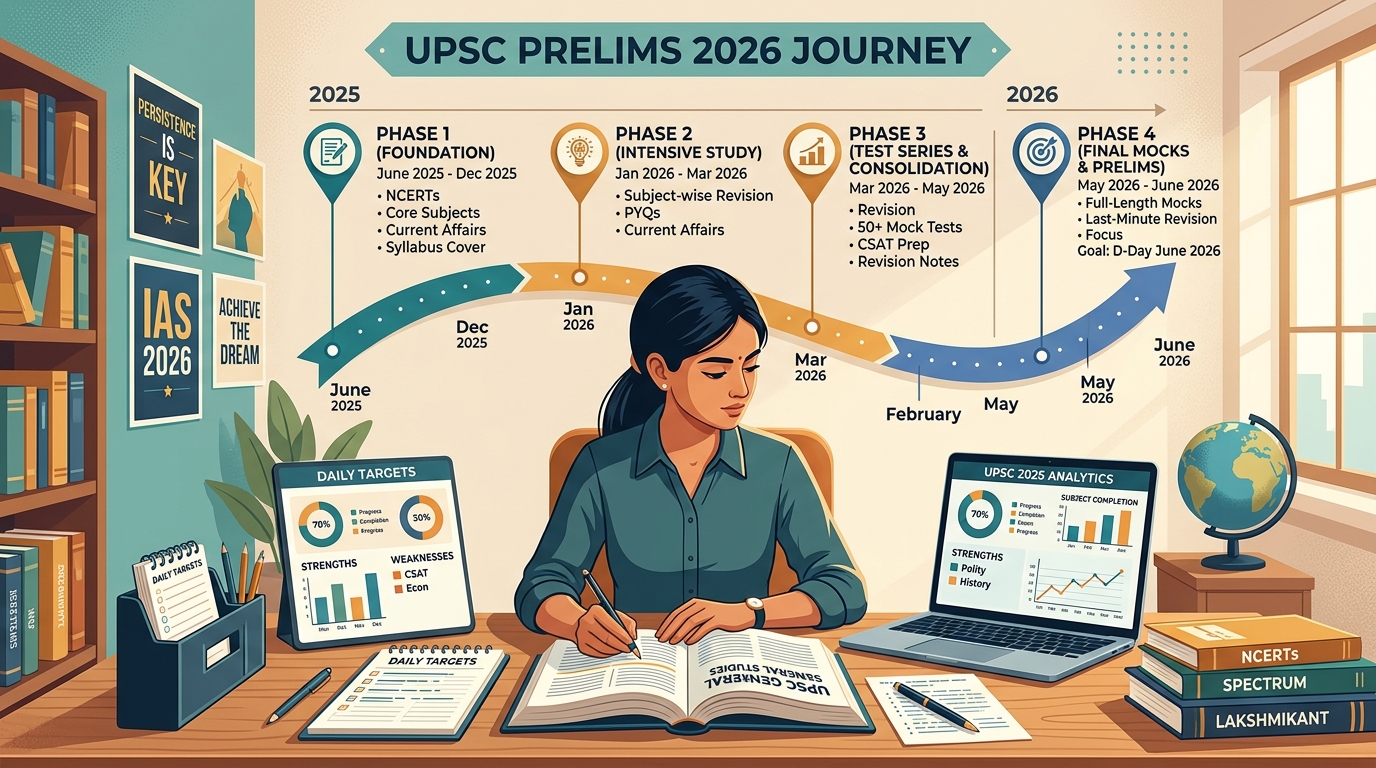
UPSC Prelims 2026 Journey: Strategic Blueprint
Here is a visual roadmap illustrating the four core phases of your Prelims preparation:
1. Decoding the Exam Structure & Cutoff Reality
Before opening a single textbook, understand the scoring mechanics and qualifying requirements:
| Paper | Subjects & Focus | Total Questions | Maximum Marks | Marking Scheme | Qualifying Criteria |
|---|---|---|---|---|---|
| General Studies Paper I | Indian Polity, Economy, History, Geography, Environment, Science & Tech, Current Events | 100 MCQs | 200 Marks | +2.00 for correct<br>-0.66 for incorrect | Determines Prelims Merit/Rank (Recent general cutoffs range between 75 to 88 marks) |
| CSAT Paper II | Reading Comprehension, Quantitative Aptitude, Logical & Analytical Reasoning | 80 MCQs | 200 Marks | +2.50 for correct<br>-0.83 for incorrect | Qualifying Only (Requires at least 33% = 66.67 Marks) |
[!IMPORTANT] The Cutoff Truth: In recent years, scoring just 85 to 90 marks out of 200 in GS Paper I was enough for General category candidates to clear the Prelims cut-off. You do not need 150 marks; you need roughly 45 to 48 net correct questions after accounting for negative marking. Consistency and accuracy beat blind guessing every single time.
2. UPSC Prelims Subject Weightage & Trend Analysis
Analyzing the last 7 to 10 years of UPSC Prelims questions highlights clear subject priorities. Preparing strategically means allocating study hours in proportion to predictable subject weightage.
| Subject Area | Typical Question Range | Nature of Questions | Primary High-Yield Focus Areas |
|---|---|---|---|
| Polity & Governance | 13 – 17 Questions | Conceptual, Constitutional, Judicial verdicts | Fundamental Rights, DPSP, Preamble, Parliament, Judiciary, Constitutional Bodies, Panchayats |
| Economy & Social Dev. | 14 – 18 Questions | Application-based, Conceptual, Macro Trends | Monetary Policy, Banking, Inflation, External Sector (BoP, Forex), Budget & Economic Survey concepts |
| Environment & Ecology | 15 – 20 Questions | Static + Current Affairs + International Treaties | Protected Areas (National Parks, Wildlife Sanctuaries), IUCN Red List species, Climate Treaties (UNFCCC, COP), Biodiversity hotspots |
| Modern History & Culture | 13 – 17 Questions | Chronological, Institutional, Cultural terms | 1857 to 1947 freedom struggle, Peasant/Tribal movements, Governor Generals, Temple architecture, Bhakti/Sufi saints, Buddhism & Jainism |
| Geography & Mapping | 8 – 14 Questions | Spatial, Conceptual, River systems | Indian physical geography, River drainage basins, World map conflict zones, Straights and ocean currents, Himalayan passes |
| Science & Technology | 10 – 14 Questions | Applied, Futuristic technologies | Biotechnology (CRISPR, gene therapy), Space missions (ISRO, NASA, James Webb), Artificial Intelligence, Green Hydrogen, Defence systems |
| Current Events & Global IR | 15 – 20 Questions | Overlapping with all static subjects | International groupings (G20, QUAD, SCO), bilateral agreements, major geopolitical conflicts, landmark national policies |
The Three "Core Pillars" of Prelims
If you look closely at the table above, three subjects—Polity, Economy, and Environment—together account for nearly 45 to 55 questions (roughly half of the entire paper). Aspirants who master these three static pillars enter the exam hall with an immense competitive advantage because these subjects have well-defined boundaries and high predictability compared to Ancient History or open-ended Current Affairs.
3. The 3-Phase Timeline for UPSC Prelims 2026
Preparing for UPSC CSE requires a synchronized approach where Prelims and Mains preparation complement each other before shifting fully into Prelims mode.
| Phase | Time Period | Key Objectives | Daily Distribution | Target Milestones |
|---|---|---|---|---|
| Phase 1: Foundation & Integrated Prep | June 2025 – December 2025 | Complete basic NCERTs, core standard books, Mains GS-1 to GS-4 syllabus, and Optional subject Paper 1 & 2. | 70% Mains & Optional<br>30% Prelims static + Newspaper | - Complete reading Laxmikanth, Spectrum, Economy basics<br>- First run of Optional complete<br>- Weekly answer writing |
| Phase 2: Prelims Transition & Consolidation | January 2026 – March 2026 | Wind down optional study; start intense subject-wise Prelims revision, PYQ solving, and CSAT foundational classes. | 70% Prelims GS & PYQs<br>30% CSAT & Revision | - Solve 10 years of subject-wise PYQs (2014–2025)<br>- Complete 15–20 sectional mock tests<br>- Diagnose CSAT weak spots |
| Phase 3: Final Sprint & Test Simulation | April 2026 – Exam Day (May/June 2026) | 100% Prelims mode. Full-length mock tests, rigorous revision cycles, CSAT speed tests, and map work. | 60% Revision & Micro-notes<br>40% Mocks & In-depth analysis | - Attempt 25–35 full-length timed mock tests<br>- Final revision of Year-long Current Affairs<br>- Practice 2:00 PM – 4:00 PM CSAT sessions |
4. Crafting Your Daily & Weekly Routine
Consistency over 12 months is what converts an aspirant into an officer. Here are balanced, realistic study schedules for both full-time aspirants and working professionals.
Option A: Full-Time Aspirant (8 – 9 Hours Daily)
| Time Slot | Duration | Planned Activity | Focus & Output |
|---|---|---|---|
| 07:00 AM – 08:30 AM | 1.5 Hours | Newspaper & Current Affairs | Read The Hindu or The Indian Express. Note major government initiatives, Supreme Court rulings, and international treaties. |
| 09:00 AM – 12:00 PM | 3.0 Hours | Core Static Slot 1 (Heavy Subject) | Indian Polity / Economy / Modern History. Read standard book with active recall. |
| 01:30 PM – 03:00 PM | 1.5 Hours | CSAT Practice Slot | 30 minutes of Reading Comprehension + 1 hour of Quantitative Aptitude/Reasoning problems. |
| 03:30 PM – 06:30 PM | 3.0 Hours | Core Static Slot 2 (Secondary Subject) | Geography / Environment & Ecology / Science & Tech. |
| 07:30 PM – 08:30 PM | 1.0 Hour | Daily MCQ Practice & Revision | Solve 25 to 30 MCQs on the topics studied during the day. Update your error log. |
Option B: Working Professional (4.5 – 5.5 Hours Daily)
- Morning Slot (06:00 AM – 08:30 AM): 2.5 hours of uninterrupted static study (Polity/Economy).
- Commute / Lunch Break: 45 minutes for digital newspaper reading or editorial summary podcasts.
- Evening Slot (08:30 PM – 10:30 PM): 2 hours for CSAT or second static subject.
- Weekends (Saturday & Sunday): 8 to 10 hours each day reserved for solving mock tests, analyzing errors, and catching up on backlogs.
5. Subject-Wise Action Plan for Prelims 2026
🏛️ Indian Polity & Governance
- Primary Resource: Indian Polity by M. Laxmikanth + Constitution of India Bare Act (select articles).
- Tactical Approach: Pay close attention to wordings like "as defined in the Constitution", "by law made by Parliament", and "at the pleasure of the President". UPSC frequently tests whether an institution is Constitutional, Statutory, or Executive.
- High-Yield Chapters: Preamble, Fundamental Rights (Articles 12–35), Directive Principles (Articles 36–51), Fundamental Duties, Parliament & State Legislatures, Supreme Court & High Courts, Emergency Provisions, Panchayati Raj (73rd & 74th Amendments).
📈 Indian Economy
- Primary Resource: NCERT Class 11 (Indian Economic Development), Indian Economy by Nitin Singhania or Vivek Singh, plus recent Union Budget & Economic Survey summaries.
- Tactical Approach: Economy questions are 80% conceptual. Understand the ripple effects of economic moves: What happens to the Rupee exchange rate when the US Federal Reserve raises interest rates? How does high inflation affect bond yields?
- High-Yield Areas: Monetary policy tools (Repo, Reverse Repo, SDF, MSF), Inflation indices (CPI vs WPI), Balance of Payments (Current Account Deficit, Capital Account), Money supply ($M_1, M_3$), Banking sector terms (NPA, Prompt Corrective Action).
🌿 Environment, Ecology & Biodiversity
- Primary Resource: PMF IAS Environment or Shankar IAS + MoEFCC official updates & down-to-earth highlights.
- Tactical Approach: Environment questions have the highest overlap with geography and current affairs. Do not just memorize names; map them geographically.
- High-Yield Areas:
- National Parks, Biosphere Reserves, and Tiger Reserves through which major rivers flow (e.g., Which river flows through Kaziranga or Silent Valley?).
- Critically endangered species in India and their natural habitats (Gharial, Great Indian Bustard, Sangai Deer, Nilgiri Tahr).
- Major global conventions: Ramsar (Wetlands), CITES, CBD, Bonn Convention on Migratory Species, Montreal Protocol, UNFCCC Paris Agreement.
📜 Modern Indian History & Art & Culture
- Primary Resource: A Brief History of Modern India (Spectrum) + NCERT Class 11 An Introduction to Indian Art (Part 1).
- Tactical Approach: Maintain chronological timelines. UPSC loves linking events (e.g., Cabinet Mission Plan vs Cripps Mission vs Quit India Movement).
- High-Yield Areas: Socio-religious reform movements, tribal and peasant uprisings prior to 1857, acts passed by the British crown (1858, 1909, 1919, 1935), Congress sessions and key resolutions, Temple architecture styles (Nagara, Dravida, Vesara), Buddhism and Jainism philosophies and councils.
🚀 Science & Technology
- Primary Resource: Monthly current affairs compilations + Science section of The Hindu (Sunday edition).
- Tactical Approach: UPSC rarely asks pure theoretical physics or chemistry. It tests applications that touch daily life, national security, or global health.
- High-Yield Areas: Gene editing (CRISPR-Cas9, Stem cells, mRNA vaccines), Space exploration (Aditya L1, Gaganyaan, Artemis Program, James Webb Telescope discoveries), Emerging tech (Web 3.0, Quantum Computing, Blockchain, generative AI, semiconductors).
6. Conquering CSAT (Paper II): The Silent Elimination Weapon
In recent years, more serious aspirants with 100+ marks in GS-1 were disqualified because they scored 60 or 64 in CSAT. Treating CSAT as a last-month formality is the fastest route to failure.
| CSAT Component | Typical Weightage | Strategy to Score Safely | Common Mistakes to Avoid |
|---|---|---|---|
| Reading Comprehension | 25 – 28 Questions | - Focus on identifying the Crux, Most logical corollary, Underlying assumption, and Implication.<br>- Always read the passage objectively without projecting personal biases or outside knowledge. | Speed reading without grasping the author's primary hypothesis; assuming unstated facts. |
| Quantitative Aptitude | 35 – 40 Questions | - Master 6 high-yield chapters thoroughly: Number System & Divisibility, Percentages & Profit-Loss, Ratio & Proportion, Averages, Time & Work, Speed-Distance-Time.<br>- Practice mental calculations and shortcuts for factorials, remainders, and digit cycles. | Getting stuck on lengthy calculation problems during the first 40 minutes of the exam. |
| Reasoning & Data Interpretation | 15 – 20 Questions | - High accuracy area. Focus on Coding-Decoding, Directions, Syllogisms, Blood Relations, and simple Venn diagrams.<br>- Solve puzzle questions only if they have 2 or more related sub-questions. | Spending 10 minutes on a single 8-person complex seating puzzle. |
The 45-Question CSAT Safety Rule
To comfortably clear the 66.7-mark threshold without negative marking anxiety:
- Target attempting 48 to 55 questions with at least 80% accuracy.
- Attempt roughly 22-25 Reading Comprehensions and 25-30 select Quant/Reasoning questions.
- That yields approximately 40 correct and 10 incorrect = (40 × 2.5) - (10 × 0.83) = 100 - 8.3 = 91.7 Marks, putting you securely beyond any cut-off fluctuations!
7. The Mock Test Masterclass: How to Practice & Analyze
Solving 40 mock tests and scoring poorly is useless if you do not perform scientific post-test autopsy.
| Question Category | Root Cause | Corrective Action Plan |
|---|---|---|
| Category A: Conceptual Blunder | Misunderstood basic theory or principle | Re-read the specific core chapter in standard reference book; write out the mechanism. |
| Category B: Factual Memory Lapse | Forgot exact year, provision, or reserve location | Make a 1-line flashcard entry in your personal Error Notebook. |
| Category C: Careless Reading / Silly Mistake | Misread "Which of the following is NOT correct" | Circle instructional words with pen; slow down your reading cadence by 5 seconds per question. |
| Category D: Unjustified Blind Guess | Took a 1-in-4 gamble without elimination | Strictly ban 0-elimination gambles; only take calculated 50-50 risks. |
The 3-Round Attempt Strategy for GS Paper 1
When sitting for your mock tests (and on the final Prelims exam day), divide your 120 minutes into three methodical rounds:
-
Round 1 (First 50 Minutes):
- Go through all 100 questions.
- Mark only those questions where you are 100% certain of the answer.
- Typically, a well-prepared candidate knows 30 to 40 questions with high conviction.
- Fill the OMR bubbles for these immediately.
-
Round 2 (Next 40 Minutes):
- Revisit questions where you successfully eliminated two options (50-50 probability).
- Apply logical deduction, context clues, and interdisciplinary connections.
- Attempt 30 to 35 questions in this category.
-
Round 3 (Last 20-25 Minutes):
- Scrutinize borderline questions where you eliminated one option or where common sense suggests an answer.
- Limit attempts here to 5 to 10 questions maximum.
- Ideal Total Attempts: 78 to 88 questions. Attempting fewer than 70 questions rarely yields enough marks unless your accuracy is superhuman (90%+).
8. The "3-2-1" Revision Framework
The human brain loses up to 70% of new information within 48 hours unless reinforced. Use the 3-2-1 Revision Rule to lock static concepts into permanent memory:
- 3 Revisions of Core Books: Complete 3 thorough readings of foundational texts (Laxmikanth, Spectrum, Shankar/PMF IAS, Nitin Singhania).
- Reading 1: Unhurried reading for conceptual understanding (No highlighting).
- Reading 2: Second reading with targeted highlighter for keywords, dates, and exceptions.
- Reading 3: Fast-paced revision accompanied by personal 1-page summary sheets.
- 2 Complete Rounds of PYQs (2014 – 2025):
- Round 1: Solve subject-wise alongside your static preparation.
- Round 2: Solve full official UPSC papers under strict exam conditions to understand UPSC's exact linguistic framing.
- 1 Master Error Notebook: A single 200-page notebook containing only your personal errors, forgotten facts, numerical data, and map pointers. This is the only document you should review in the final 7 days before Prelims.
9. Top 5 Fatal Mistakes to Avoid
- Resource Hoarding (FOMO Syndrome): Buying every newly published compilation or joining multiple test series without finishing one single source thoroughly. Remember: Reading 1 book 5 times beats reading 5 books 1 time.
- Ignoring Official UPSC PYQs: Coaching mock tests are created by content writers; official UPSC papers are set by university professors and seasoned civil servants. The flavor, subtlety, and thought-process of UPSC questions can only be learned from authentic PYQs.
- Leaving CSAT for May: Believing an engineering or science background guarantees passing CSAT is a fatal fallacy. CSAT tests cognitive stamina under afternoon heat and fatigue.
- Neglecting Reverse Engineering from Options: When studying PYQs, don't just check the right answer. Research all four options and related terms, because UPSC frequently turns an incorrect option from three years ago into the main question today.
- Panic and Information Overload in the Last 15 Days: Cease attempting new tests 7 days before the exam. Focus solely on light revision, sleeping on a 10 PM – 6 AM circadian cycle, and mental conditioning.
Frequently Asked Questions (FAQs)
How many hours should I study daily for UPSC Prelims 2026?
For full-time aspirants, 7 to 9 focused hours of high-concentration study is optimal. For working aspirants, 4 to 5 consistent hours on weekdays and 8 to 10 hours on weekends is sufficient if you stay disciplined and avoid social media distractions.
When should I switch exclusively to Prelims-oriented preparation?
If you have covered your basic foundation and optional subject, you should switch 100% to Prelims mode by January 2026 or February 2026 at the absolute latest (roughly 4 to 5 months before the preliminary exam).
How many mock tests are recommended before Prelims 2026?
An ideal target is 35 to 45 quality mock tests, including:
- 15 to 20 Subject-Wise Sectional Tests
- 15 to 20 Full-Length GS Tests (comprehensive syllabus)
- 8 to 10 Full-Length CSAT timed tests
Is note-making necessary for every UPSC Prelims subject?
No. Do not duplicate standard textbooks like Laxmikanth or Spectrum into handwritten notebooks. Only make micro-notes for:
- Factual summaries (Ramsar sites, national parks, tribal rebellions, constitutional articles)
- Recurring mistakes recorded in your Error Log
- Current affairs monthly digests
Final Words: Mindset and Consistency
UPSC Prelims is not an intelligence test; it is an emotional resilience and decision-making test under uncertainty. On exam day, out of 100 questions, even the all-India rankers know only 35 to 40 questions with absolute certainty. The remaining marks come from calm elimination, analytical poise, and trust in your preparation.
Stick to your sources, review your mistakes weekly, respect CSAT, and approach Prelims 2026 with unshakeable conviction. You have all the tools you need—now execute with discipline!