
Preparing for the UPSC Civil Services Examination becomes much easier when you clearly understand what you actually need to study. The syllabus acts like a roadmap—it tells you where to focus, what to revise, and which topics deserve more attention.
The UPSC Syllabus 2026 is divided into two written stages: Preliminary Examination (Prelims) and Main Examination (Mains), followed by the Personality Test (Interview).
In this guide, we explain the complete UPSC syllabus in a simple, subject-wise format so that both beginners and serious aspirants can use it while planning their preparation.
UPSC Civil Services Examination 2026: Visual Roadmap
Below is the complete structural roadmap of the UPSC Civil Services Examination, highlighting the three distinct stages and paper distribution:
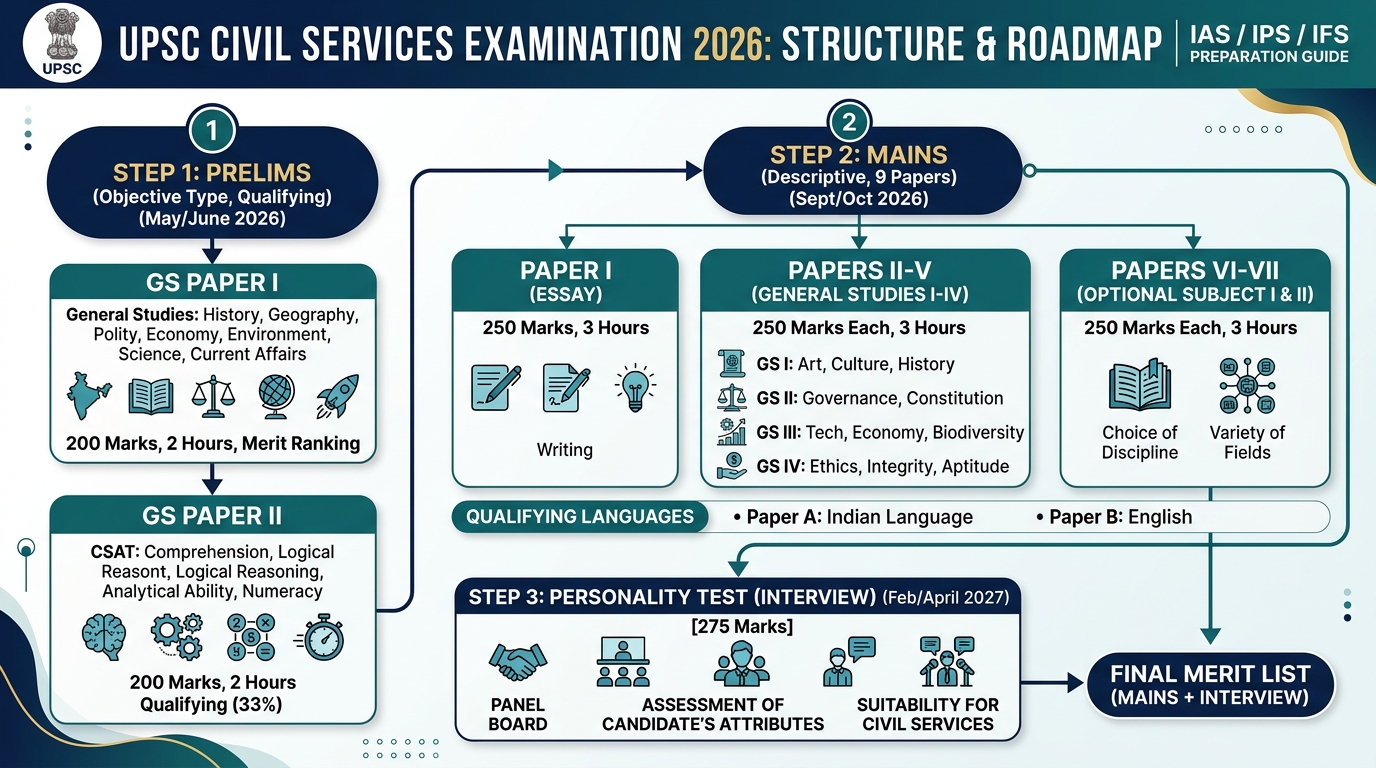
UPSC Civil Services Examination: An Overview
The Civil Services Examination is conducted annually by the Union Public Service Commission (UPSC) for recruitment to premier administrative services, including:
- Indian Administrative Service (IAS)
- Indian Police Service (IPS)
- Indian Foreign Service (IFS)
- Indian Revenue Service (IRS) and other Group 'A' and Group 'B' Central Services.
Stages of the Examination at a Glance
| Stage | Examination | Mode / Type | Papers | Marks | Nature |
|---|---|---|---|---|---|
| Stage 1 | Preliminary Examination (Prelims) | Offline (OMR Objective) | 2 Papers (GS I & CSAT) | 400 Marks | Screening / Qualifying |
| Stage 2 | Main Examination (Mains) | Offline (Descriptive Written) | 9 Papers (7 Merit + 2 Qualifying) | 1,750 Marks | Merit Ranking |
| Stage 3 | Personality Test (Interview) | Face-to-Face Board Interview | 1 Assessment | 275 Marks | Merit Ranking |
| Total | Final Selection Merit | — | — | 2,025 Marks | All India Rank (AIR) |
Important Note: Prelims is primarily used as a screening stage to filter candidates. The marks obtained in the Prelims do not count towards the final merit list. Only the marks scored in Mains (1,750 marks) and the Personality Test (275 marks) determine your final rank and service allocation.
UPSC Prelims Syllabus 2026
The UPSC Preliminary Examination consists of two compulsory objective-type papers conducted on the same day:
| Paper | Subject | Questions | Marks | Duration | Negative Marking | Minimum Qualifying Criteria |
|---|---|---|---|---|---|---|
| Paper I | General Studies (GS) | 100 MCQs | 200 Marks | 2 Hours | 1/3rd (0.66 marks) | Cut-off determines entry to Mains |
| Paper II | CSAT (Aptitude Test) | 80 MCQs | 200 Marks | 2 Hours | 1/3rd (0.83 marks) | Qualifying (33% or 66 Marks required) |
General Studies Paper I: Subject-Wise Breakdown
The General Studies Paper I syllabus covers seven major foundational areas:
1. Current Events of National and International Importance
Questions are asked from major socio-economic developments and events happening across India and globally:
- National & International Developments: Bilateral relations, international summits, treaties, and major global groupings (G20, Quad, BRICS, SCO).
- Government Schemes & Policies: Flagship welfare programs, health, rural development, and education initiatives.
- Key Reports & Indices: Global and national indices (HDI, Ease of Doing Business, Multidimensional Poverty Index).
- Awards & Appointments: Major honours, international agency leadership, and judicial appointments.
- Science, Tech & Environment News: Space missions, defense acquisitions, renewable energy advancements.
Tip: Do not study current affairs in isolation. Always connect current news items to their underlying static concepts in the UPSC syllabus.
2. History of India and Indian National Movement
This section focuses extensively on cultural heritage, ancient and medieval dynasties, and India's freedom struggle:
- Ancient Indian History: Indus Valley Civilization, Vedic Period, Buddhism & Jainism, Mauryan & Gupta Empires, South Indian kingdoms.
- Medieval Indian History: Delhi Sultanate, Vijayanagara Empire, Bhakti & Sufi movements, Mughal Empire, Marathas.
- Modern Indian History: Advent of Europeans, British expansion, economic impact of colonial rule.
- Indian National Movement: Revolt of 1857, Socio-religious reform movements, Early Congress, Partition of Bengal, Swadeshi Movement.
- Gandhian Era & Mass Movements: Non-Cooperation, Civil Disobedience, Quit India, Revolutionary nationalism, INA, Cabinet Mission, Independence & Partition.
3. Indian and World Geography
Covers both physical phenomena and human-economic spatial distribution:
- Physical Geography: Geomorphology (plate tectonics, earthquakes, volcanoes, rock cycles), Climatology (monsoons, cyclones, atmospheric circulation), Oceanography (ocean currents, tides, marine resources).
- Indian Geography: Physiographic divisions, drainage systems (Himalayan vs. Peninsular rivers), soil types, climatic zones, vegetation, mineral distribution.
- Human & Economic Geography: Agriculture cropping patterns, industrial location factors, population distribution, migration, urbanization trends.
- Map-Based Learning: Strategic straits, international sea routes, disputed border areas, rivers, national parks, and mountain passes.
4. Indian Polity and Governance
Polity is one of the highest-scoring and most predictable sections of the Prelims:
- Constitutional Framework: Preamble, Fundamental Rights (Articles 12–35), Directive Principles of State Policy (DPSP), Fundamental Duties, Basic Structure Doctrine.
- Union & State Executive: President, Vice-President, Prime Minister, Council of Ministers, Governors, Chief Ministers.
- Legislature: Parliament, legislative procedures, parliamentary committees, State Legislative Assemblies.
- Judiciary: Supreme Court, High Courts, Subordinate Courts, Judicial Review, Public Interest Litigation (PIL).
- Federalism & Local Governance: Centre-State relations, Emergency provisions, 73rd and 74th Constitutional Amendment Acts (Panchayati Raj and Municipalities).
- Constitutional & Statutory Bodies: Election Commission, UPSC, CAG, Finance Commission, NITI Aayog, NHRC, CIC.
5. Economic and Social Development
Combines macroeconomic concepts with human development indicators:
- Macroeconomics: National income accounting (GDP, GNP), inflation types and measurement, monetary policy (RBI tools), fiscal policy and Union Budget.
- Financial Sector: Banking system, NPAs, capital markets, SEBI, insurance, digital public infrastructure.
- External Sector: Balance of Payments, Foreign Trade Policy, exchange rates, IMF, World Bank, WTO.
- Poverty & Inclusivity: Poverty estimation methodologies, inequality, unemployment types, demographic dividend.
- Sustainable Development: UN Sustainable Development Goals (SDGs), social security initiatives, rural infrastructure.
6. Environment, Ecology, Biodiversity and Climate Change
High weightage due to the combined Preliminary examination with the Indian Forest Service (IFoS):
- Ecology & Ecosystems: Trophic levels, energy flow, food webs, ecological succession, biomes.
- Biodiversity: Flora and fauna distribution, biodiversity hotspots, endangered and endemic species (IUCN Red List).
- Conservation Areas: National Parks, Wildlife Sanctuaries, Biosphere Reserves, Ramsar Wetland Sites, Tiger Reserves, Marine Protected Areas.
- Climate Change: Greenhouse effect, global warming, carbon sequestration, IPCC reports, UNFCCC COP summits.
- Pollution & Legislation: Air and water pollution, Wildlife Protection Act (1972), Environment (Protection) Act (1986), National Green Tribunal (NGT).
7. General Science & Emerging Technologies
Broad coverage of fundamental scientific principles and cutting-edge innovations:
- Basic Sciences: Foundational principles of Physics, Chemistry, and Biology.
- Biotechnology: Gene editing (CRISPR), GM crops, vaccines, stem cell research, DNA fingerprinting.
- Space & Defence: ISRO launch vehicles (PSLV, GSLV, LVM3), deep space missions, missile defense systems (Agni, BrahMos).
- Information Technology & Future Tech: Artificial Intelligence, Quantum Computing, Blockchain, 5G/6G communication, Cybersecurity.
UPSC CSAT Syllabus 2026 (General Studies Paper II)
General Studies Paper II tests analytical aptitude, reasoning, and comprehension. You must score at least 33% (66 marks out of 200) to qualify.
| CSAT Section | Core Topics Covered | Key Skills Evaluated |
|---|---|---|
| Reading Comprehension | Complex analytical passages, inference questions, critical assumptions, logical conclusions | Speed reading, contextual vocabulary, analytical deduction |
| Logical Reasoning | Syllogisms, analogies, seating arrangements, blood relations, puzzles, direction sense | Pattern recognition, logical consistency |
| Basic Numeracy | Number systems, HCF/LCM, percentages, profit & loss, ratios, averages, time & work, speed & distance | Class 10 level quantitative problem solving |
| Data Interpretation | Tables, bar graphs, pie charts, line graphs, data sufficiency | Quick data calculation and numerical reasoning |
Warning: Never ignore CSAT. Over the past few years, the difficulty level of CSAT has increased substantially. Even students with exceptional GS scores have missed the Prelims cut-off solely due to CSAT.
UPSC Mains Syllabus 2026
Candidates who clear the Prelims cut-off appear for the descriptive Main Examination consisting of nine papers.
UPSC Mains Papers & Marking Scheme
| Paper Code | Subject / Focus | Nature | Maximum Marks | Minimum Qualifying / Weightage |
|---|---|---|---|---|
| Paper A | Compulsory Indian Language (from 8th Schedule) | Qualifying | 300 Marks | 25% (75 marks) |
| Paper B | English Language | Qualifying | 300 Marks | 25% (75 marks) |
| Paper I | Essay | Merit | 250 Marks | Counted for Merit |
| Paper II | General Studies I (Indian Heritage, History, Geography & Society) | Merit | 250 Marks | Counted for Merit |
| Paper III | General Studies II (Governance, Constitution, Polity, Social Justice & IR) | Merit | 250 Marks | Counted for Merit |
| Paper IV | General Studies III (Technology, Economy, Environment, Security & DM) | Merit | 250 Marks | Counted for Merit |
| Paper V | General Studies IV (Ethics, Integrity and Aptitude) | Merit | 250 Marks | Counted for Merit |
| Paper VI | Optional Subject — Paper 1 | Merit | 250 Marks | Counted for Merit |
| Paper VII | Optional Subject — Paper 2 | Merit | 250 Marks | Counted for Merit |
| Total | Written Examination Total | — | 1,750 Marks | Determines Interview Call |
Qualifying Language Papers (Paper A & Paper B)
Both language papers test standard matriculation-level language comprehension and composition:
- Paper A: Indian Language (300 Marks): Candidate selects one modern Indian language included in the Eighth Schedule of the Constitution.
- Reading comprehension of unseen passages
- Precis writing
- Vocabulary and sentence construction
- Short essay (approx. 600 words)
- Translation (English to Indian language and vice-versa)
- Paper B: English (300 Marks):
- Reading comprehension
- Precis writing
- Grammar and vocabulary
- Short essay
UPSC Essay Paper (Paper I — 250 Marks)
In the Essay paper, candidates are required to write two essays (1,000–1,200 words each), choosing one from Section A and one from Section B (125 marks each).
- Section A: Frequently features philosophical, introspective, or abstract quotations.
- Section B: Often explores socio-economic, administrative, political, or technological themes.
What Makes a High-Scoring Essay:
- A gripping and thought-provoking introduction.
- A structured, multidimensional body (PESTLE approach: Political, Economic, Social, Technological, Legal, Environmental).
- Smooth transitions between paragraphs.
- Balanced viewpoints without ideological bias.
- A visionary, solution-oriented conclusion.
General Studies Paper I (Paper II — 250 Marks)
Themes: Indian Heritage and Culture, History and Geography of the World, and Indian Society.
| Subject Area | Detailed Syllabus Topics |
|---|---|
| Indian Culture | Salient aspects of Art Forms, Literature, and Architecture from ancient to modern times. |
| Modern Indian History | Events, personalities, and issues from the middle of the eighteenth century until the present; stages of the freedom struggle. |
| Post-Independence India | Consolidation and reorganization within the country, linguistic reorganization, tribal integration. |
| World History | Events from 18th century: Industrial Revolution, World Wars, redraw of national boundaries, colonization, decolonization, political philosophies like Communism, Capitalism, Socialism. |
| Indian Society | Salient features of Indian Society, Diversity of India, Role of women and women's organizations, Population issues, Poverty, Urbanization, Effects of Globalization, Social empowerment, Communalism, Regionalism & Secularism. |
| Physical & Human Geography | Distribution of key natural resources across the world, Factors responsible for the location of primary, secondary, and tertiary sector industries, Important Geophysical phenomena (earthquakes, tsunami, volcanic activity, cyclones), geographical features and their location-changes in critical geographical features and flora/fauna. |
General Studies Paper II (Paper III — 250 Marks)
Themes: Governance, Constitution, Polity, Social Justice, and International Relations.
| Subject Area | Detailed Syllabus Topics |
|---|---|
| Indian Constitution | Historical underpinnings, evolution, features, amendments, significant provisions, and basic structure. |
| Functions & Responsibilities | Issues and challenges pertaining to the federal structure, devolution of powers and finances up to local levels, separation of powers between organs, dispute redressal mechanisms. |
| Parliament & Legislatures | Structure, functioning, conduct of business, powers & privileges, and issues arising out of these. |
| Executive & Judiciary | Structure, organization and functioning of Ministries; pressure groups and formal/informal associations; appointments to various Constitutional posts, powers, functions and responsibilities of various Constitutional Bodies. |
| Governance & Civil Services | Government policies and interventions for development in various sectors; development processes and the development industry (role of NGOs, SHGs); welfare schemes for vulnerable sections; e-governance applications, models, successes, limitations, and potential; citizen charters, transparency, accountability, and the role of civil services in a democracy. |
| Social Justice | Issues relating to development and management of Social Sector/Services relating to Health, Education, Human Resources; issues relating to poverty and hunger. |
| International Relations | India and its neighborhood-relations; bilateral, regional and global groupings and agreements involving India; effect of policies and politics of developed and developing countries on India's interests, Indian diaspora; important International institutions, agencies and fora. |
General Studies Paper III (Paper IV — 250 Marks)
Themes: Technology, Economic Development, Biodiversity, Environment, Security, and Disaster Management.
| Subject Area | Detailed Syllabus Topics |
|---|---|
| Indian Economy | Issues relating to planning, mobilization of resources, growth, development and employment; Inclusive growth and government budgeting; Major crops, cropping patterns, irrigation, storage, transport and marketing of agricultural produce, e-technology for farmers; Issues related to direct and indirect farm subsidies and minimum support prices (MSP); PDS objectives, functioning, limitations, buffer stocks, food security; Economics of animal-rearing; Food processing industries; Land reforms in India; Effects of liberalization, industrial policy changes. |
| Science & Technology | Developments and their applications and effects in everyday life; Achievements of Indians in science & technology; indigenization of technology; awareness in IT, Space, Computers, Robotics, Nanotechnology, Bio-technology, and issues relating to intellectual property rights (IPR). |
| Environment & Biodiversity | Conservation, environmental pollution and degradation, environmental impact assessment (EIA). |
| Disaster Management | Disaster and disaster management, institutional frameworks (NDMA), climate risk mitigation. |
| Internal Security | Linkages between development and spread of extremism; Role of external state and non-state actors in creating challenges to internal security; Challenges through communication networks, media, and social networking sites; Cyber security basics, money-laundering; Security challenges and their management in border areas, linkages of organized crime with terrorism; Various Security forces and agencies and their mandate. |
General Studies Paper IV: Ethics, Integrity & Aptitude (Paper V — 250 Marks)
GS Paper IV is designed to evaluate the candidate's integrity, moral compass, and problem-solving approach to ethical dilemmas:
| Section | Focus Area | Detailed Scope |
|---|---|---|
| Section A (125 Marks) | Theoretical Ethics & Aptitude | Ethics and Human Interface, Human Values, Attitude (content, structure, function, its influence and relation with thought and behaviour), Emotional Intelligence concepts and their utilities, Contributions of moral thinkers and philosophers from India and the world, Public/Civil Service values and Ethics in Public administration, Probity in Governance. |
| Section B (125 Marks) | Case Studies on Administrative Dilemmas | Practical case studies on ethical dilemmas, corruption, conflict of interest, utilization of public funds, challenges of corruption, impartiality, and empathy in public decision-making. |
Optional Subjects (Paper VI & Paper VII — 500 Marks)
Candidates must choose one optional subject from the list of approved subjects. The optional subject consists of two papers (Paper 1 and Paper 2), each carrying 250 marks (total 500 marks).
Popular optional subjects include:
- Public Administration
- Political Science & International Relations (PSIR)
- Sociology
- Geography
- History
- Anthropology
- Economics
- Philosophy
- Literature of any Indian language (Hindi, Odia, Tamil, English, Sanskrit, etc.)
Personality Test / Interview (Stage 3 — 275 Marks)
Candidates who attain the minimum qualifying marks in the written Main Examination are invited for the Personality Test.
- The board consists of competent and unbiased observers headed by a UPSC Member.
- The objective is to evaluate mental alertness, critical powers of assimilation, clear and logical exposition, balance of judgement, variety and depth of interest, ability for social cohesion and leadership, and intellectual and moral integrity.
- Marks: 275 marks.
- Combined Final Score: Mains (1,750) + Interview (275) = 2,025 Marks.
Step-by-Step UPSC Study Strategy for Beginners
| Phase | Duration | Primary Focus | Key Action Items |
|---|---|---|---|
| Phase 1 | Month 1–3 | Foundational NCERTs & Syllabus | Read NCERTs (Class 6–12), memorize syllabus, read daily newspaper. |
| Phase 2 | Month 4–7 | Core Standard Books | Laxmikanth (Polity), Spectrum (Modern History), GC Leong & NCERT (Geography), Economy basics. |
| Phase 3 | Month 8–10 | Optional Subject & Mains Writing | Complete Optional Paper 1 & 2, start daily answer writing, join test series. |
| Phase 4 | Month 11–12 | Prelims Intensive & Revision | 40+ full-length mock tests, intense revision of static subjects, CSAT practice papers. |
Frequently Asked Questions (FAQs)
What is the UPSC syllabus for 2026?
The UPSC Civil Services Examination 2026 syllabus covers two preliminary objective papers (General Studies and CSAT), nine descriptive Mains papers (Essay, GS I–IV, two Optional subject papers, and two qualifying language papers), and the Personality Test (Interview).
Is the UPSC syllabus the same every year?
The broad syllabus remains largely consistent from year to year. However, aspirants must always verify the official UPSC notification for the current examination year to identify any minor rule updates or pattern adjustments.
Is CSAT compulsory for UPSC Prelims?
Yes, CSAT (General Studies Paper II) is compulsory for all candidates. You must score at least 33% (66 out of 200 marks) to qualify for evaluation of your GS Paper I and secure entry to the Mains stage.
Which subjects carry the highest weightage in UPSC Prelims?
Indian Polity, Modern History & Art/Culture, Geography, Economy, Environment & Ecology, and Current Affairs form the core of Prelims. Environment and Economy typically have the highest volume of questions.
How should beginners start studying the UPSC syllabus?
Start by reading through the complete syllabus, reviewing the last 5 years of PYQs, studying Class 6–12 NCERT books for conceptual clarity, and reading one national daily newspaper (The Hindu or Indian Express) every day.
Is UPSC Mains more difficult than Prelims?
Prelims requires broad knowledge, rapid elimination techniques, and factual accuracy. Mains requires depth, analytical ability, structured multi-dimensional answer writing, and speed. Both require dedicated, methodical preparation.