
Whenever the UPSC Civil Services Examination results are announced, one of the first queries searched by lakhs of aspirants is: "What books did the UPSC topper read?"
Aspirants pore over interviews of AIR 1 holders—from Tina Dabi and Anudeep Durishetty to Kanishak Kataria, Shubham Kumar, and Ishita Kishore—hoping to discover a hidden, magical book that unlocks the secret to clearing the exam.
Yet, when you carefully compare the booklists of over 50 top-rankers from the last seven years, you discover a startling truth:
Every single UPSC topper reads almost the exact same 10 to 12 foundational books.
There are no secret textbooks or hidden coaching manuals. What separates a top-100 ranker from a struggling aspirant is not what books they buy, but how deeply they master those books, how strictly they limit their sources, and how systematically they revise.
This guide details the definitive UPSC Topper Booklist for Prelims, Mains GS 1 to 4, and Essay, along with the precise reading and note-making methodology used by rankers to extract maximum value from each page.
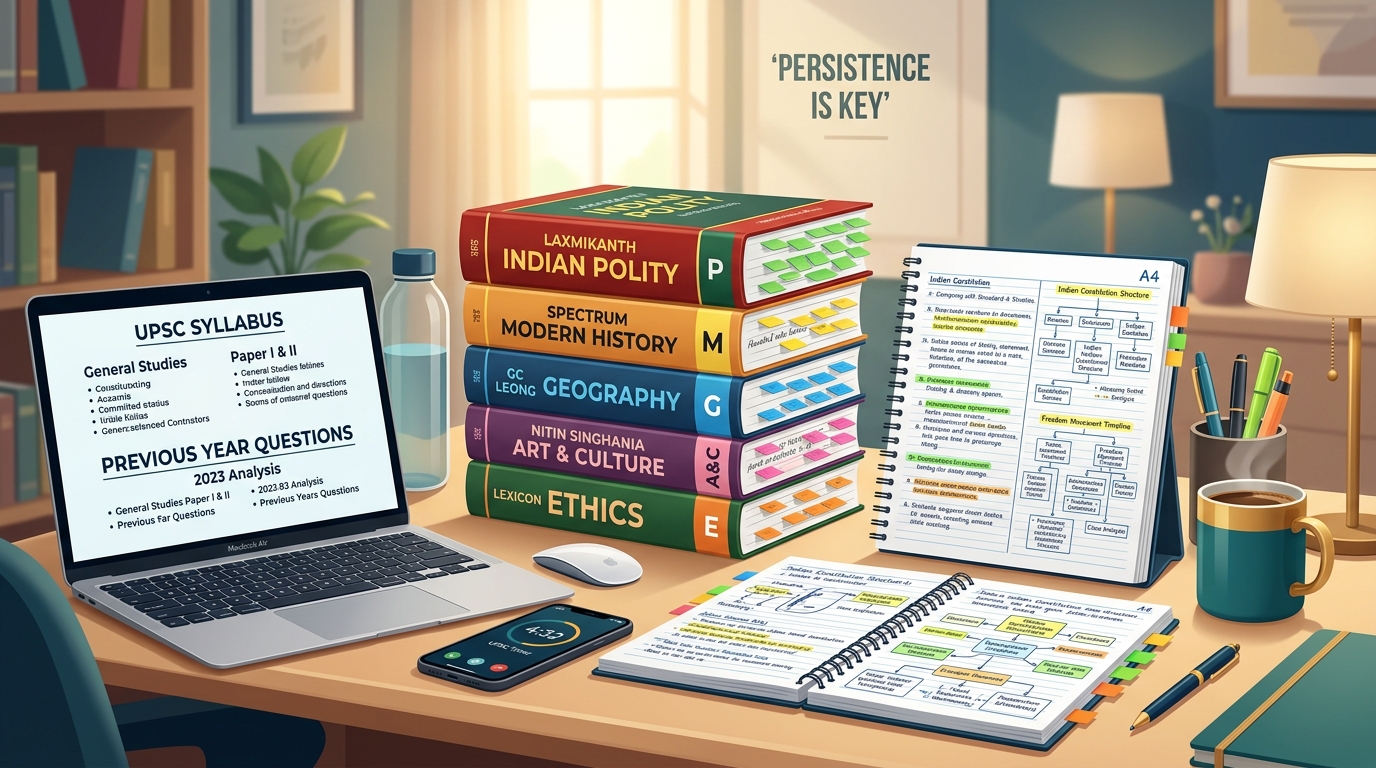
The Topper Study Desk: Books, Tabs & Active Notes
Successful aspirants don't hoard dozens of books—they deeply annotate, tab, and master a select core bookstack:
1. The Core Philosophy of a Topper's Booklist
Before looking at individual titles, understand the three fundamental booklist principles shared by all top rankers:
- The Principle of Minimalist Sources:
- Rule: Never buy two standard reference books for the same subject.
- Trap to Avoid: Reading both Laxmikanth and DD Basu for Polity, or reading both Spectrum and Bipan Chandra for Modern History. Pick one and read it 6 times.
- The 80/20 Rule (Pareto Principle):
- 80% of UPSC questions stem from 20% of core static areas (Constitution, Macroeconomics, Physical Geography, Modern Freedom Struggle, and Environmental Treaties). Focus your deepest energy here.
- Integration of Prelims and Mains from Day One:
- Toppers do not prepare for Prelims first and Mains later. They study a standard book comprehensively for Mains concepts, and then solve MCQs for Prelims factual precision.
2. GS Paper 1: Topper-Recommended Booklist
General Studies Paper 1 encompasses History, Art & Culture, Geography, and Indian Society.
| Subject Area | Primary Book / Source | Complementary / Value-Addition Source | Topper Advice & Key Focus |
|---|---|---|---|
| Modern Indian History | A Brief History of Modern India (Spectrum - Rajiv Ahir) | Old NCERT Class 11 by Bipan Chandra (optional for storyline) | Focus on 1857 to 1947, tribal and peasant rebellions, socio-religious reforms, and British administrative acts. Make chronological timelines. |
| Ancient & Medieval History | NCERT Class 11: Themes in Indian History (Parts 1 & 2) | Tamil Nadu Board Class 11 History Textbook | UPSC questions focus heavily on terminology, Buddhist/Jain philosophies, Bhakti-Sufi traditions, and agrarian terms from Mauryan/Mughal periods. |
| Art & Culture | An Introduction to Indian Art (Class 11 NCERT Part 1) | Indian Art and Culture by Nitin Singhania (Select chapters only) | Do not read Nitin Singhania cover-to-cover. Focus on Temple Architecture, Classical Dances, UNESCO World Heritage sites, and ancient literature. |
| Physical & World Geography | NCERTs Class 11 (Fundamentals of Physical Geography) | Certificate Physical and Human Geography by G.C. Leong | Master geomorphology, climate zones, pressure belts, and ocean currents. G.C. Leong Part 2 is indispensable for climate regions. |
| Indian Geography & Mapping | NCERT Class 11 (India: Physical Environment) | Orient BlackSwan or Oxford Student Atlas | River drainage systems, Himalayan passes, national parks, and international conflict hotspots. Map work must be practiced by drawing freehand. |
| Indian Society | NCERT Class 12: Indian Society & Social Change in India | Monthly Current Affairs (Women, Urbanization, Globalization, Communalism) | Conceptual definitions of secularism, regionalism, caste dynamics, and demographic dividend. |
3. GS Paper 2: Topper-Recommended Booklist
General Studies Paper 2 covers Indian Constitution, Polity, Governance, Social Justice, and International Relations.
| Subject Area | Primary Book / Source | Complementary / Value-Addition Source | Topper Advice & Key Focus |
|---|---|---|---|
| Indian Polity & Constitution | Indian Polity by M. Laxmikanth | Constitution of India Bare Act (PM Bakshi) for select Articles | Read Laxmikanth with active cross-referencing. Note constitutional vs. statutory bodies, emergency provisions, and parliamentary committees. |
| Governance & Public Policy | 2nd Administrative Reforms Commission (2nd ARC) Summaries | NITI Aayog Strategy Reports + PRS India | Study 2nd ARC Report 1 (Right to Information), Report 4 (Ethics in Governance), and Report 12 (Citizen Centric Administration) for high-scoring recommendations. |
| Social Justice & Welfare | Economic Survey & Union Budget Schemes | NITI Aayog SDG India Index + Annual Ministry Reports | Focus on healthcare, education, poverty indices, malnutrition (NFHS-5 data), and vulnerable groups (SC/ST/Disabled/Transgender). |
| International Relations | The Hindu / Indian Express World Section | Ministry of External Affairs (MEA) Official Briefings + ORF Analysis | Bilateral ties with neighbors, groupings (QUAD, G20, SCO, BRICS), and India's strategic maritime interests (Indo-Pacific). |
4. GS Paper 3: Topper-Recommended Booklist
General Studies Paper 3 covers Economy, Agriculture, Environment, Science & Tech, Internal Security, and Disaster Management.
| Subject Area | Primary Book / Source | Complementary / Value-Addition Source | Topper Advice & Key Focus |
|---|---|---|---|
| Indian Economy | Indian Economy by Nitin Singhania OR Vivek Singh | Class 11 NCERT (Indian Economic Development) + Recent Economic Survey | Understand core macroeconomic mechanisms: Monetary policy, Balance of Payments, inflation trends, and banking sector reforms. |
| Agriculture & Food Processing | NCERT Class 11/12 Biology & Geography chapters | NITI Aayog Agriculture Papers + PMF IAS Agriculture notes | Cropping patterns, MSP debates, irrigation tech (micro-irrigation), supply chain bottlenecks, and PDS reforms. |
| Environment & Biodiversity | PMF IAS Environment OR Shankar IAS | MoEFCC official releases + Down to Earth Magazine | Protected areas, Ramsar wetlands, IUCN Red List species, and global climate summits (UNFCCC COP, CBD). |
| Science & Technology | Monthly Current Affairs Compilations | The Hindu (Sunday Science Page) | Applied technologies: CRISPR, mRNA vaccines, AI, Green Hydrogen, space missions (ISRO/NASA), and semiconductor tech. |
| Internal Security | Challenges to Internal Security of India (Ashok Kumar IPS) | IDSA (Manohar Parrikar Institute) articles | Border management, cyber warfare, Left-Wing Extremism (LWE), money laundering, and drone threats. |
| Disaster Management | NCERT Class 11: Natural Hazards and Disasters | National Disaster Management Authority (NDMA) Guidelines | Sendai Framework, community-based disaster management, urban flooding, and heatwaves. |
5. GS Paper 4: Ethics, Integrity & Aptitude
Ethics is one of the highest-yield papers in UPSC Mains. A difference of 25 to 35 marks in GS-4 frequently determines whether you secure an IAS rank or fall off the final list.
| Component | Primary Source | How Toppers Use It |
|---|---|---|
| Ethics Lexicon & Definitions | Lexicon for Ethics, Integrity & Aptitude (Chronicle) OR Decode Ethics by Mudit Jain | Create 1-page definition sheets for every syllabus keyword: Integrity, Probity, Empathy, Compassion, Fortitude, Public Interest. |
| Ethical Thinkers & Philosophers | IGNOU Ethics Notes / Standard coaching summary | Learn core concepts of Socrates, Plato, Aristotle, Kant (Categorical Imperative), Utilitarianism (Bentham/Mill), and Gandhi's Talisman. |
| Case Studies | Solved Toppers' Ethics Answer Copies (AIR 1 copies) | Follow a structured format: Stakeholders involved, Ethical dilemmas, Available options with pros/cons, Best course of action with constitutional backing. |
| Personal Examples Diary | Self-Made Diary | Maintain a personal collection of 25 real-world ethical examples: inspiring civil servants (TN Seshan, Armstrong Pame), corporate leaders, historical icons, and personal life incidents. |
6. Essay Paper & Current Affairs Sources
The Essay Paper Strategy
- Primary Resource: Selected Essays by Anudeep Durishetty (AIR 1, 2017) or Nishant Jain (AIR 13).
- The Topper Methodology:
- Dedicate 25 minutes of the 90-minute essay slot strictly to brainstorming and outlining.
- Examine topics through the PESTLE approach: Political, Economic, Social, Technological, Legal, and Environmental dimensions.
- Connect abstract philosophical quotes to tangible historical and contemporary human realities.
The Current Affairs Golden Rule
- Daily: One national newspaper (The Hindu or The Indian Express). Read only syllabus-relevant editorials.
- Monthly: One standard monthly compilation (e.g., Vision IAS, ForumIAS, or InsightsIAS). Never read multiple monthly compilations.
- Annual: Economic Survey summary, Union Budget highlights, and India State of Forest Report (ISFR).
7. The "3-Iteration" Reading Technique of Toppers
Buying the right book is only 10% of the battle. How you read it determines the remaining 90%:
┌─────────────────────────────────────────────────────────────┐
│          THE 3-ITERATION TOPPER READING FRAMEWORK           │
├─────────────────────────────────────────────────────────────┤
│ ITERATION 1: NO HIGHLIGHTER (Day 1–10)                      │
│ → Read like a novel to grasp the storyline & big picture.   │
│                                                             │
│ ITERATION 2: SYLLABUS MAPPING & PENCIL NOTES (Day 15–25)    │
│ → Mark keywords, dates, exceptions; map to Mains syllabus.  │
│                                                             │
│ ITERATION 3: REVISION CARDS & PYQ SOLVING (Day 30–40)       │
│ → Test active recall; write 1-page micro-sheets per chapter.│
└─────────────────────────────────────────────────────────────┘
- Iteration 1 (The Speed Read): Read the book without highlighting or taking notes. Understand the structure, context, and storyline.
- Iteration 2 (The Analytical Read): Use a pencil to underline core concepts. Look at previous 10 years' questions on that topic immediately after finishing the chapter.
- Iteration 3 (The Synthesis Read): Use a single highlighter for high-yield facts, exceptions, and keywords. This becomes your quick revision base for the days leading up to the exam.
8. Topper Note-Making Rules: What to Make vs. What to Skip
- DO NOT Make Notes from Laxmikanth or Spectrum: These books are already concise summaries. Rewriting them by hand is a massive waste of 100+ study hours. Simply annotate and highlight inside the book itself.
- DO Make Micro-Notes for:
- Government schemes, nodal ministries, and target metrics.
- Environment: National Parks, river flow routes, and IUCN conservation statuses.
- Mains Value-Addition: Data points, Supreme Court verdicts, Law Commission reports, and committee recommendations.
- Personal Error Log from mock tests.
Frequently Asked Questions (FAQs)
How many total books should I buy for UPSC preparation?
You need roughly 12 to 14 core books covering all static subjects of General Studies (Prelims & Mains), plus your chosen Optional subject materials. Avoid accumulating hundreds of books or coaching booklets.
Can I clear UPSC only by reading NCERTs?
No. NCERTs build indispensable foundational clarity, but they are not sufficient on their own for the advanced analytical depth tested in UPSC CSE. You must build on NCERTs using standard reference books like Laxmikanth, Spectrum, and current affairs.
Should I read old NCERTs or new NCERTs?
- History: Old NCERTs (Ancient by RS Sharma, Medieval by Satish Chandra, Modern by Bipan Chandra) are highly recommended.
- Geography, Polity, Economy, Science: Always read the New NCERTs (Classes 9 to 12) as they contain updated facts, maps, and contemporary data.
Final Words: Discipline Over Volume
When asked about his preparation strategy, an AIR 1 ranker famously noted:
"I did not read 50 books once; I read 10 books 5 times."
Your success in UPSC CSE does not depend on having a lavish library. It depends on choosing the standard books listed above, reading them with relentless focus, revising them until concepts become second nature, and applying them in answer writing.
Start with this core booklist, stick to it without distraction, and execute your preparation with conviction!