
Every year, over a million young Indians from small rural hamlets, bustling metropolitan towns, prestigious IITs, local degree colleges, and corporate cubicles embark on the same daunting quest: the UPSC Civil Services Examination (CSE).
With an acceptance rate below 0.2%, cynical observers often ask:
- "Why spend your peak youth chasing an exam with such razor-thin odds?"
- "Is it just for the red beacon (lal batti) prestige, job security, or parental validation?"
- "What happens to the 99.8% who don't see their names on the final PDF?"
The truth, known only to those who have genuinely immersed themselves in the process, is profound: UPSC Civil Services is not just an employment exam; it is a transformative intellectual, psychological, and civic pilgrimage.
Whether your journey ends on the steps of the Lal Bahadur Shastri National Academy of Administration (LBSNAA) in Mussoorie or takes you into alternative leadership domains, honest UPSC preparation is never a waste. It fundamentally rewires how you think, how you speak, and how you perceive your role in nation-building.
Here is an honest, comprehensive look at why you should prepare for UPSC, what the service actually offers, and why the preparation itself is one of the highest-return investments you can ever make in yourself.
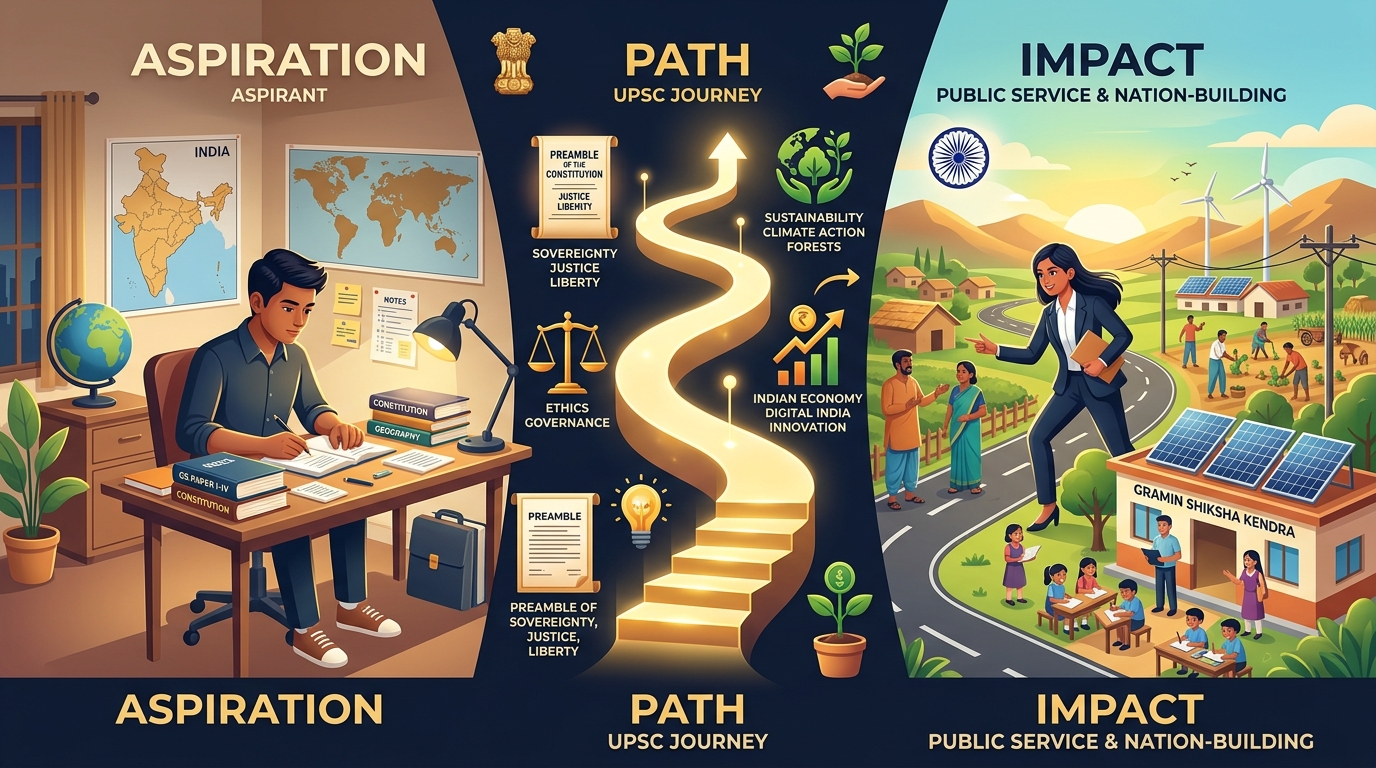
The UPSC Evolution: Aspiration to Impact
The journey of an aspirant bridges individual determination and transformative societal contribution:
1. The 4 Irreplaceable Privileges of Civil Services
No private sector job, corporate bonus, or startup title can replicate the unique operational canvas of an Indian Civil Servant (IAS, IPS, IFS, IRS, and central services):
1. Immense Scale of Direct Human Impact
At 28 or 30 years of age, a Sub-Divisional Magistrate (SDM) or District Collector oversees the welfare of 15 to 30 lakh citizens. With a single signature, you can:
- Modernize 100 dilapidated rural schools (Gramin Shiksha Kendras).
- Ensure life-saving maternal healthcare reaches the most remote tribal hamlet.
- Direct disaster management operations during severe floods or cyclones to evacuate thousands to safety.
- Implement direct-benefit welfare transfers that keep thousands of marginalized families above the poverty line.
Corporate leadership measures success in quarterly profit margins and shareholder dividends; civil leadership measures success in human dignity restored, poverty alleviated, and justice delivered.
2. Unrivaled Professional Diversity
In a standard corporate career, you may specialize in one narrow vertical—fintech, software architecture, marketing, or taxation—for decades.
In the civil services, your canvas transforms every 3 to 4 years:
- Year 1–3: Field administration, land records, disaster management, and law & order.
- Year 4–8: District leadership in health, education, rural roads, and municipal governance.
- Year 9–15: State or central ministry policymaking in renewable energy, industrial corridors, or tribal affairs.
- Senior Years: Formulating national fiscal policies, drafting landmark legislative acts, or negotiating multilateral climate pacts at the United Nations.
3. Constitutional Authority & Institutional Protection
An Indian administrative officer does not serve at the whim of private owners. Under Article 311 of the Constitution of India, civil servants enjoy constitutional safeguards ensuring they can act fearlessly in accordance with the rule of law without arbitrary dismissal. You are an instrument of the Constitution, sworn to uphold equality, justice, and liberty for every citizen.
4. Direct Seat at the Nation-Building Table
India is currently undergoing its most consequential socio-economic metamorphosis in modern history—transitioning from a developing economy into a $5-trillion+ global powerhouse. Being a civil servant means you are not merely a spectator observing history; you are an active architect driving India's developmental destiny.
2. "Even If You Don't Clear": The Intellectual & Personal Transformation
What if you dedicate two or three years to this examination and do not make the final list? Is that time lost?
Ask any serious ex-aspirant, and they will tell you that the person who emerged from the study room was unrecognizable from the person who entered it. Here is how the preparation process rewires you:
| Dimension of Life | Before UPSC Preparation | After Serious UPSC Preparation |
|---|---|---|
| Worldview & Civic Literacy | Superficial understanding based on sensational news headlines and social media soundbites. | Deep structural knowledge of the Constitution, macroeconomic forces, geopolitics, and historical precedents. |
| Problem-Solving Ability | Emotion-driven, one-sided, or simplistic opinions on complex social issues. | Multi-dimensional analysis: You instinctively evaluate challenges through Social, Economic, Political, Ethical, and Ecological lenses. |
| Discipline & Mental Stamina | Struggles with 2 hours of sustained concentration; easily distracted by notifications. | Capable of 8 to 10 hours of uninterrupted deep cognitive work, structured planning, and sustained delayed gratification. |
| Crisis Management & Resilience | Collapses under unexpected setbacks or career disappointments. | Hardened emotional resilience; trained to handle uncertainty, manage stress under pressure, and bounce back from failure. |
| Communication & Articulation | Vague, rambling essays or unorganized verbal discussions. | Laser-sharp synthesis: Ability to distill a 500-page policy document into a 150-word balanced, actionable brief with diagrams and data points. |
The "Intellectual Rebirth"
Most college degrees teach you what to memorize to pass a semester. UPSC teaches you how the world actually operates:
- You understand why inflation rises when central banks adjust interest rates.
- You learn why river disputes occur, how monsoon patterns dictate agricultural GDP, and how international straits govern world energy security.
- You understand the ethical dilemmas of governance—balancing environmental conservation against industrial employment.
You emerge as an enlightened, articulate, and deeply responsible citizen who commands respect in any boardroom, policy forum, or intellectual gathering.
3. What Most Degrees Teach vs. What the UPSC Journey Teaches
┌─────────────────────────────────────────────────────────────────────────┐
│              THE REAL CURRICULUM OF THE UPSC JOURNEY                    │
├─────────────────────────────────────────────────────────────────────────┤
│ • GS-1 (History, Society, Geography) → Cultural Empathy & Global Roots  │
│ • GS-2 (Polity, Governance, IR)     → Institutional Mechanics & Power   │
│ • GS-3 (Economy, Ecology, Tech)     → Sustainable Progress & Innovation │
│ • GS-4 (Ethics, Integrity, Aptitude)→ Moral Compass & Value Anchors     │
│ • Essay & CSAT                      → Structured Thought & Mental Agility│
└─────────────────────────────────────────────────────────────────────────┘
When you study Ethics (GS-4), you do not just study for marks. You study Socrates, Aristotle, Kant, Mahatma Gandhi, and Kautilya. You resolve intricate case studies involving corporate whistleblowers, communal tensions, and administrative dilemmas. This builds a permanent internal moral compass that guides you for the rest of your life.
4. Where Do Serious Aspirants Go If They Don't Clear?
A common anxiety among beginners is the fear of being "unemployable" after years of self-study. In reality, a dedicated UPSC aspirant is among the most versatile, intellectually agile minds in the job market.
Here are thriving career pathways where UPSC preparation gives you an unfair competitive advantage:
1. State Public Service Commissions (State PCS / OAS / UPPCS / BPSC)
- Syllabus Overlap: 75% to 85% identical to UPSC CSE.
- Outcome: Thousands of aspirants who missed the central UPSC list by a few marks routinely secure top ranks in their State Civil Services, becoming Deputy Collectors, DSPs, and Block Development Officers with administrative powers comparable to IAS/IPS within their state cadres.
2. Public Policy Think Tanks & Policy Consulting
- Top Institutions: NITI Aayog (Young Professionals Program), Observer Research Foundation (ORF), Centre for Policy Research (CPR), PRS Legislative Research, Indian Council for Research on International Economic Relations (ICRIER).
- Why Aspirants Excel: Think tanks desperately seek individuals who already understand government functioning, budget cycles, legislative procedures, and policy impact analysis.
3. Corporate Strategy, Public Affairs & ESG Leadership
- With environmental regulations, CSR mandates, and data protection laws expanding globally, multinational corporations (Big 4, consulting giants, tech conglomerates) actively hire ex-aspirants as Public Policy Analysts, Regulatory Affairs Specialists, and ESG (Environmental, Social, and Governance) Heads.
4. Media, Investigative Journalism & Geopolitics
- Your grasp of international relations, internal security, and judicial rulings makes you an exceptional investigative journalist, foreign affairs columnist, or defense analyst.
5. Multilateral Agencies (UN, World Bank, ADB)
- International development agencies look for professionals with deep grass-roots awareness of developing nations. UPSC preparation covers rural development, sanitation, climate adaptation, and gender equality in unmatched depth.
5. The Internal Shift: Cultivating "The Officer Like Qualities"
Long before the Union Public Service Commission awards you a service allocation letter, you must become an officer in your personal conduct:
- Empathy for the Marginalized: You stop viewing the poor through numbers or pity. You understand systemic inequality, historical injustices, and the structural interventions needed to empower people.
- Freedom from Dogma: You learn to see both sides of controversial issues without prejudice. Whether analyzing farm subsidies, uniform civil codes, or international treaties, you assess merit through the lens of constitutional morality and public interest.
- Mastery Over Solitude: In a hyper-connected world addicted to 15-second dopamine hits, spending 12 to 18 months in deep, solitary intellectual pursuit gives you a superpower that 99% of your peers will never develop.
6. Self-Audit: Are You Preparing for the Right Reasons?
Before committing years of your youth to this preparation, take this honest self-reflection test:
| Reason for Preparation | Healthy / Sustainable? | Long-Term Outcome |
|---|---|---|
| "I want power, prestige, and a government bungalow to show off to relatives." | ❌ Extremely Toxic | Will lead to frustration, burnout, and emotional breakdown at the first hurdle. |
| "My parents or family are forcing me to become an IAS officer." | ❌ Unsustainable | Lack of intrinsic motivation makes enduring 10 hours of daily study impossible. |
| "I want an unshakeable platform to solve grassroots problems and serve my country." | ✅ Optimal & Inspiring | Provides limitless fuel through long nights, bad mock scores, and exam stress. |
| "I want to master how the world works, build lifelong mental discipline, and test my limits." | ✅ Transformational | Ensures you win in life regardless of what the final rank list says. |
Frequently Asked Questions (FAQs)
Is it foolish to leave a well-paying private job to prepare for UPSC?
It is not foolish if you do it with a calculated safety margin. Work for 2 to 3 years, build a financial emergency fund, test your aptitude with the syllabus on weekends, and set a hard limit of 2 full-time attempts. If you have a clear plan, the intellectual and professional growth is worth the calculated risk.
Does UPSC preparation cause a career gap that hurts in the private sector?
Not if you frame it properly during interviews. Smart employers understand that a candidate who prepared seriously for UPSC possesses superior analytical capabilities, exceptional writing skills, high stress tolerance, and deep knowledge of regulatory frameworks. Many corporate consulting firms actively value this background.
How do I know if UPSC is truly my calling?
Read the NCERT books for Class 11 Politics, Economics, and History for 3 weeks. Follow the daily editorials of The Hindu or The Indian Express. If engaging with national issues, constitutional debates, and social problems excites your curiosity rather than boring you, you have the foundational spark required for this journey.
The Verdict: The Journey is the Reward
In the Bhagavad Gita, Lord Krishna shares the eternal philosophy of Nishkama Karma: focus wholeheartedly on the dedication of your action without being paralyzed by the anxiety of the outcome.
UPSC preparation is the ultimate modern manifestation of this principle. When you prepare with pure intentions, unyielding discipline, and intellectual honesty, you cannot lose.
If you clear the exam, you earn the honor of transforming millions of lives as a civil servant. And if life directs your path elsewhere, you step into the world as a fearless thinker, an articulate leader, and a resilient human being capable of excelling in any domain you touch.
Dare to prepare. Commit with your entire heart. The journey will reward you for a lifetime!