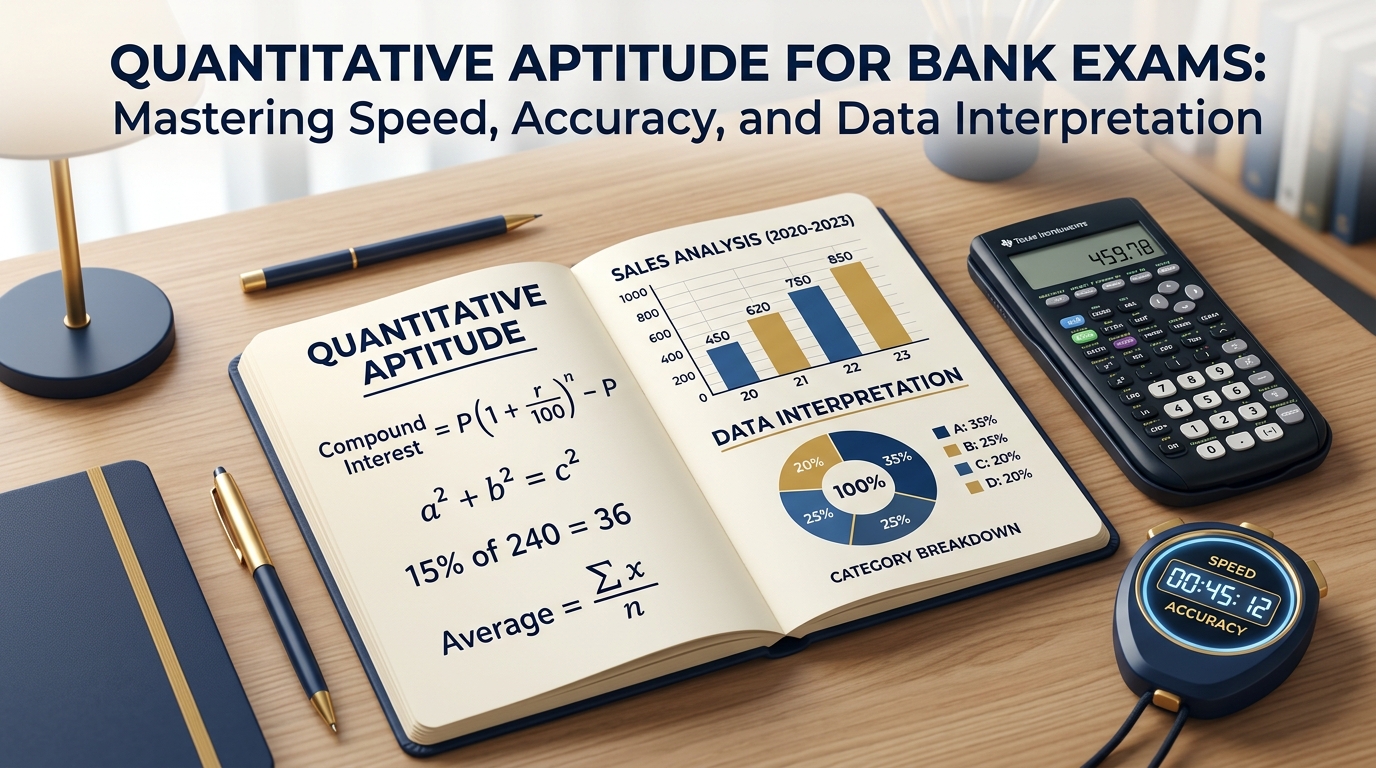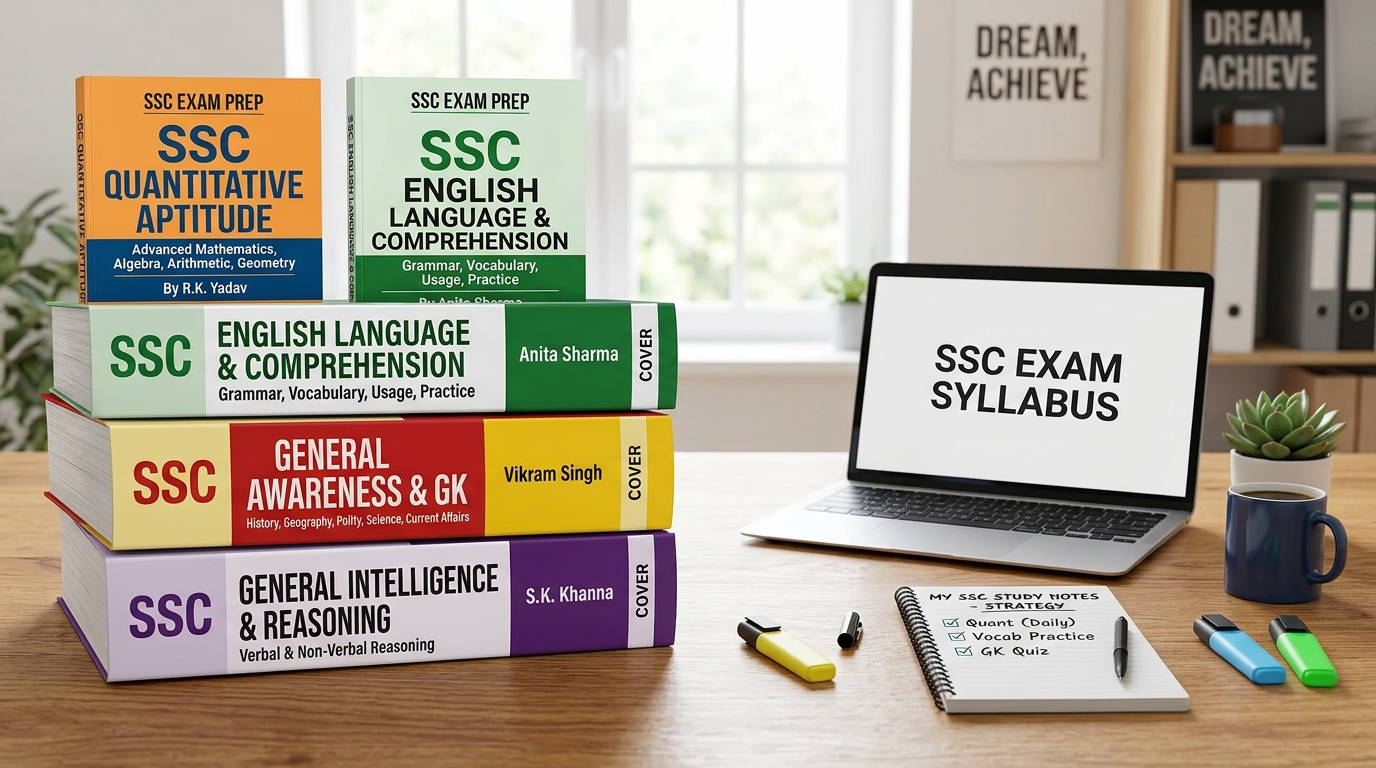
With hundreds of coaching modules, PDF compilations, and YouTube channels flooding the market, aspiring bankers often ask: "Do I still need physical books to crack SBI PO and IBPS PO?"
The answer is yes.
While online mock tests build speed and exam temperament, standard books build rock-solid conceptual clarity. Without strong fundamentals, you will get stuck in Mains-level high-order thinking puzzles and twisted Data Interpretation caselets.
Here is the curated, subject-wise booklist recommended by successful bank officers and subject faculties for 2026.
1. Quick Summary: The Essential Bank Exam Booklist
| Subject | Primary Recommended Book | Advanced / Mains Level |
|---|---|---|
| Quantitative Aptitude | Quantitative Aptitude for Competitive Examinations by R.S. Aggarwal | Data Interpretation & Analysis by Arun Sharma |
| Reasoning Ability | A Modern Approach to Verbal & Non-Verbal Reasoning by R.S. Aggarwal | Magical Book on Quicker Maths by M. Tyra & Analytical Reasoning by M.K. Pandey |
| English Language | Word Power Made Easy by Norman Lewis & Objective General English by S.P. Bakshi | High School English Grammar by Wren & Martin |
| General & Banking Awareness | Banking Awareness by Arihant Publications | Daily Newspapers (The Hindu / Business Standard) + Monthly Compendiums |
| Computer Aptitude | Objective Computer Awareness by Arihant | Online Sectional Quizzes & Previous Year Questions |
2. Quantitative Aptitude: From Foundation to Mains DI
1. Quantitative Aptitude for Competitive Examinations – R.S. Aggarwal
- Why It’s Essential: The gold standard for non-math and math background aspirants alike. It breaks down every arithmetic topic—percentages, ratios, simple interest, profit and loss, time and work—into structured exercises.
- How to Use: Solve Level-1 and Level-2 problems. Don’t try to solve all 50 questions per exercise; pick 15–20 representative variations to master the underlying logic.
2. How to Prepare for Data Interpretation for CAT – Arun Sharma
- Why It’s Essential for SBI PO & IBPS PO Mains: Traditional books only teach basic bar charts. Modern bank Mains exams ask Caselet DIs, Missing DIs, and Radar DIs. Arun Sharma’s book (specifically Chapters 1 to 4 on Calculations & Tables) trains you to handle heavy multi-variable data without panic.
3. Reasoning Ability: Puzzles, Seating & Critical Logic
Reasoning carries maximum weightage in both Prelims and Mains. It is split into two distinct halves: Puzzles/Seating Arrangement and Analytical/Critical Reasoning.
1. A Modern Approach to Verbal & Non-Verbal Reasoning – R.S. Aggarwal
- Focus Areas: Syllogisms, Inequalities, Blood Relations, Direction Sense, and Coding-Decoding.
- Strength: Excellent collection of beginner to intermediate practice drills that guarantee speed in Prelims.
2. Analytical Reasoning – M.K. Pandey
- Why It’s a Game-Changer for Mains: In SBI PO and IBPS PO Mains, 10 to 12 marks come from Critical Reasoning (Statement & Assumption, Cause & Effect, Course of Action, Strength of Arguments).
- M.K. Pandey is widely recognized as the single best guide to understand the logic behind these questions and avoid negative marking traps.
4. English Language: Grammar, Vocabulary & Comprehension
English is the section with the highest return on time invested. You don't have to calculate formulas—either you understand the passage, or you don't.
1. Word Power Made Easy – Norman Lewis
- Why You Need It: A revolutionary etymology-based book. Instead of memorizing isolated words, it teaches Latin and Greek roots (e.g., bene, mal, chron, omni). In 30 days, your reading speed and vocabulary comprehension will double.
2. Objective General English – S.P. Bakshi (Arihant)
- Focus Areas: Error detection, sentence improvement, cloze test, and para jumbles.
- How to Study: Study one grammatical rule per day (e.g., Subject-Verb Agreement, Pronoun cases) and immediately solve 30 practice questions to reinforce usage.
5. Banking Awareness & General Knowledge
General Awareness is the make-or-break section in the Mains exam. Because there is no sectional time limit pressure (typically 35–40 minutes for 40–50 questions), candidates scoring 35+ here secure final merit selection.
Recommended Core Resources:
- Arihant’s Banking Awareness: Thoroughly covers RBI history, monetary policy tools (Repo rate, Reverse Repo, CRR, SLR), types of bank accounts, negotiable instruments, and NPA frameworks (Insolvency and Bankruptcy Code).
- Daily Financial Newspaper: Read the editorial and economy pages of The Hindu, The Indian Express, or Business Standard for 30 minutes daily.
- Monthly Current Affairs Compendiums: Review last 6 months of banking, financial, and national developments prior to the Mains exam date.
6. How to Study from These Books Efficiently
┌────────────────────────────────────────────────────────────┐
│              3-STAGE SYSTEMATIC READING METHOD             │
├────────────────────────────────────────────────────────────┤
│ Stage 1 (Days 1–30): Concept Building                      │
│ ──► Read concepts from books and solve basic examples.     │
│ ──► Note down core formulas and shortcuts in a single book.│
├────────────────────────────────────────────────────────────┤
│ Stage 2 (Days 31–60): Topic-Wise Sectional Practice        │
│ ──► Solve 30–40 timed questions per topic.                 │
│ ──► Analyze speed bottlenecks and calculation errors.      │
├────────────────────────────────────────────────────────────┤
│ Stage 3 (Days 61+): Full Mock Test Simulations             │
│ ──► Switch from books to full-length online mock tests.    │
│ ──► Use books only for targeted revision of weak topics.   │
└────────────────────────────────────────────────────────────┘
Take the Next Step:
- Explore the complete Banking Exam Syllabus & Pattern.
- Take a free full-length SBI PO Prelims Mock Test to evaluate your current preparation score.
Founder & Chief Educator at Competition Prepare. Dedicated to helping competitive exam aspirants crack UPSC CSE, NEET UG, Banking, SSC, Railway & OPSC with structured roadmaps, high-yield study notes, and proven exam strategies.
Discussion & Aspirant Comments
0Have a question, study tip, or doubt regarding this article? Share your thoughts below.