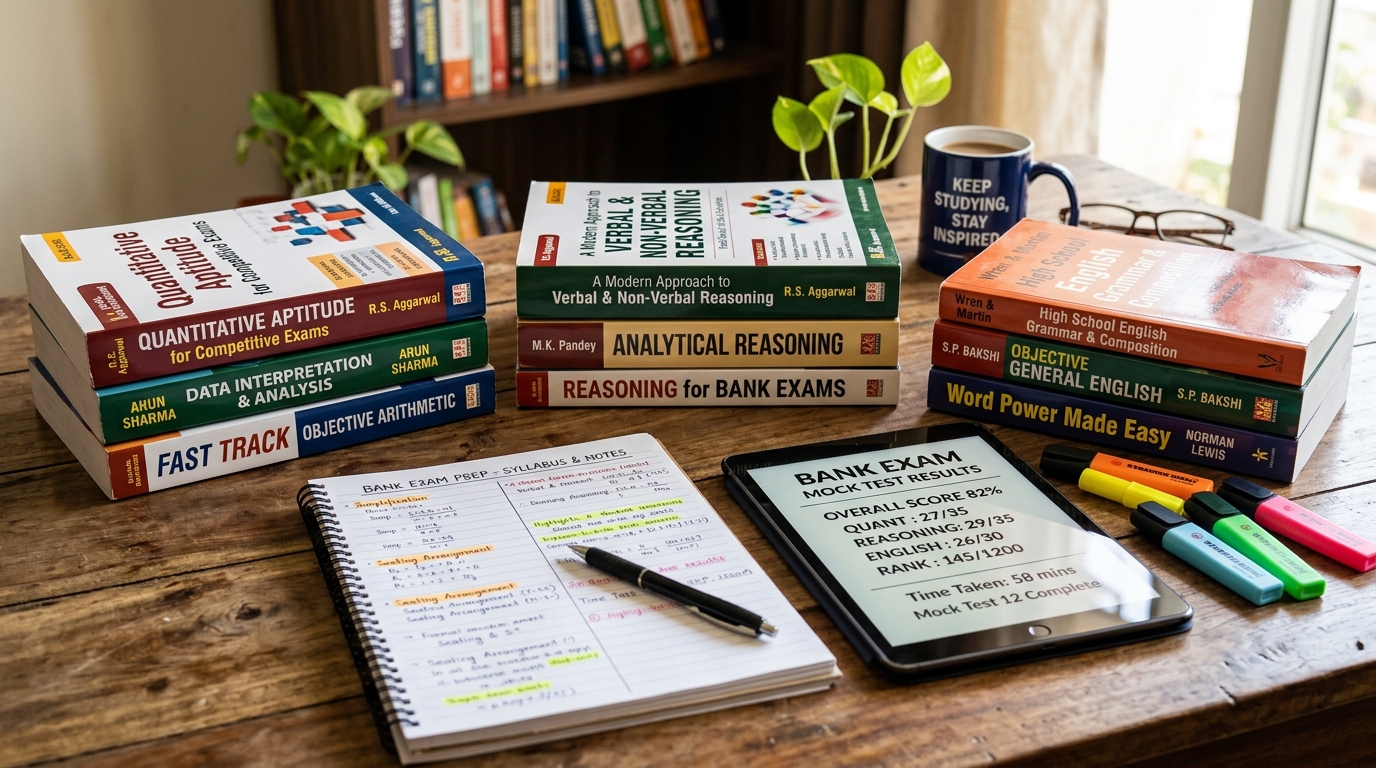
In banking examinations like SBI PO, IBPS PO, and IBPS Clerk, Quantitative Aptitude is widely feared. Why? Because you are asked to solve 35 tricky questions in strictly 20 minutes.
That gives you barely 34 seconds per question, including reading, calculating, and marking the answer.
Most candidates fail Quant not because they don't know the mathematical formulas, but because they attack the wrong questions in the wrong order.
Here is the exact battle-tested blueprint I used to consistently score 30+ marks in banking prelims.
1. Weightage Analysis: The 35-Mark Prelims Matrix
Understanding how the 35 marks are distributed is 50% of the game:
| Section | Expected Questions | Difficulty Level | Ideal Target Time |
|---|---|---|---|
| Simplification / Approximation | 5 – 10 Questions | Easy – Moderate | 3 to 4 Minutes |
| Number Series (Missing/Wrong) | 5 Questions | Moderate | 2.5 to 3 Minutes |
| Quadratic Equations | 5 Questions | Easy – Moderate | 2 to 2.5 Minutes |
| Data Interpretation (DI Sets) | 10 – 15 Questions | Moderate | 6 to 7 Minutes |
| Arithmetic Word Problems | 10 Questions | Moderate – Tricky | 4 to 5 Minutes |
Pro Rule: The first three topics (Simplification, Number Series, Quadratic Equations) are "Speed Math" items. Together, they carry 15 to 20 marks. If you can solve these 15 questions in 7 to 8 minutes, scoring 30+ is practically guaranteed.
2. Phase 1: Memorization Drills for Speed Math
Before solving complex word problems, your brain must perform basic arithmetic calculations instinctively without using pen and paper.
The Non-Negotiable Mental Drills:
- Multiplication Tables: From
1 to 30(especially 13, 17, 19, 23, 29). - Squares: From
1 to 50(e.g., $24^2 = 576$, $37^2 = 1369$). - Cubes: From
1 to 30(e.g., $14^3 = 2744$, $19^3 = 6859$). - Fraction-to-Percentage Table:
┌────────────────────────────────────────────────────────┐
│             ESSENTIAL PERCENTAGE FRACTIONS             │
├────────────────────┬───────────────────────────────────┤
│ 1/2 = 50%          │ 1/7 = 14.28%                      │
│ 1/3 = 33.33%       │ 1/8 = 12.5%                       │
│ 1/4 = 25%          │ 1/9 = 11.11%                      │
│ 1/5 = 20%          │ 1/11 = 9.09%                      │
│ 1/6 = 16.66%       │ 1/12 = 8.33%                      │
└────────────────────┴───────────────────────────────────┘
Example: If a question asks for $37.5% \text{ of } 640$, a beginner will multiply $640 \times 0.375$. A smart aspirant instantly sees $3 \times (1/8) \times 640 = 3 \times 80 = 240$. You save 25 seconds on a single question.
3. Phase 2: Mastering Quadratic Equations in 2 Minutes
In banking exams, quadratic equations ($ax^2 + bx + c = 0$) are solved using Sign Methods without calculating the full discriminant formula:
| Equation Signs | Root Signs |
|---|---|
| $+ \quad +$ | $- \quad -$ |
| $- \quad +$ | $+ \quad +$ |
| $+ \quad -$ | $- \quad +$ |
| $- \quad -$ | $+ \quad -$ |
Crucial Shortcut: If both equations have a negative constant term (e.g., $x^2 + 5x - 24 = 0$ and $y^2 - 3y - 40 = 0$), the relationship is always "Cannot be determined (CND)". You can click the answer in 2 seconds without solving!
4. Phase 3: Cracking Data Interpretation (DI)
Prelims typically feature two sets of Data Interpretation (10 questions):
- Set 1: Bar Graph or Tabular Chart (Standard calculation-based)
- Set 2: Pie Chart or Line Graph (Ratio/Percentage based)
The 3 Core Pillars of DI:
Every single question in DI is built around three fundamental concepts:
- Ratio: What is the ratio between sales of Company A in 2024 and Company B in 2025?
- Percentage Increase/Decrease: $\frac{\text{Final} - \text{Initial}}{\text{Initial}} \times 100$
- Averages: Sum of elements divided by total number.
Tactical Tip: In any 5-question DI set, 3 questions are easy, 1 is moderate, and 1 is lengthy and calculation-heavy. Solve the 3 quick ones immediately, and skip the lengthy 4-line calculation to maintain momentum.
5. Phase 4: Selective Arithmetic Strategy
Arithmetic questions (Profit & Loss, Time & Work, Simple & Compound Interest, Mixtures, Boats & Streams) determine the final merit rank.
Recommended Priority Hierarchy:
- Tier 1 (High Accuracy, Formula-Light):
- Ages & Partnership (Ratios based — highly scoring)
- Time and Work (Unit efficiency method)
- Profit, Loss & Discount (Fraction method)
- Tier 2 (Moderate Calculation):
- Simple Interest & Compound Interest (Successive percentage formulas)
- Speed, Time & Distance (Trains & Platforms)
- Tier 3 (Solve Only If Time Permits):
- Probability & Permutation-Combination
- Mensuration 2D/3D (Lengthy formulas)
6. The Winning 20-Minute Exam Hall Order
When the timer starts ticking from 20:00 down to 00:00, follow this strict sequence:
Minutes 00:00 – 07:00 ──► Solve Simplification, Number Series & Quadratics (Target: 15Q)
Minutes 07:00 – 14:00 ──► Solve 2 Sets of Data Interpretation (Target: 8–10Q)
Minutes 14:00 – 19:30 ──► Pick & Solve 6-8 Familiar Arithmetic Topics (Target: 6–8Q)
Minutes 19:30 – 20:00 ──► Buffer / Quick Review
─────────────────────────────────────────────────────────────────────────────
TOTAL ATTEMPTS: 29 – 33 Questions with 95%+ Accuracy!
Practice Now:
- Take our free Banking Quantitative Aptitude Quizzes to drill calculation speed.
- Attempt full-length SBI PO Mock Tests under exact 20-minute sectional conditions.
Founder & Chief Educator at Competition Prepare. Dedicated to helping competitive exam aspirants crack UPSC CSE, NEET UG, Banking, SSC, Railway & OPSC with structured roadmaps, high-yield study notes, and proven exam strategies.
Discussion & Aspirant Comments
0Have a question, study tip, or doubt regarding this article? Share your thoughts below.