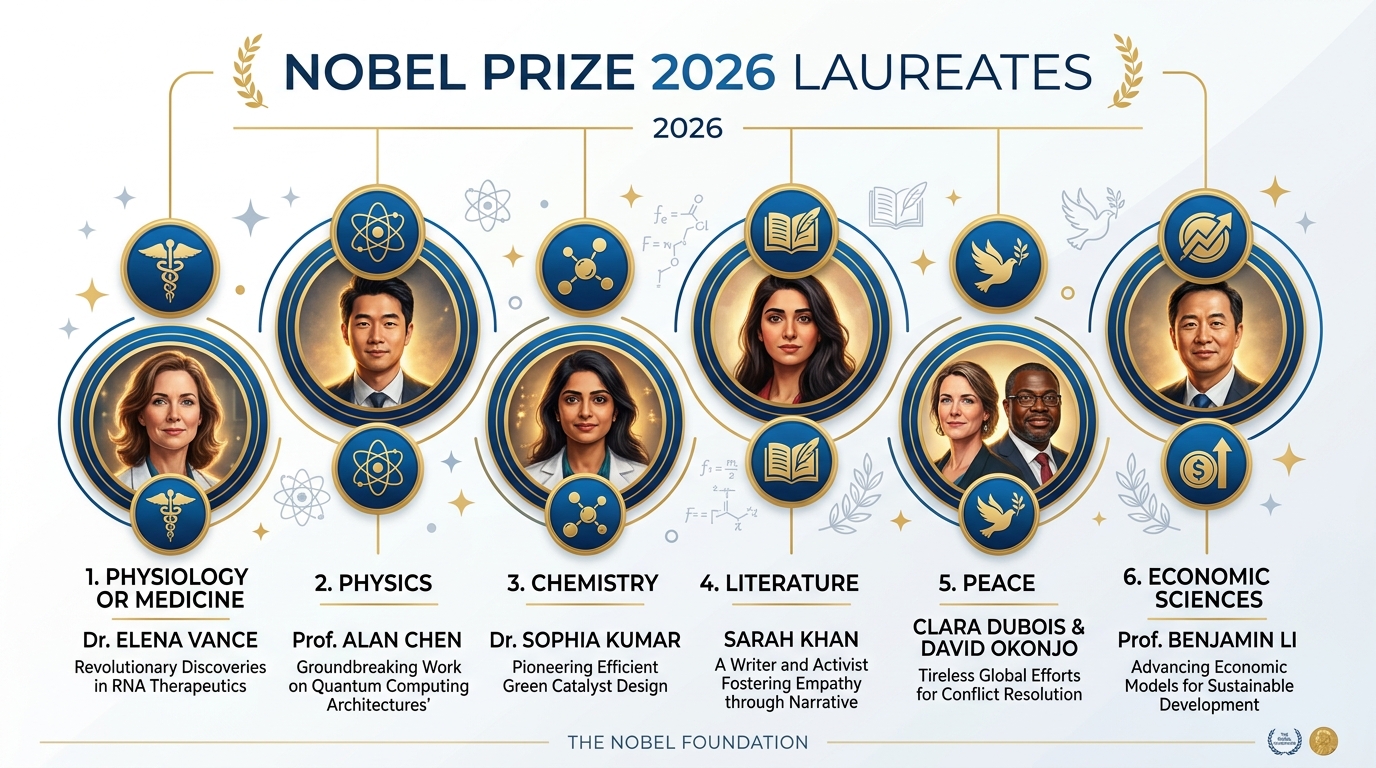
Every year in October, the Royal Swedish Academy of Sciences, the Nobel Assembly at Karolinska Institutet, and the Norwegian Nobel Committee announce the Nobel Prizes across six disciplines: Physiology or Medicine, Physics, Chemistry, Literature, Peace, and Economic Sciences.
For competitive exam aspirants across India preparing for UPSC CSE (Prelims & Mains GS-3), SSC CGL/CHSL, Banking (IBPS/SBI PO General Awareness), Railway RRB, and State PSCs (OPSC, UPPSC, BPSC), the Nobel Prize announcement is a guaranteed source of 2 to 4 marks.
In this comprehensive guide, we provide the category-wise breakdown of the Nobel Prize 2026 winners, the scientific significance behind each award, static GK facts about the Nobel Foundation, mnemonics for memorization, and practice MCQs designed specifically for exam pattern trends.
1. Quick Master Table: Nobel Prize 2026 Winners at a Glance
| Category | Awardee(s) | Country / Institution | Field of Contribution / Discovery | High-Yield Exam Keyword |
|---|---|---|---|---|
| Physiology or Medicine | Victor Ambros & Gary Ruvkun | United States (UMass & Harvard) | Discovery of microRNA and its post-transcriptional gene regulation mechanism | Gene regulation, microRNA, non-coding RNA |
| Physics | John J. Hopfield & Geoffrey E. Hinton | USA (Princeton) / Canada (Univ. of Toronto) | Foundational discoveries & inventions enabling Machine Learning with Artificial Neural Networks | Hopfield Network, Boltzmann Machine, Deep Learning foundations |
| Chemistry | David Baker, Demis Hassabis & John Jumper | University of Washington & Google DeepMind | Computational protein design and AI-driven protein structure prediction (AlphaFold) | Computational biology, AlphaFold2, De Novo Protein Design |
| Literature | Han Kang | South Korea | For her intense poetic prose confronting historical traumas and exposing the fragility of human life | The Vegetarian, Human Acts, South Korean literature |
| Peace | Nihon Hidankyo | Japan | For grassroots efforts to achieve a world free of nuclear weapons and witness testimony (Hibakusha) | Anti-nuclear proliferation, Hiroshima & Nagasaki atomic bomb survivors |
| Economic Sciences | Daron Acemoglu, Simon Johnson & James A. Robinson | MIT & University of Chicago | Studies on how institutions are formed and how inclusive vs extractive institutions affect prosperity | Why Nations Fail, Institutional Economics, Colonial Origins of Comparative Development |
2. In-Depth Category Breakdown for UPSC & PSC Mains
Examinations like UPSC CSE GS-3 (Science & Technology) do not simply ask who won the award; they examine why the discovery matters to modern science, public health, and technological sovereignty.
Science & Artificial Intelligence Core Comparison
| Field | Core Scientific Discovery | Why It Matters for Competitive Exams | Direct Applications |
|---|---|---|---|
| Medicine | microRNA & Gene Regulation | Explains how identical DNA produces distinct cell types (nerve, muscle, blood) via post-transcriptional silencing. | Targeted oncology (cancer therapeutics), cardiac repair, autoimmune treatments. |
| Physics | Artificial Neural Networks | Merged statistical physics and thermodynamics (molecular spin systems) with artificial intelligence. | Modern Large Language Models (LLMs), pattern recognition, climate modeling. |
| Chemistry | AlphaFold & Protein Design | Solved the 50-year-old protein folding challenge and enabled de novo synthetic enzyme generation. | Rapid drug discovery, vaccine development, enzymatic plastic waste recycling. |
A. Physiology or Medicine: microRNA and Gene Regulation
- The Core Problem: Human cells carry identical genetic information (DNA), yet a nerve cell looks and functions completely differently from a muscle cell or kidney cell. How does a cell know which genes to express?
- The Breakthrough: The discovery of microRNA (miRNA)—minute molecules of non-coding RNA that bind to messenger RNA (mRNA) inside the cytoplasm. This binding regulates whether protein synthesis proceeds or shuts down.
- Why It Matters for UPSC: Disruptions in microRNA regulation are directly linked to human oncogenesis (cancer), cardiac disorders, and autoimmune conditions. miRNA-based therapies are now entering clinical trials worldwide.
B. Physics: Machine Learning & Statistical Physics
- The Contribution: John Hopfield developed associative neural memory systems using physical concepts of molecular spin systems (Hopfield Networks). Geoffrey Hinton expanded upon this with the Boltzmann Machine, laying the statistical foundation for multi-layer deep neural networks.
- Strategic Impact: This marked the first time the Nobel Prize in Physics recognized theoretical computer science merged with statistical thermodynamics, reflecting how Artificial Intelligence is transforming scientific discovery.
C. Chemistry: Solving the 50-Year Protein Folding Mystery
- The Feat: Proteins are strings of amino acids folded into intricate 3-dimensional shapes that dictate all cellular chemistry. Predicting this shape previously took months of expensive X-ray crystallography or Cryo-EM.
- The Achievement:
- David Baker mastered de novo computational protein design, creating brand-new synthetic proteins from scratch to combat enzymes and toxic pollutants.
- Demis Hassabis and John Jumper built AlphaFold2, an AI system that accurately mapped virtually all 200 million known proteins in biology.
- Global Benefit: Accelerated drug discovery against antibiotic-resistant bacteria, malaria, and enzymatic plastic degradation.
3. Literature, Peace & Economics: Humanities Highlights
Literature: Han Kang (South Korea)
- First South Korean author and first Asian female writer to win the Nobel Prize in Literature.
- Key Masterpieces for SSC/Banking Recall:
- The Vegetarian (Won the International Booker Prize in 2016)
- Human Acts (Based on the 1980 Gwangju Uprising)
- We Do Not Part
Nobel Peace Prize: Nihon Hidankyo (Japan)
- A grassroots confederation representing the surviving victims of the atomic bombings of Hiroshima and Nagasaki (known as Hibakusha).
- Exam Relevance: Highlights global adherence to the "nuclear taboo" amidst rising geopolitical tensions and modern modernization of nuclear arsenals.
Economic Sciences: The Sveriges Riksbank Prize
- Pioneering Framework: Acemoglu, Johnson, and Robinson demonstrated that nations with inclusive political and economic institutions (protecting property rights, rule of law, democracy) experience long-term economic growth, whereas extractive institutions trap societies in poverty cycles.
- Influential Works: Why Nations Fail: The Origins of Power, Prosperity, and Poverty.
4. Static GK: Essential Nobel Facts for SSC & Banking Exams
Banking exams (SBI/IBPS Clerk & PO) and SSC exams (CGL, CHSL, MTS) consistently ask static questions about the history of the Nobel Prize:
| Static GK Parameter | Official Fact / Rule | Exam Significance |
|---|---|---|
| Year of Inception | 1901 | Established through the 1895 will of Alfred Nobel (inventor of dynamite). |
| Economics Prize Added | 1968 (First awarded in 1969) | Instituted by Sweden's central bank (Sveriges Riksbank). |
| Venue for Peace Prize | Oslo, Norway | Awarded by the Norwegian Nobel Committee. |
| Venue for Other 5 Prizes | Stockholm, Sweden | Awarded by Swedish institutions on December 10 (Nobel's death anniversary). |
| Posthumous Rule | Disallowed since 1974 | Cannot be awarded posthumously unless recipient dies after official declaration. |
| Maximum Recipients per Prize | 3 Persons | Cannot be divided among more than three individuals. |
| Only Double Female Laureate | Marie Curie | 1903 (Physics) & 1911 (Chemistry). |
| Most Awarded Organization | ICRC (Red Cross) | Won 3 times (1917, 1944, 1963). |
5. Indian Nobel Laureates Reference Table
Every Indian competitive aspirant must memorize this historical list:
| Laureate | Year | Category | Landmark Contribution / Detail |
|---|---|---|---|
| Rabindranath Tagore | 1913 | Literature | Gitanjali (First Asian Nobel Laureate) |
| Sir C.V. Raman | 1930 | Physics | Raman Scattering Effect |
| Dr. Har Gobind Khorana | 1968 | Medicine | Deciphering the genetic code and protein synthesis (US Citizen) |
| Mother Teresa | 1979 | Peace | Humanitarian work with Missionaries of Charity |
| Subrahmanyan Chandrasekhar | 1983 | Physics | Chandrasekhar Limit ((1.44 M_\odot)) on white dwarf stars |
| Amartya Sen | 1998 | Economics | Welfare Economics and Social Choice Theory |
| Venkatraman Ramakrishnan | 2009 | Chemistry | Studies of the structure and function of the ribosome |
| Kailash Satyarthi | 2014 | Peace | Bachpan Bachao Andolan (Shared with Malala Yousafzai) |
| Abhijit Banerjee | 2019 | Economics | Experimental approach to alleviating global poverty (Shared with Esther Duflo & Michael Kremer) |
6. High-Yield Practice Questions (MCQs) for 2026-2027 Exams
Test your instant recall with these exam-standard questions:
Question 1 (UPSC Pattern)
With reference to the Nobel Prize in Chemistry, consider the following statements:
- Demis Hassabis and John Jumper were awarded for the development of AlphaFold2.
- AlphaFold utilizes deep learning algorithms to predict three-dimensional protein structures directly from amino acid sequences.
- David Baker was awarded for the discovery of microRNA.
Which of the statements given above is/are correct?
A) 1 only
B) 1 and 2 only
C) 2 and 3 only
D) 1, 2, and 3
Correct Answer: B (1 and 2 only)
Explanation: David Baker was awarded for computational protein design, while the discovery of microRNA was recognized in the Physiology/Medicine category.
Question 2 (SSC / Banking Pattern)
Which grassroots organization of atomic bomb survivors won the Nobel Peace Prize?
A) International Campaign to Abolish Nuclear Weapons (ICAN)
B) Nihon Hidankyo
C) Pugwash Conferences on Science and World Affairs
D) Amnesty International
Correct Answer: B (Nihon Hidankyo)
Explanation: Nihon Hidankyo is the Japanese confederation of A-bomb sufferers from Hiroshima and Nagasaki.
Question 3 (State PSC Pattern)
The Sveriges Riksbank Prize in Economic Sciences in Memory of Alfred Nobel was instituted in which year?
A) 1901
B) 1945
C) 1968
D) 1974
Correct Answer: C (1968)
Explanation: The Economics Prize was established by Sweden's central bank (Sveriges Riksbank) in 1968 and was first awarded in 1969 to Ragnar Frisch and Jan Tinbergen.
Conclusion & Next Steps
When revising current affairs for upcoming examinations, focus on:
- The names of the laureates and their home nations.
- The exact scientific nomenclature (microRNA, AlphaFold, Hopfield networks).
- The ethical and socio-economic dimensions for UPSC Mains questions.
To solidify your preparation, practice full-length sectional tests and current affairs quizzes on Competition Prepare Free Mock Tests today!
Founder & Chief Educator at Competition Prepare. Dedicated to helping competitive exam aspirants crack UPSC CSE, NEET UG, Banking, SSC, Railway & OPSC with structured roadmaps, high-yield study notes, and proven exam strategies.
Discussion & Aspirant Feedback
Have a question or study doubt? Leave a comment below.
Ask a Question or Share Your Preparation Strategy
Share your study routine, clarify doubts, or suggest topics. Verified submissions are reviewed by the editorial desk.
Be the first to ask a question or leave feedback on this article!