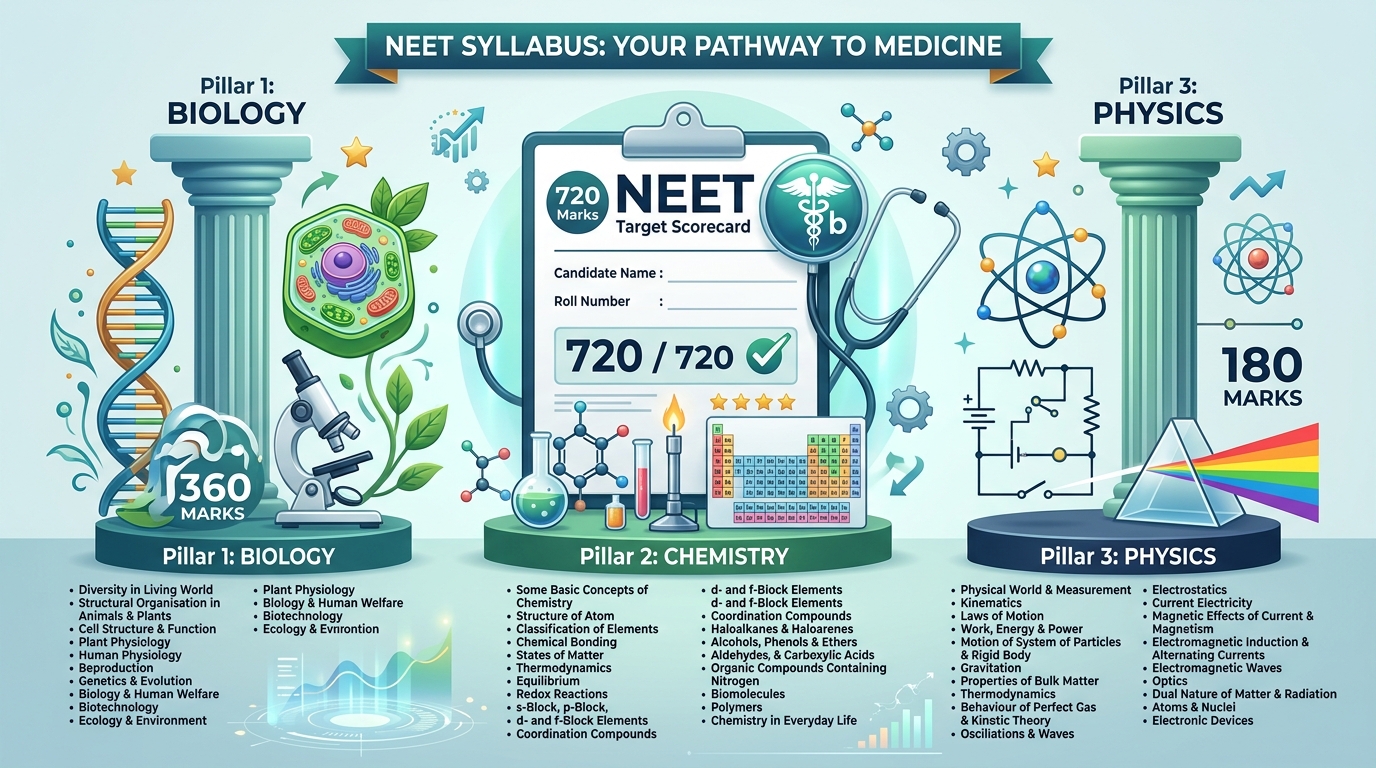
Preparing for the National Eligibility cum Entrance Test (NEET UG) can feel overwhelming with nearly 100 chapters across Physics, Chemistry, and Biology. With more than 20 lakh medical aspirants competing for limited government MBBS seats, scoring 650+ marks is no longer just an ambition—it is a competitive necessity.
The secret of past NEET toppers is not attempting to study all 100 chapters with equal time and energy. It lies in Smart Prioritization: mastering the top 35% of high-yield chapters that consistently deliver over 70% of the 720 marks in the actual NTA question paper.
In this detailed blueprint, we provide the definitive Subject-Wise Priority List for Biology (360 Marks), Physics (180 Marks), and Chemistry (180 Marks) based on chapter weightage trends from the past 10 years of NEET and AIPMT question papers.
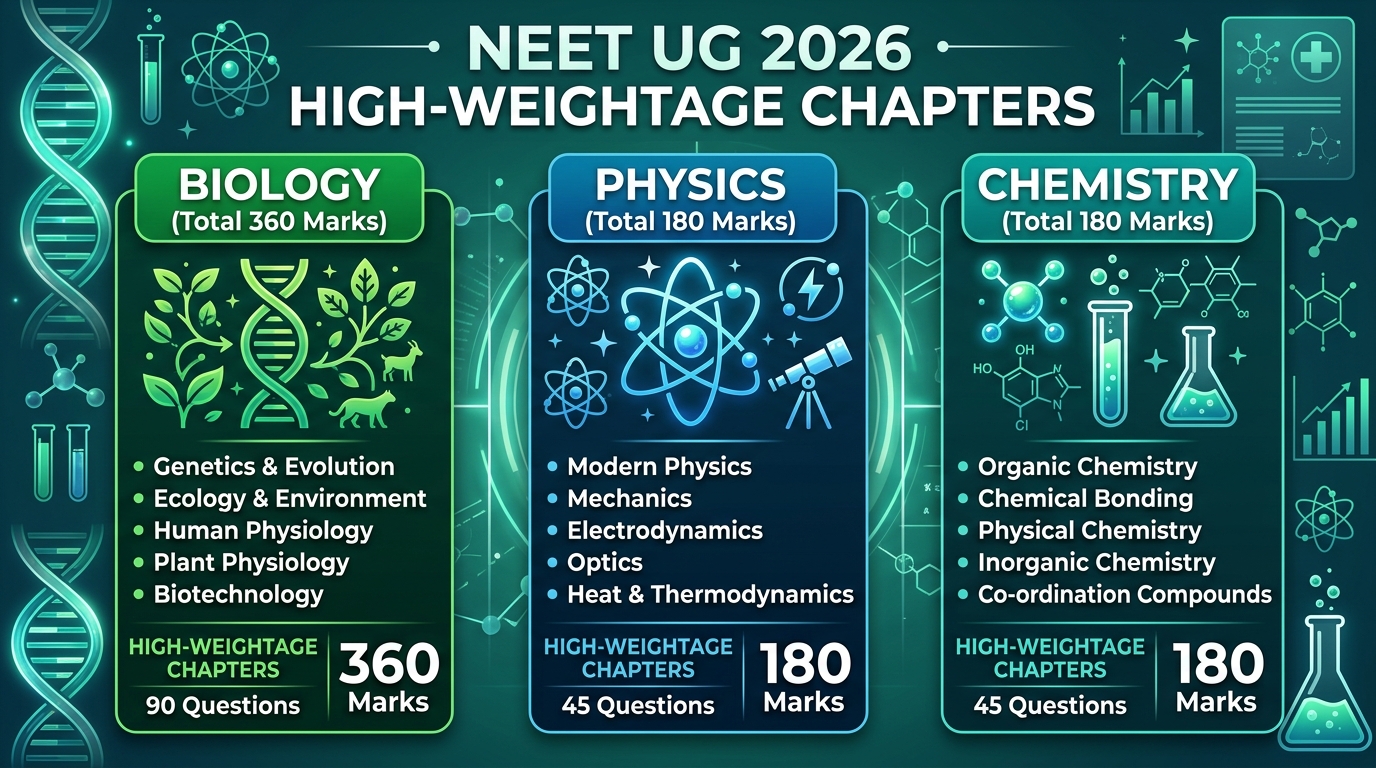
1. NEET UG 2026 Exam Pattern & Marks Allocation
| Subject | Section A (Mandatory) | Section B (Attempt Any 10/15) | Total Questions | Total Marks | Percentage Weightage |
|---|---|---|---|---|---|
| Botany | 35 Questions | 15 Questions (Attempt 10) | 45 Questions | 180 Marks | 25% |
| Zoology | 35 Questions | 15 Questions (Attempt 10) | 45 Questions | 180 Marks | 25% |
| Physics | 35 Questions | 15 Questions (Attempt 10) | 45 Questions | 180 Marks | 25% |
| Chemistry | 35 Questions | 15 Questions (Attempt 10) | 45 Questions | 180 Marks | 25% |
| Grand Total | 140 Questions | 60 Questions (Attempt 40) | 180 Questions | 720 Marks | 100% |
2. Biology (Botany & Zoology) — The 360-Mark Foundation
Biology accounts for 50% of your total NEET score. To secure a government medical college seat, your target in Biology must be 340+ marks.
Questions in Biology are drawn almost 100% directly from the line-by-line text, summary boxes, and scientist biographies of NCERT Class 11 & Class 12.
Priority 1: Ultra High-Yield Units (Contributes 180–200 Marks)
| Unit / Chapter Name | Typical Questions | Key Focus Areas for NEET UG |
|---|---|---|
| Genetics & Evolution | 12 – 16 Questions | Principles of Inheritance, Monohybrid/Dihybrid crosses, Linkage, DNA Replication, Transcription, Translation, Lac Operon, Genetic Code. |
| Human Physiology | 10 – 14 Questions | Neural Control & Coordination (reflex arc, ear/eye mechanism), Chemical Coordination (hormones), Excretory Products, Locomotion & Movement. |
| Ecology & Environment | 10 – 12 Questions | Population Interactions (mutualism, commensalism), Ecological Pyramids, Nutrient Cycles, Biodiversity Hotspots, National Parks. |
| Cell: Structure & Function | 8 – 10 Questions | Cell Organelles (Endomembrane system), Mitochondria/Chloroplast differences, Mitosis vs Meiosis stages (Prophase I sub-stages). |
| Biotechnology | 7 – 9 Questions | Restriction Enzymes, Gel Electrophoresis, Cloning Vectors (pBR322), PCR process, Bt Cotton, RNA Interference (RNAi). |
Priority 2: Moderate Yield (Contributes 80–100 Marks)
- Plant Physiology: Photosynthesis (C3 vs C4 cycle, Light reactions), Respiration in Plants (Glycolysis, Krebs cycle), Plant Growth Regulators (Auxin, Cytokinin, Gibberellin).
- Reproduction: Human Reproduction (Gamete formation, Menstrual cycle), Sexual Reproduction in Flowering Plants (Double fertilization, Embryo sac).
- Structural Organisation in Animals & Plants: Frog morphology, Plant Anatomy (Tissues, Vascular bundles).
Priority 3: Factual & Diagram Revision
- Diversity in Living World: Biological Classification, Plant Kingdom (Algae, Bryophytes, Pteridophytes life cycles), Animal Kingdom (Phylum characteristics and examples).
3. Physics (180 Marks) — The Rank Decider
Physics is universally regarded as the primary differentiator in NEET rankings. Aspirants who score 130 to 150+ in Physics regularly secure ranks under AIR 5,000.
The golden rule for NEET Physics: Prioritize formula retention, unit dimensions, and direct numerical application over lengthy derivations.
Priority 1: High-Scoring & Direct Formula Chapters (Contributes 70–80 Marks)
| Unit / Chapter Name | Typical Questions | Why This Chapter Is High-Yield |
|---|---|---|
| Modern Physics (Dual Nature, Atoms, Nuclei) | 7 – 9 Questions | Direct formula-based questions. High scoring with minimal calculation complexity. Photoelectric equation, Bohr's model, Binding energy. |
| Semiconductor Electronics | 3 – 4 Questions | Logic gates, p-n junction diode forward/reverse bias, Zener diode voltage regulator. Almost zero complex calculus. |
| Current Electricity | 4 – 5 Questions | Ohm's law, Kirchhoff's laws, Wheatstone bridge, Cell combinations, Drift velocity and resistivity relations. |
| Thermal Physics (Thermodynamics & KTG) | 5 – 6 Questions | First law of thermodynamics, Carnot engine efficiency, PV indicator diagrams, Degree of freedom, RMS speed. |
Priority 2: Core Mechanics & Electrodynamics (Contributes 60–70 Marks)
| Chapter Name | Questions | High-Yield Concepts |
|---|---|---|
| Ray & Wave Optics | 4 – 5 Questions | Lens maker formula, Total Internal Reflection (TIR), Prism deviation, Young's Double Slit Experiment (YDSE fringe width). |
| Electrostatics & Capacitance | 4 – 5 Questions | Coulomb's law, Electric field & potential due to dipole, Gauss's law applications, Parallel plate capacitor with dielectric. |
| Work, Energy & Power | 2 – 3 Questions | Work-Energy theorem, Conservation of mechanical energy, Collisions (elastic vs inelastic). |
| System of Particles & Rotational Motion | 3 – 4 Questions | Moment of Inertia of standard bodies, Torque equation ((\tau = I\alpha)), Conservation of angular momentum, Rolling motion. |
| Gravitation | 2 – 3 Questions | Variation of 'g' with height/depth, Orbital speed, Escape velocity, Kepler's laws. |
Priority 3: Foundational Tools
- Units & Dimensions & Error Analysis: 2 direct questions every year. Master dimensional formulas and percentage error calculation.
4. Chemistry (180 Marks) — Balance of Speed and Accuracy
Chemistry is the most balanced subject in NEET. It is split into three distinct branches, each requiring a specialized preparation approach:
       ┌────────────────────────────────────────────────────────┐
       │             NEET CHEMISTRY TRIPOD STRATEGY             │
       └───────────────────────────┬────────────────────────────┘
                                   │
         ┌─────────────────────────┼─────────────────────────┐
         │                         │                         │
         ▼                         ▼                         ▼
  [ INORGANIC CHEM ]        [ ORGANIC CHEM ]         [ PHYSICAL CHEM ]
  • NCERT memorization      • Named reactions        • Formula sheet
  • Periodic trends         • Reaction mechanisms    • Numerical drills
  • Coordination bonds      • GOC stability orders   • Mole concept & Thermo
A. Organic Chemistry (14–16 Questions)
Organic chemistry requires understanding reaction mechanisms and intermediate stabilities:
- General Organic Chemistry (GOC): Inductive effect, Resonance, Hyperconjugation, Carbocation/Carbanion stability, Acidic/Basic strength orders. (Crucial foundation for 8–10 questions).
- Hydrocarbons: Markovnikov vs Anti-Markovnikov addition, Ozonolysis of alkenes.
- Aldehydes, Ketones & Carboxylic Acids: Aldol condensation, Cannizzaro reaction, Clemmensen reduction, Haloform test.
- Amines & Biomolecules: Carbylamine test, Diazonium salt reactions, Glucose structure, Peptide linkage, Vitamins classification.
B. Inorganic Chemistry (14–16 Questions)
Inorganic chemistry questions are 100% direct line extractions from NCERT textbooks:
- Chemical Bonding & Molecular Structure: VSEPR theory, Hybridization (sp, sp2, sp3, sp3d), Molecular Orbital Theory (bond order and magnetic nature), Dipole moments. (Guaranteed 4–5 questions).
- Coordination Compounds: IUPAC naming, Werner's theory, Crystal Field Splitting Theory (CFST), Isomerism.
- Classification of Elements & Periodic Trends: Ionization enthalpy exceptions, Electron gain enthalpy, Atomic/Ionic radii across periods and groups.
- d and f-Block Elements: Electronic configuration, Lanthanoid contraction, Catalytic properties, Important compounds ((\text{KMnO}_4), (\text{K}_2\text{Cr}_2\text{O}_7)).
C. Physical Chemistry (14–16 Questions)
Focus on short numerical formulas and unit conversions:
- Solutions: Raoult's law, Colligative properties (Elevation in boiling point, Depression in freezing point, Osmotic pressure), Van 't Hoff factor ((i)).
- Electrochemistry: Nernst equation, Kohlrausch's law, Faraday's laws of electrolysis.
- Chemical Kinetics: Order of reaction, Rate constant units, Integrated rate equations for zero and first order, Arrhenius equation.
- Thermodynamics & Equilibrium: First law, Hess's law, Gibbs free energy ((\Delta G = \Delta H - T\Delta S)), Le Chatelier's principle, Buffer solutions, Solubility product ((K_{sp})).
5. Master Priority Matrix: What to Study First
Use this 3-tier roadmap to structure your weekly study timetable:
| Priority Level | Biology Focus | Physics Focus | Chemistry Focus | Cumulative Marks Potential |
|---|---|---|---|---|
| Tier 1 (Do-or-Die Chapters) | Genetics, Human Physiology, Ecology, Cell Biology | Modern Physics, Semiconductors, Current Electricity, Thermal Physics | Chemical Bonding, GOC, Solutions, Coordination Compounds | ~380 to 420 Marks |
| Tier 2 (High-Yield Chapters) | Biotechnology, Plant Physiology, Human Reproduction | Ray Optics, Electrostatics, Work Energy Power, Gravitation | Aldehydes & Ketones, Electrochemistry, Kinetics, Periodic Trends | ~200 to 240 Marks |
| Tier 3 (Finishing Touches) | Living World, Animal Morphology, Plant Anatomy | Waves & Sound, Fluids, Magnetism, Kinematics | d & f-Block, Equilibrium, Redox, Hydrocarbons | ~80 to 100 Marks |
6. 4-Step Action Plan to Cross the 650+ Threshold
- Rule of NCERT Supremacy in Biology & Inorganic: Read every chapter of Biology at least 5 to 7 times. Highlight scientist summaries, lab techniques, and footnote diagrams.
- Create a Dedicated Formula Notebook: Keep a 100-page notebook containing all Physics formulas and Physical Chemistry constants. Review it for 30 minutes every morning before starting new topics.
- Daily Mixed MCQ Target: Solve a minimum of:
- 60 Biology questions (target completion in 45 minutes).
- 30 Chemistry questions (target completion in 35 minutes).
- 30 Physics numericals (target completion in 45 minutes).
- Timed Full-Syllabus Mock Tests: Never wait until the syllabus is 100% finished to take mock tests. Attempt standard full-syllabus tests on Competition Prepare Free NEET Mock Tests to build real exam stamina and curb negative marking.
Conclusion
Cracking NEET UG with a top rank is not about studying 16 hours a day blindly; it is about strategic discipline. By locking down the Tier 1 and Tier 2 chapters outlined in this guide, you guarantee yourself a solid scoring foundation well above the cutoff.
Put your concepts to the test right now: attempt our NEET Full Syllabus Mock Test and Biology NCERT Drill to measure your current preparation level!
Founder & Chief Educator at Competition Prepare. Dedicated to helping competitive exam aspirants crack UPSC CSE, NEET UG, Banking, SSC, Railway & OPSC with structured roadmaps, high-yield study notes, and proven exam strategies.
Discussion & Aspirant Feedback
Have a question or study doubt? Leave a comment below.
Ask a Question or Share Your Preparation Strategy
Share your study routine, clarify doubts, or suggest topics. Verified submissions are reviewed by the editorial desk.
Be the first to ask a question or leave feedback on this article!