In the Railway Recruitment Board Non-Technical Popular Categories (RRB NTPC) examination, General Awareness (GA) carries the single highest mark weightage:
- CBT-1: 40 Questions out of 100 (40% Weightage)
- CBT-2: 50 Questions out of 120 (41.6% Weightage)
While Quantitative Aptitude and General Intelligence & Reasoning require time-consuming calculations in the examination hall, General Awareness questions are pure speed: you either know the answer in 5 seconds or you move on.
Scoring 32+ out of 40 in CBT-1 and 40+ out of 50 in CBT-2 provides an insurmountable lead over competitors who solely focus on Math drills.
In this guide, we break down the exact 50-Day Day-by-Day Master Plan, topic-wise question distribution, and high-yield Railway static notes based on previous official RRB NTPC papers.
1. RRB NTPC General Awareness Weightage Analysis
Based on trends across recent RRB NTPC CBT-1 and CBT-2 shifts, the 40/50 marks are distributed across four main domains:
| Subject Domain | CBT-1 Weightage (Out of 40) | CBT-2 Weightage (Out of 50) | High-Yield Sub-Topics |
|---|---|---|---|
| General Science (PCB) | 10 – 12 Questions | 12 – 15 Questions | Biology (Human body, diseases, vitamins), Physics (SI units, optics, motion), Chemistry (Acids/bases, metals, periodic table) |
| Static GK & Art & Culture | 8 – 10 Questions | 10 – 12 Questions | Classical & Folk dances, National Parks, First in India, Temples & Heritage sites, Books & Authors |
| Current Affairs | 7 – 9 Questions | 8 – 10 Questions | Government schemes, Sports medals, Summits, Military exercises, Appointments |
| Indian Polity & Constitution | 4 – 5 Questions | 5 – 6 Questions | Fundamental Rights, Articles & Amendments, President, Parliament, Panchayati Raj |
| Indian History & Freedom Struggle | 4 – 5 Questions | 5 – 6 Questions | Indus Valley, Buddhism/Jainism, Mughal Empire, 1857 Revolt, Gandhian Era (1915–1947) |
| Geography & Environment | 3 – 4 Questions | 4 – 5 Questions | Rivers & Tributaries, Mountain passes, Soil types, Biosphere reserves |
| Indian Railways Special GK | 2 – 3 Questions | 3 – 4 Questions | History of Indian Railways, Zones & Headquarters, Vande Bharat, UNESCO Railway tracks |
2. Pillar-Wise High-Yield Breakdown
       ┌────────────────────────────────────────────────────────┐
       │             RRB NTPC GA CORE SCORING PILLARS           │
       └───────────────────────────┬────────────────────────────┘
                                   │
         ┌─────────────────────────┼─────────────────────────┐
         │                         │                         │
         ▼                         ▼                         ▼
  [ GENERAL SCIENCE ]      [ STATIC & RAILWAYS ]     [ CURRENT AFFAIRS ]
  • Class 9-10 NCERT       • Dances & Festivals      • Last 8-10 Months
  • Diseases & Vitamins    • 19 Railway Zones        • Government Schemes
  • Chemical Common Names  • National Parks & Dams   • Sports & Awards
Pillar A: General Science (Target: 100% Accuracy)
Railway exams emphasize practical Class 9 and Class 10 NCERT science questions:
- Biology:
- Vitamins: Chemical names (e.g., Vitamin C = Ascorbic acid, Vitamin B1 = Thiamine) and deficiency diseases (Rickets, Scurvy, Beriberi, Night Blindness).
- Human Body: Blood groups (AB+ Universal recipient, O- Universal donor), Endocrine glands (Pituitary, Thyroid, Pancreas), Digestive enzymes (Pepsin, Trypsin, Amylase).
- Pathogens: Bacterial vs Viral diseases (Cholera, Tuberculosis vs Dengue, Polio, Rabies).
- Physics:
- SI Units & Measuring Instruments: Pressure ((\text{Pascal})), Electric Current ((\text{Ampere})), Barometer, Hygrometer, Ammeter.
- Optics & Mechanics: Laws of Reflection, Concave/Convex mirrors, Total Internal Reflection (optical fiber, mirage), Acceleration due to gravity.
- Chemistry:
- Common Names of Chemicals: Bleaching powder ((\text{CaOCl}_2)), Baking soda ((\text{NaHCO}_3)), Washing soda ((\text{Na}_2\text{CO}_3 \cdot 10\text{H}_2\text{O})), Plaster of Paris ((\text{CaSO}_4 \cdot \frac{1}{2}\text{H}_2\text{O})).
- Periodic Table Trends: Modern Periodic Law (Mendeleev vs Moseley), Noble gases, Alkali metals.
Pillar B: Indian Railways Specific GK (Guaranteed 2–3 Marks)
Every RRB exam shift asks direct questions about Indian Railways history, administration, and infrastructure:
| Parameter | Official Record / Fact | Exam Importance |
|---|---|---|
| First Passenger Train | 16 April 1853 | Ran between Mumbai (Bori Bunder) and Thane (34 km, 14 carriages, 3 locomotives: Sultan, Sindh, Sahib). |
| First Electric Train | 3 February 1925 | Ran between Bombay VT and Kurla Harbour (Deccan Queen in 1930). |
| Total Railway Zones | 19 Zones (including Kolkata Metro & South Coast Railway) | Frequent matching question on Zone vs Headquarters. |
| Longest Railway Platform in India | Hubballi (Karnataka) | Shree Siddharoodha Swamiji Hubballi Jn (1,507 metres). |
| Highest Railway Arch Bridge | Chenab Bridge (J&K) | World's highest railway bridge (359 metres above river bed). |
| Mountain Railways of India (UNESCO) | 3 Historic Routes | Darjeeling Himalayan Railway, Nilgiri Mountain Railway, Kalka-Shimla Railway. |
Top Railway Zone Headquarters to Memorize:
- Northern Railway: New Delhi
- Western Railway: Mumbai (Churchgate)
- Central Railway: Mumbai (CSMT)
- Southern Railway: Chennai
- Eastern Railway: Kolkata
- East Coast Railway: Bhubaneswar
- North Eastern Railway: Gorakhpur
Pillar C: Static General Knowledge (High Recall)
- Folk & Classical Dances: Bharatanatyam (Tamil Nadu), Kathakali & Mohiniyattam (Kerala), Kuchipudi (Andhra Pradesh), Kathak (North India/UP), Sattriya (Assam), Bihu (Assam), Rouf (J&K), Lavani (Maharashtra).
- National Parks & Tiger Reserves: Kaziranga (Assam, One-horned rhino), Jim Corbett (Uttarakhand), Bandhavgarh (MP), Periyar (Kerala), Gir (Gujarat, Asiatic Lion).
- International Organizations: United Nations (New York), WHO & WTO (Geneva), UNESCO (Paris), IMF & World Bank (Washington D.C.), ADB (Manila).
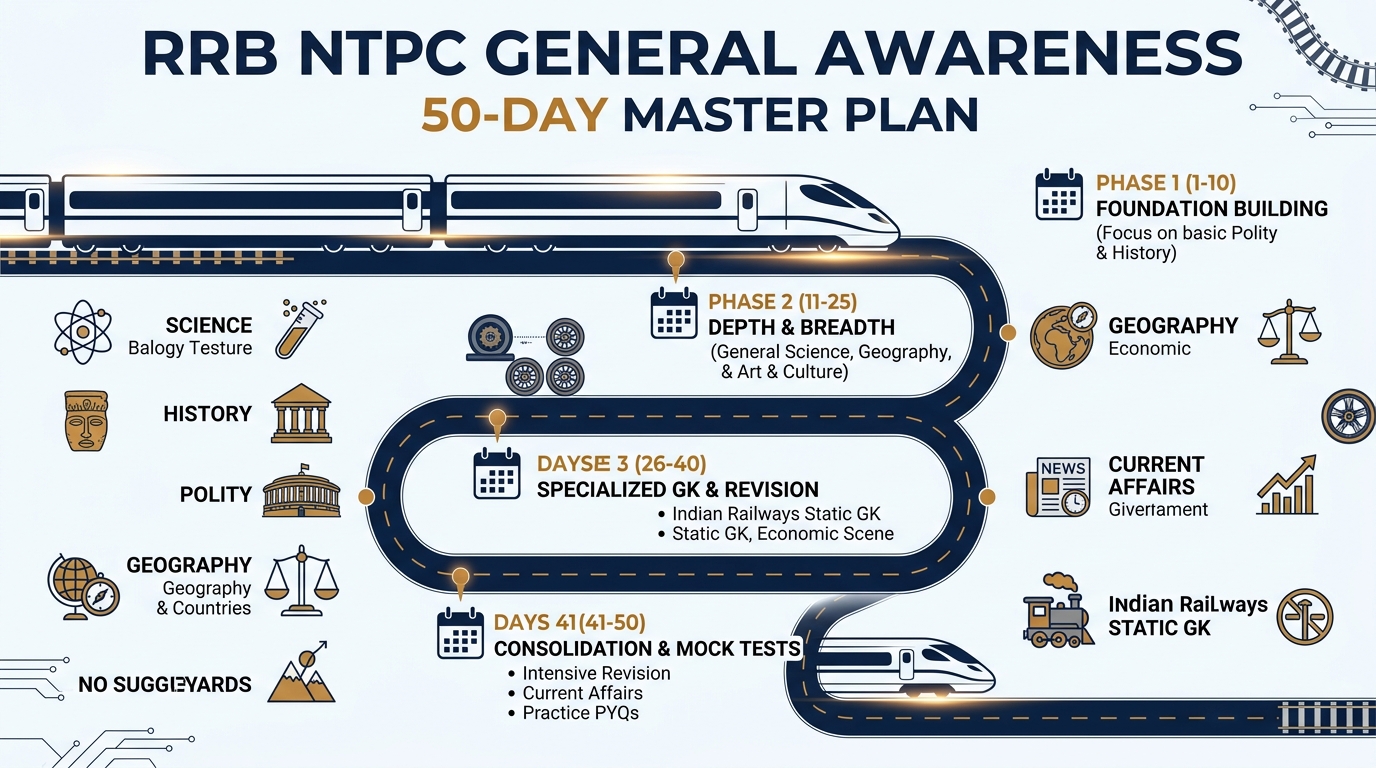
3. The 50-Day Day-by-Day Master Timetable
Dedicate 2 to 2.5 hours every day to General Awareness alongside your Math and Reasoning schedule.
| Phase | Day Range | Daily Focus & Subject Areas | Target Revision Output |
|---|---|---|---|
| Phase 1: Foundation Building | Days 1 to 10 | Indian Polity & Modern History<br>• Days 1–5: Articles, Fundamental Rights, President, Parliament.<br>• Days 6–10: 1857 Revolt, INC Sessions, Gandhian movements. | 150 PYQ MCQs on Polity & History. Create quick 1-page article cheat-sheets. |
| Phase 2: The Science Stronghold | Days 11 to 25 | General Science (Physics, Chemistry, Biology)<br>• Days 11–16: Biology (Human systems, nutrition, diseases).<br>• Days 17–21: Chemistry (Formulas, periodic table, metals).<br>• Days 22–25: Physics (SI units, optics, heat, electricity). | 250 Science PYQ MCQs. Memorize all common chemical names and SI units. |
| Phase 3: Geography & Static GK | Days 26 to 40 | Geography & Static GK Essentials<br>• Days 26–30: Indian Rivers, Dams, Mountain passes.<br>• Days 31–35: Folk dances, Festivals, National parks, UNESCO sites.<br>• Days 36–40: Indian Railways special GK & Computer fundamentals. | Complete Static GK flashcard revision. 150 Geography MCQs. |
| Phase 4: Current Affairs & Consolidation | Days 41 to 50 | Last 8 Months Current Affairs & Full Mocks<br>• Days 41–46: Monthly compilations (Govt schemes, sports, appointments).<br>• Days 47–50: Full-length sectional timed GA mock tests. | Solve 500 mixed questions across all shifts. Target 80%+ accuracy. |
4. Exam Hall Strategy: The "Three-Second Rule"
In RRB NTPC CBT-1 (90 minutes for 100 questions):
- Never spend more than 15–20 seconds on a GA question.
- Attempt General Awareness First: Finish all 40 GA questions in the first 10 to 12 minutes.
- Save Mental Energy for Math and Reasoning: Starting with GA allows you to lock in 30+ marks instantly, leaving an uninterrupted 75+ minutes for Quantitative Aptitude and Reasoning puzzles.
- Avoid Guesswork: Negative marking is (\frac{1}{3})rd ((-0.33) marks). Never guess unless you have cleanly eliminated two choices.
Conclusion & Next Steps
General Awareness is the ultimate rank booster in Railway examinations. With consistent daily execution of this 50-day plan, you will transform GA from a dreaded memorization burden into your strongest, fastest scoring section.
Review our dedicated RRB NTPC 2026 Complete Preparation Strategy and test your recall today on Competition Prepare Free Practice Tests!
Founder & Chief Educator at Competition Prepare. Dedicated to helping competitive exam aspirants crack UPSC CSE, NEET UG, Banking, SSC, Railway & OPSC with structured roadmaps, high-yield study notes, and proven exam strategies.
Discussion & Aspirant Feedback
Have a question or study doubt? Leave a comment below.
Ask a Question or Share Your Preparation Strategy
Share your study routine, clarify doubts, or suggest topics. Verified submissions are reviewed by the editorial desk.
Be the first to ask a question or leave feedback on this article!