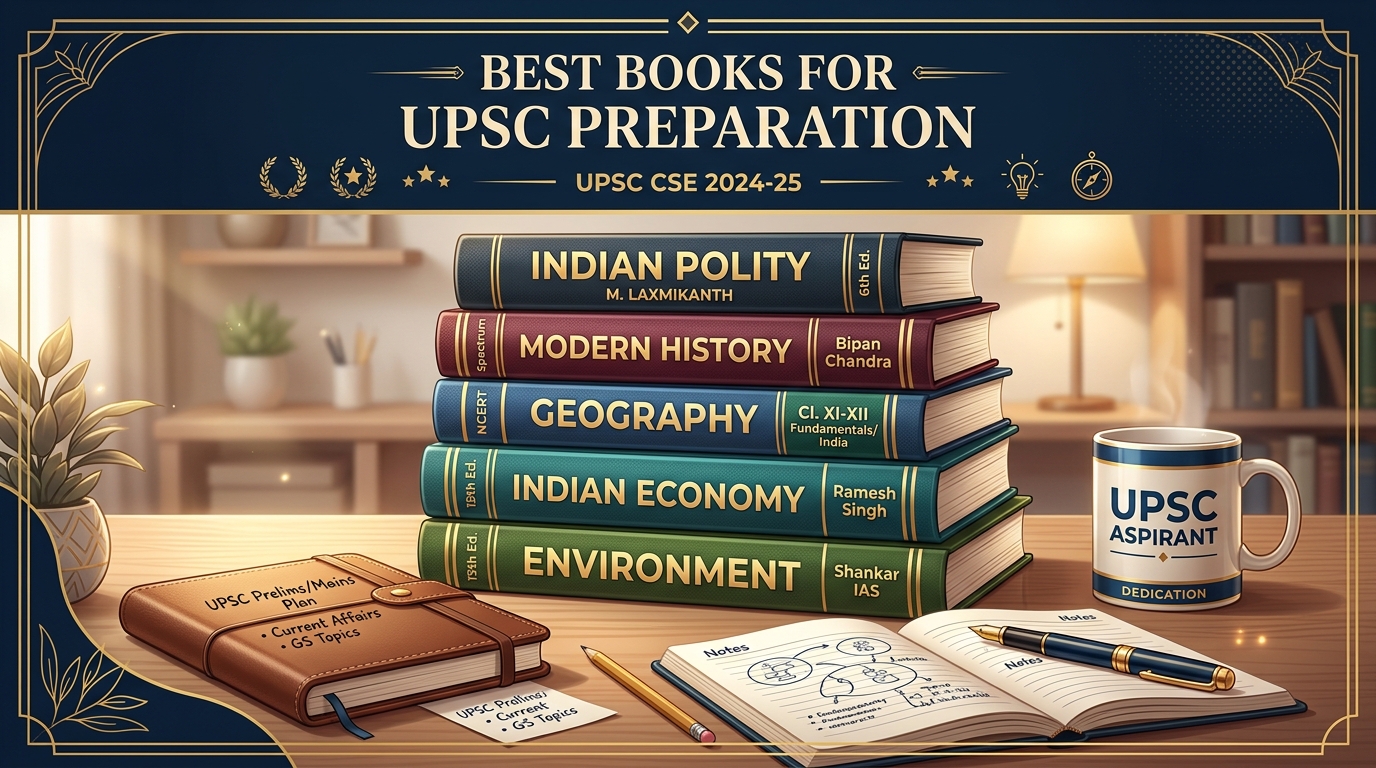
Preparing for the UPSC Civil Services Examination (CSE) is universally regarded as a full-time endeavor demanding 10 to 12 hours of relentless daily study. For millions of working professionals—software engineers, doctors, bankers, corporate consultants, teachers, and public sector employees—this prevailing narrative creates immediate self-doubt:
"Can I realistically crack the IAS exam while working 9 hours a day at my job?"
The resounding, evidence-backed answer is YES. Every single year, scores of working aspirants clear UPSC in the top ranks. Rank holders like IAS Tina Dabi, IAS Kanishak Kataria, and working toppers like Dr. Shena Aggarwal and Anudeep Durishetty (IRS to IAS Rank 1) have proven that UPSC does not test how many hours you sit at a desk; it tests how effectively you master the syllabus, how disciplined your revision cycles are, and how analytically you express your answers.
This comprehensive 2026 blueprint provides an actionable roadmap tailored specifically for the working aspirant: the battle-tested 4-hour weekday and 10-hour weekend routine, syllabus rationalization, optional subject selection, micro-learning tactics during office hours, and strategic leave management.
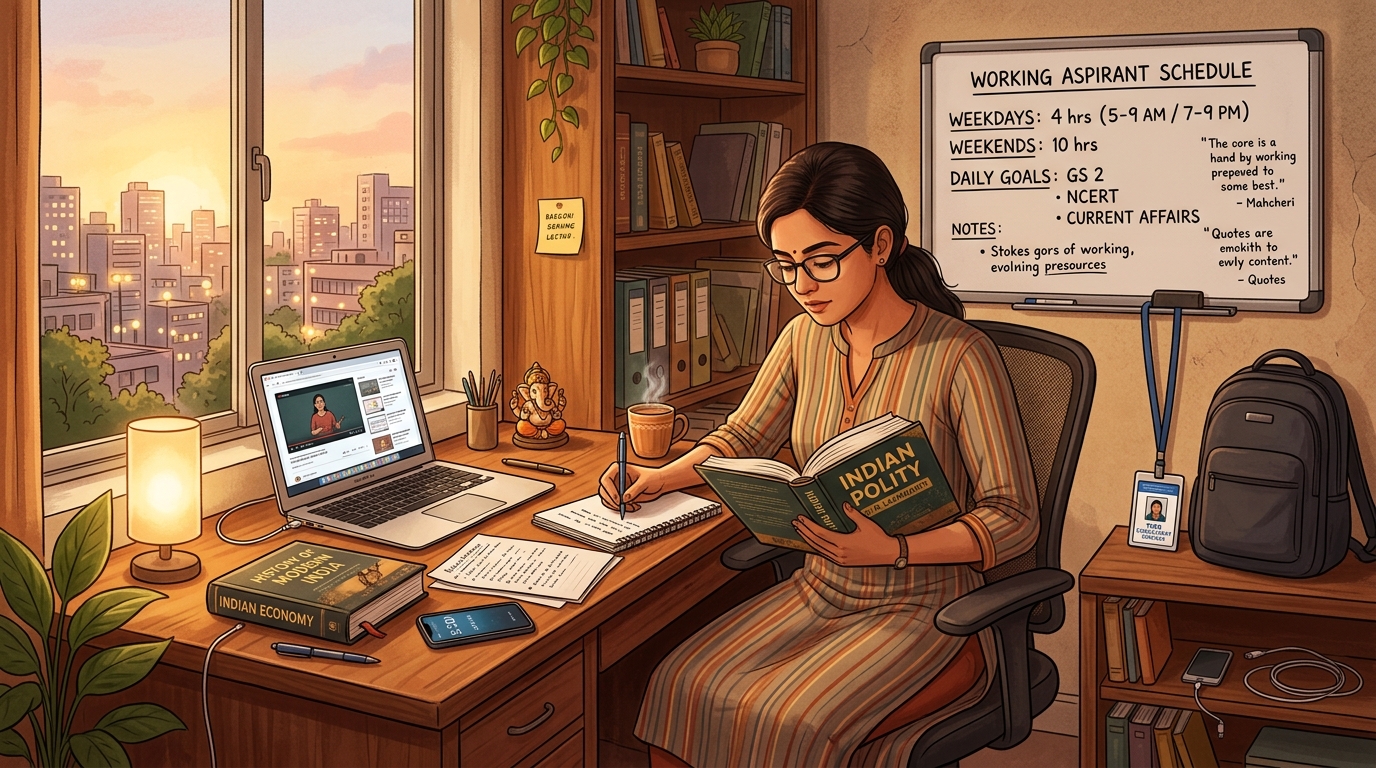
1. The Working Professional's Edge: Turning Constraints into Superpowers
While full-time aspirants have abundant time, they frequently suffer from Parkinson's Law—where study expands to fill the entire day, causing procrastination, burnout, and extreme performance anxiety.
Working professionals operate under tight constraints, which paradoxically grants them distinct competitive advantages:
- Financial Independence & Reduced Anxiety: You do not face the agonizing guilt of burning parental savings or fearing what happens if an attempt fails. Financial security keeps your mind calm during high-stress exam conditions.
- Ruthless Time Efficiency: When you only have 4 hours a day, you don't waste 45 minutes deliberating which pen to use or scrolling social media. You dive straight into high-yield topics.
- Maturity in Ethics & Interview (Personality Test): Professional experience dealing with team dynamics, organizational hierarchy, compliance, and crisis resolution directly enriches your answers in GS Paper 4 (Ethics, Integrity & Aptitude) and makes you confident and grounded before the UPSC Interview Board.
- Natural Execution Discipline: Corporate deadlines, project deliverables, and client accountability train you to meet weekly syllabus milestones with project-management rigor.
2. The Non-Negotiable Daily Routine Matrix: 4-Hour Weekdays
The secret to preparing alongside a full-time job is not finding large chunks of free time; it is anchoring fixed study blocks before and after your workday, complemented by micro-learning slots.
Target a baseline of 4 to 4.5 productive hours Monday through Friday (20–22 hours/week).
The Standard Weekday Blueprint (For 9:30 AM – 6:30 PM Office Hours)
| Time Slot | Duration | Primary Activity | Focus Subject / Task | Strategic Rules |
|---|---|---|---|---|
| 05:00 AM – 05:20 AM | 20 mins | Wake-up & Warm-up | Hydration, light stretching, green tea | Keep phone on Do Not Disturb (DND) mode. |
| 05:20 AM – 07:50 AM | 2.5 Hours | Morning Power Session 1 | Core Static GS (Polity / History / Economy) | Golden Slot: Fresh mind, zero office emails, zero family interruptions. Complete toughest conceptual reading here. |
| 07:50 AM – 08:45 AM | 55 mins | Transition & Commute | Daily breakfast, ready for office, metro/cab travel | Listen to All India Radio (AIR) news podcast or editorial summary on commute. |
| 09:30 AM – 01:30 PM | 4 Hours | Office Work Block 1 | Core professional duties | Deliver 100% at work; avoid opening study PDFs on office monitors to maintain career integrity. |
| 01:30 PM – 02:15 PM | 45 mins | Lunch & Micro-Study | Quick meal + Digital News Review | Skim The Hindu / Indian Express digital app (Explainers & Editorial page only). |
| 02:15 PM – 06:30 PM | 4.25 Hours | Office Work Block 2 | Core professional duties | Complete all workplace targets so you leave on time without carrying office stress home. |
| 06:30 PM – 07:30 PM | 1 Hour | Commute & Decompression | Evening commute + tea/freshen up | Listen to RSTV / Sansad TV 'Perspectives' or current affairs discussion. |
| 07:30 PM – 08:15 PM | 45 mins | Evening Micro-Slot | Mains Answer Writing (1-2 Questions) | Write 1 GS answer from PYQ; review model solutions immediately. |
| 08:15 PM – 09:00 PM | 45 mins | Dinner & Mental Recharge | Light dinner, brief walk, family conversation | No screen time during dinner. |
| 09:00 PM – 10:30 PM | 1.5 Hours | Night Consolidation Session | Current Affairs / CSAT / Static Revision | Revise morning notes or solve 15 CSAT quantitative/reasoning questions. |
| 10:30 PM – 05:00 AM | 6.5 Hours | Restorative Sleep | Deep sleep & mental recovery | Non-negotiable sleep schedule to prevent cognitive fatigue. |
Pro-Tip on Morning Study: If you take away only one lesson from this guide, let it be this: Win the morning, win the attempt. Never postpone your primary study to the evening after a grueling 9-hour workday. Exhaustion and unexpected office meetings will derail evening plans. When you finish 2.5 hours by 7:50 AM, your core daily quota is secured before the workday even begins.
3. The Weekend Intensive Accelerator (10 Hours/Day)
Weekdays provide your foundation; weekends provide your velocity. On Saturday and Sunday, you must log 10 hours each day (20 hours total), bringing your weekly tally to 40–42 productive study hours. This directly equals the output of a full-time candidate who studies 6–7 hours daily.
Weekend Study Distribution Matrix
| Weekend Time Block | Dedicated Activity | Hours Allocated | Output Milestone |
|---|---|---|---|
| Morning Block (07:00 AM – 11:30 AM) | Optional Subject Deep Dive | 4.5 Hours | Finish 1 complete chapter/unit of Optional with handwritten notes. |
| Post-Lunch Block (01:30 PM – 04:30 PM) | Full-Length Mock Test & Simulation | 3.0 Hours | Simulate 2-hour Prelims/Mains test under strict exam conditions + 1 hr initial self-check. |
| Late Afternoon (05:00 PM – 06:30 PM) | Test Error Log & Diagnostic Analysis | 1.5 Hours | Analyze why you got answers wrong (conceptual gap vs silly error). |
| Night Block (08:00 PM – 10:00 PM) | Weekly Current Affairs Compilation & Revision | 2.0 Hours | Read Monthly Current Affairs magazine (Vision IAS / ForumIAS) to synthesize the week's news. |
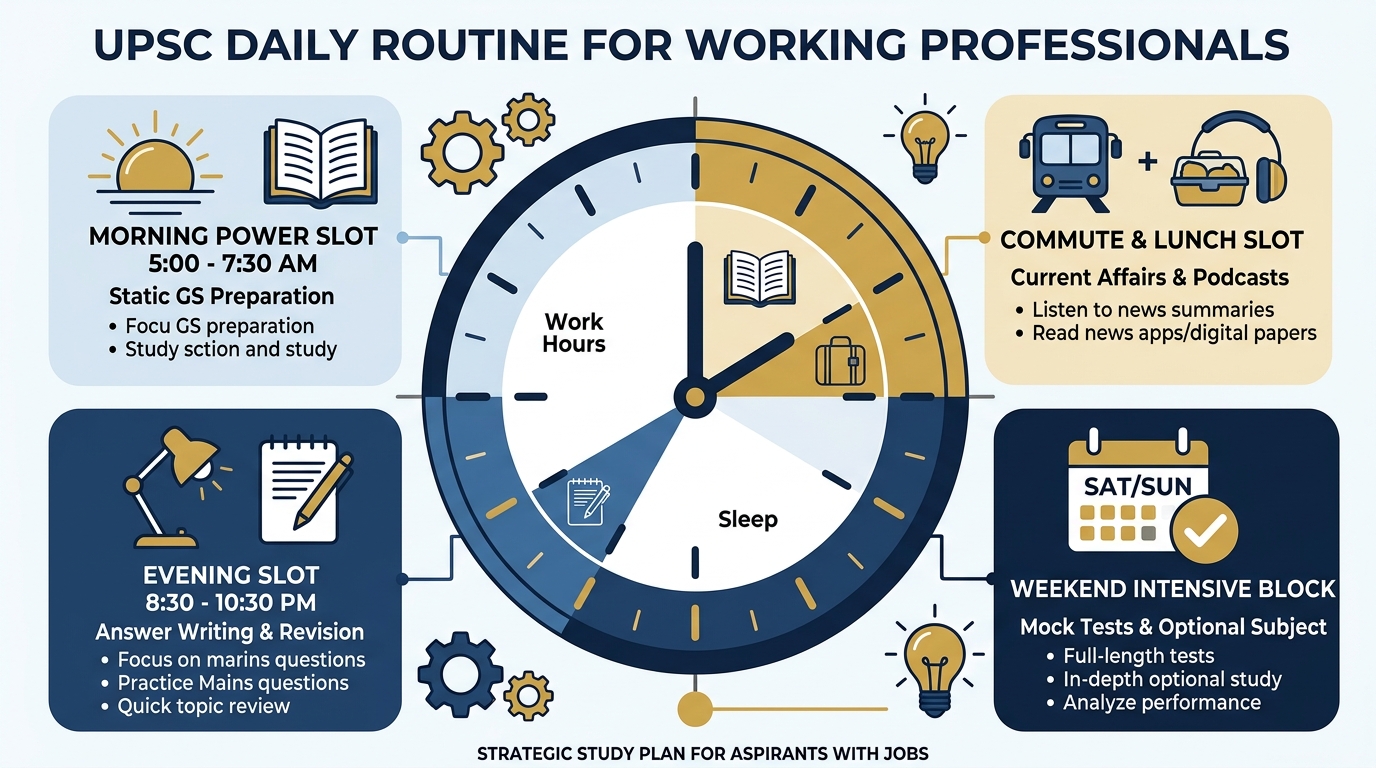
4. Visualizing the Daily Strategy
Here is a clear breakdown of how successful working candidates allocate their 24 hours between job responsibilities, high-yield study blocks, and essential rest:
5. Syllabus Rationalization: The "One-Source" Philosophy
Working professionals do not have the luxury of reading three different books for Modern Indian History or four different sources for Environment. You must enforce the Rule of Minimum Resources, Maximum Revisions:
Static Mastery = Core NCERTs + 1 Standard Reference Book + 5x Revision Cycles + PYQs
Essential Minimalist Booklist for Working Aspirants
| Subject | Non-Negotiable Source | Complementary Revision Source | What to Skip |
|---|---|---|---|
| Polity | Indian Polity by M. Laxmikanth | Bare Act for key Articles & Amendments | Multiple bulky constitutional commentaries |
| Modern History | A Brief History of Modern India (Spectrum) | Class 11 NCERT (Bipin Chandra) | Bipin Chandra's India's Struggle for Independence |
| Art & Culture | Class 11 NCERT An Introduction to Indian Art | Nitin Singhania (Selected Chapters only) | Encyclopedic dance/music treatises |
| Geography | NCERT Class 11 (Physical) & Class 12 (Human) | GC Leong (Certificate Physical Geography) | Heavy academic university textbooks |
| Economy | Mrunal Sir's PCB Notes / Vivek Singh's Indian Economy | Union Budget & Economic Survey Highlights | Bulky volumes of Ramesh Singh or Mishra & Puri |
| Environment | PMF IAS Environment or Shankar IAS | Monthly Current Affairs updates | Random forestry research papers |
| Science & Tech | Monthly Current Affairs compilations | NCERT Class 9 & 10 Science (General concepts) | Advanced engineering/medical science texts |
| Ethics (GS 4) | Lexicon for Ethics / Atul Garg notes | 25 Solved Case Studies from Topper Copies | Abstract philosophical treatises without case examples |
6. How to Choose the Ideal Optional Subject with a Full-Time Job
For a working candidate, your Optional Subject will determine your final selection. A bad optional choice with a massive, unstructured syllabus can destroy your preparation timeline.
Selection Criteria for Working Aspirants:
- Syllabus Compactness & Predictability: The syllabus must be manageable within 3.5 to 4 months of weekend study.
- Overlap with General Studies: High overlap directly saves hundreds of hours across GS Papers 1, 2, 3, and Essay.
- Availability of Concise Notes: Standard, updated classroom notes must be readily available so you don't spend months creating primary notes from scratch.
Recommended Optionals for Working Aspirants
- Sociology: Highly structured, compact syllabus, immense overlap with GS 1 (Society), GS 4 (Ethics), and the Essay paper.
- Political Science & International Relations (PSIR): Immense overlap with GS 2 (Polity, Governance, IR), significant contribution to Essay and Interview.
- Anthropology: Highly scoring, scientific, crisp diagrams, predictable past-year question patterns.
- Public Administration: Deep overlap with GS 2 (Governance) and GS 4 (Administrative Ethics), practical appeal for corporate managers.
- Literature Optionals (Hindi, Telugu, Kannada, etc.): Fixed, static syllabus with zero current affairs dependence; ideal for aspirants fluent in their regional language.
7. Current Affairs Without Burning 3 Hours Daily
The biggest trap for working aspirants is spending 2.5 to 3 hours reading newspapers cover-to-cover and creating colorful handwritten notes. Stop doing this immediately.
Follow the Topper-Proven Current Affairs Workflow:
- Digital News Reading (30–45 Mins Max): Skim The Hindu or The Indian Express on your phone/tablet during your commute or lunch. Read only the Front Page, Editorial/Op-Ed page, and National Affairs. Skip political mudslinging, local crime, and sports scores.
- Do NOT Make Handwritten Newspaper Notes: Monthly compilations from reputed institutes cover every news event with syllabus-mapped background context, diagrams, and statistics far better than manual notes.
- Weekly Monthly Magazine Consolidation (2 Hours on Sunday): Dedicate two hours every weekend to read the relevant section in a monthly compilation (such as Vision IAS Current Affairs). Highlight directly in the PDF or printout.
- Current Affairs PYQ Filtering: Keep the last 10 years of Prelims questions handy to know how UPSC asks questions (e.g., International Organizations, Wildlife Sanctuaries, S&T applications).
8. Smart Leave Management Strategy
Do not burn all your annual leaves randomly for minor family events or sporadic mid-year burnout. Save your Earned Leave (EL), Casual Leave (CL), and Medical Leave for the critical final sprints:
| Milestone Phase | Timing | Recommended Leave Duration | Primary Objective During Leave |
|---|---|---|---|
| Prelims Final Sprint | 3 to 4 Weeks before Prelims | 20 – 25 Days | Solve 25+ Full Mock Tests, revise CSAT formulas, memorize maps/reports, 3x static revision. |
| Mains Answer Writing Sprint | 6 to 8 Weeks before Mains | 45 – 60 Days (Take Sabbatical/Earned Leave) | Intensive 3-hour answer writing drills, GS 1-4 full mock simulations, Optional revision, Essay drills. |
| Interview Preparation | 7 to 10 Days before Personality Test | 7 – 10 Days | Attend 2-3 mock interviews, DAQ/DAF deep research, refine body language and state-specific issues. |
9. Overcoming Workplace Fatigue & Burnout
When juggling corporate deadlines and UPSC targets, mental fatigue is inevitable. Use these psychological techniques to sustain momentum across 12 to 18 months:
- The 1-Hour Non-Zero Day Rule: On days when client emergencies or server crashes keep you at work until 10:00 PM, do not despair. Never let a day be a "Zero Day". Read just 5 pages of Laxmikanth or solve 10 MCQs on an app for 30 minutes. Maintaining the daily streak preserves psychological momentum.
- Keep Your Preparation Confidential at Work: Never broadcast in your office that you are preparing for UPSC. It creates unwanted scrutiny, colleagues may view you as distracted, and managers might deny legitimate promotions or assign awkward tasks to test your loyalty.
- Digital Dopamine Detox: Strictly silence non-essential social notifications. When you have only 4 hours to study, 30 minutes lost on Instagram or LinkedIn cuts your study productivity by 25%.
10. Frequently Asked Questions (FAQs)
Q1: Can I clear UPSC Prelims with just 4 hours of study daily?
Yes. Consistency beats volume. Studying 4 focused hours every weekday plus 10 hours on Saturday and Sunday gives you 38–40 hours per week. Over a 10-month period, that equals over 1,600 productive hours, which is more than enough to cover the entire static syllabus, revise 4 times, and solve 40+ mock test papers.
Q2: Should I quit my high-paying corporate/IT job for UPSC?
No, at least not in your first attempt. The UPSC Civil Services Exam has a success rate of less than 0.1%. Quitting your job creates immense psychological pressure, and a study gap can hurt your career if things do not go as planned. Give your first attempt with structured time management while retaining your job. Only consider unpaid sabbatical or study leave when you have cleared Prelims and are appearing for Mains.
Q3: How should working professionals tackle CSAT (Paper 2)?
Many working aspirants with engineering or technical backgrounds make the fatal mistake of taking CSAT for granted and fail by 1–2 marks. Dedicate 45 minutes every alternate day or 2 hours every Saturday to solve previous 10-year CSAT papers, especially reading comprehension inference questions and number system problems.
Q4: Should I mention my job in the UPSC Detailed Application Form (DAF)?
Absolutely yes. Having work experience is a tremendous asset in the UPSC Interview. The board appreciates candidates who demonstrate multitasking ability, financial maturity, and real-world administrative problem-solving skills. Be thoroughly prepared with details about your employer, industry trends, and why you wish to transition from your sector to the Civil Services.
Summary Checklist for Tomorrow Morning
- Set your alarm for 5:00 AM and place your phone across the room.
- Complete 2.5 hours of static GS (Polity or Modern History) before 8:00 AM.
- Download a digital news app and read the daily editorials during your commute.
- Write 1 Mains answer at 7:30 PM.
- Review your progress, sleep by 10:30 PM, and repeat.
Founder & Chief Educator at Competition Prepare. Dedicated to helping competitive exam aspirants crack UPSC CSE, NEET UG, Banking, SSC, Railway & OPSC with structured roadmaps, high-yield study notes, and proven exam strategies.
Discussion & Aspirant Comments
0Have a question, study tip, or doubt regarding this article? Share your thoughts below.