
In recent UPSC Civil Services Preliminary Examinations, General Studies Paper 2 (CSAT) has emerged as the most decisive gatekeeper.
Year after year, hundreds of hardworking aspirants score 95 to 110+ marks in GS Paper 1, comfortably clearing the General Category cutoff, only to be disqualified because their CSAT score stopped at 63 or 65 marks—just shy of the mandatory 66.67 qualifying threshold (33.33%).
The trend is clear: UPSC has moved away from formulaic questions to conceptual aptitude, lengthier reading comprehension passages, and multi-layered Number System puzzles.
Treating CSAT as an afterthought in the final two weeks is no longer a viable strategy. In this guide, we break down the exact 80+ scoring roadmap across Quantitative Aptitude, Logical Reasoning, and Reading Comprehension with zero guesswork.
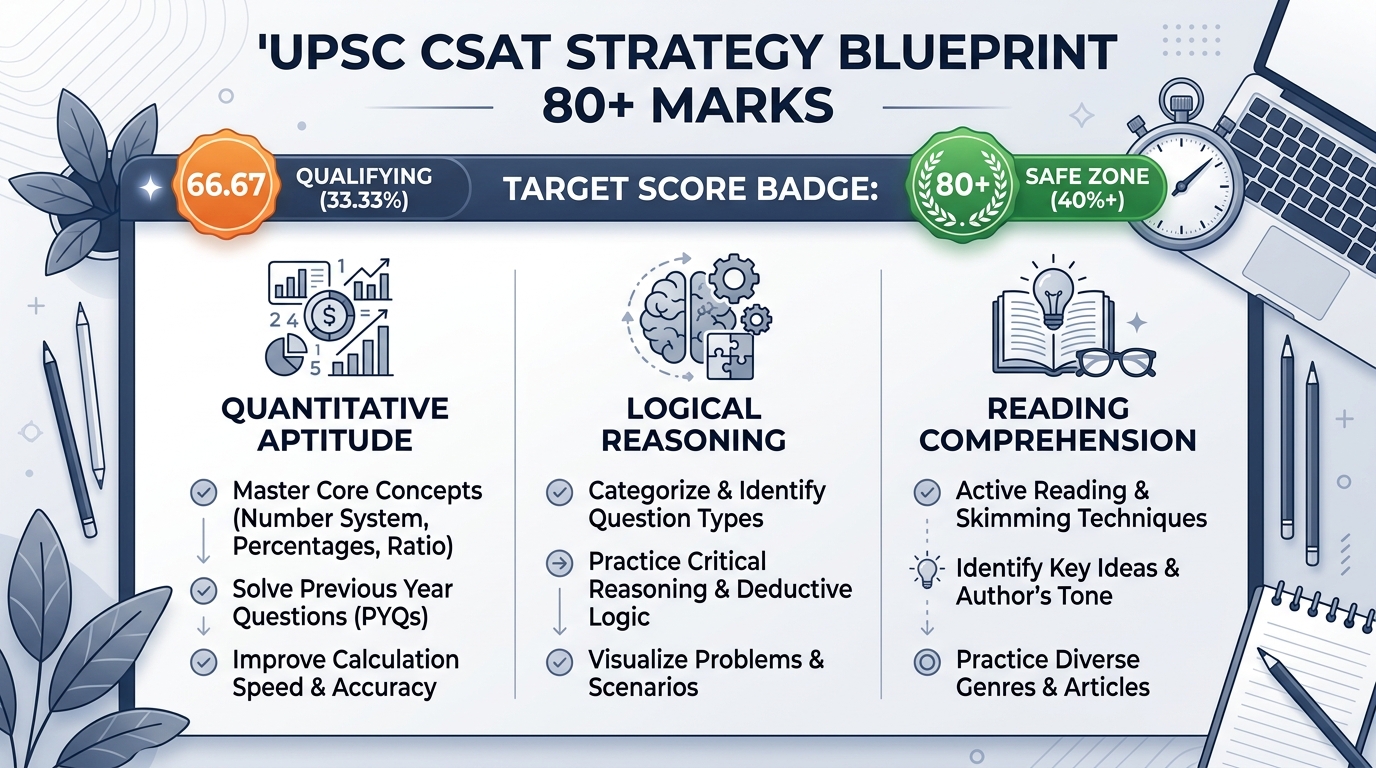
1. Understanding the Exam Mechanics & Safe Score Target
Before solving a single question, understand the mathematical scoring architecture of CSAT Paper 2:
| Examination Parameter | Official Specification | Strategic Implication |
|---|---|---|
| Total Questions | 80 Questions | 120 Minutes (Average 1.5 minutes per question) |
| Total Marks | 200 Marks | 2.5 Marks per correct response |
| Negative Marking | (-0.83) Marks per incorrect answer | (\frac{1}{3}) of the question's mark value |
| Minimum Qualifying Marks | 66.67 Marks (33.33%) | 27 net correct questions required |
| Recommended Target Score | 80 to 95 Marks | 35–38 net correct questions for complete peace of mind |
Why Aim for 80+ Instead of Just 66.67?
Aiming exactly for 67 marks is statistically dangerous. Even a slight variation in passage interpretation or an unforeseen calculation trap in the exam hall can drop your score below the threshold. Targeting 80+ marks creates an indispensable buffer of 14 to 15 marks, insulating your preparation against tricky answer keys.
2. Topic-Wise Weightage Analysis (Recent Trend)
An analysis of recent UPSC CSAT papers reveals a marked redistribution across the three core sections:
| Subject Pillar | Typical Questions | Dominant Sub-Topics | Difficulty Trend |
|---|---|---|---|
| Quantitative Aptitude | 35 – 42 Questions | Number System, Permutations & Combinations, Probability, Percentages, Time & Work | High (Conceptual & Lengthy) |
| Reading Comprehension | 26 – 28 Questions | Assumptions, Inferences, Corollaries, Central Themes | Moderate to High (Subjective options) |
| Logical & Analytical Reasoning | 12 – 18 Questions | Syllogisms, Direction Sense, Blood Relations, Coding, Puzzles | Moderate (Most scoring section) |
3. Pillar 1: Quantitative Aptitude (The Core Anchor)
You do not need an advanced engineering degree to master CSAT Maths. The syllabus is rooted in Class 10 fundamentals, but tests deep conceptual agility rather than repetitive formulas.
       ┌────────────────────────────────────────────────────────┐
       │             HIGH-YIELD QUANT FOCUS AREAS               │
       └───────────────────────────┬────────────────────────────┘
                                   │
         ┌─────────────────────────┼─────────────────────────┐
         │                         │                         │
         ▼                         ▼                         ▼
   [ NUMBER SYSTEM ]       [ ARITHMETIC CORE ]        [ COMBINATORICS ]
   • Divisibility Rules     • Percentages & Profit    • Permutations
   • Remainder Theorem      • Ratio & Proportion      • Combinations
   • Unit Digit & Factors   • Time, Speed & Distance  • Basic Probability
High-Yield Chapters to Prioritize:
-
Number System (15–20 Questions):
- Divisibility Tests: Especially for primes like 7, 11, 13, 17, 19 and composite rules ((72 = 8 \times 9)).
- Remainder Theorem: Finding remainders of large exponential expressions using Euler's totient or binomial expansion.
- Unit Digits & Cyclicity: Understanding cyclicity of 2, 3, 7, 8 (period of 4) and 4, 9 (period of 2).
- Factorials & Trailing Zeros: Counting factors of 5 and 2 in large products.
-
Permutation, Combination & Probability (6–8 Questions):
- Fundamental principles of counting (multiplication vs addition rule).
- Formation of numbers under constraints (e.g. four-digit even numbers without repetition).
- Selection vs Arrangement logic.
-
Core Arithmetic Essentials (8–10 Questions):
- Percentages & Fraction Equivalents: Memorize fractions from (\frac{1}{2}) to (\frac{1}{15}) for instant mental calculation.
- Ratio & Proportions: Mixtures and alligation shortcuts.
- Averages & Weighted Averages: Age-based equations and weighted score balancing.
4. Pillar 2: Logical & Analytical Reasoning (Your Scoring Haven)
Logical reasoning carries the highest return on time invested. Unlike Reading Comprehension, reasoning solutions are objective and verifiable.
| Reasoning Topic | Frequency | Strategic Approach for Exam Hall |
|---|---|---|
| Syllogisms | 2–4 Qs | Use Venn diagram technique; never make assumptions outside given premises. |
| Directions & Distances | 1–3 Qs | Sketch coordinate axes (N-S-E-W) with clear turning angles and Pythagorean theorem. |
| Blood Relations | 1–2 Qs | Use standard generational family tree diagrams ((+) for male, (-) for female). |
| Data Sufficiency | 3–5 Qs | Determine whether Statement 1 or Statement 2 alone suffices; do not waste time calculating exact numerical answers. |
| Seating Arrangement & Ordering | 2–4 Qs | Tabulate linear or circular constraints; test edge cases systematically. |
5. Pillar 3: Reading Comprehension (Deciphering UPSC Vocabulary)
Reading Comprehension passages in UPSC CSAT are typically short (100–200 words) drawn from topics like climate change, economic governance, agriculture, and ethics.
The key challenge is differentiating between specific question directives:
Directives Decoded:
- "Crux / Central Idea": What is the author's primary thesis? Eliminate options that describe secondary examples or peripheral arguments.
- "Logical and Rational Assumption": What unstated premise did the author take for granted to arrive at their conclusion? The correct assumption must support the passage, not extrapolate beyond it.
- "Logical Corollary": What natural consequence or outcome flows directly from the passage?
- "Most Rational Inference": What fact can be deduced purely from the evidence presented, without bringing outside knowledge?
Golden Rule of RC: Never use external general knowledge to answer CSAT passages. Even if an option is universally true in science or geography, if it is not supported by the passage, it is incorrect.
6. The 120-Minute Exam Hall Execution Strategy
How you manage your two hours inside the examination hall determines whether you clear CSAT or get trapped in time pressure.
┌────────────────────────────────────────────────────────────────────────┐
│                   THE 3-ROUND EXAM HALL TIMETABLE                      │
├────────────────────────────────────────────────────────────────────────┤
│ • ROUND 1 (00 to 50 Mins): Solve 25 Easy / Familiar Questions          │
│   - Target: Clean reasoning puzzles, single-paragraph RC, basic arithmetic│
│   - Mark unsure questions with a circle for Round 2.                  │
│                                                                        │
│ • ROUND 2 (50 to 95 Mins): Tackle Moderate Calculation Problems        │
│   - Target: Number system remainders, multi-statement data sufficiency│
│   - Accumulate total attempted questions to 45–50.                    │
│                                                                        │
│ • ROUND 3 (95 to 110 Mins): Revisit Shortlisted Possibilities          │
│   - Solve 3 to 5 questions where you eliminated 2 options.            │
│                                                                        │
│ • BUFFER (110 to 120 Mins): OMR Bubbling & Final Cross-Verification    │
└────────────────────────────────────────────────────────────────────────┘
Recommended Question Attempt Target:
- Ideal Attempts: 48 to 55 Questions
- Accuracy Expectation: 75% to 80%
- Net Calculation:
- 40 Correct ((40 \times 2.5 = 100) marks)
- 10 Incorrect ((10 \times 0.83 = 8.3) negative marks)
- Final Score: 91.7 Marks (Safely across the 66.67 threshold!)
7. Recommended Resources & Preparation Schedule
Core Reference Material:
- UPSC CSAT Previous Year Papers (2015–2025): The single most authentic resource. Practice them under strict 2-hour timers between 2:30 PM and 4:30 PM (matching real exam timing).
- Quantitative Aptitude: Quantum CAT by Sarvesh Verma (Level 1 only) or Quantitative Aptitude by R.S. Aggarwal for foundational concepts.
- Analytical Reasoning: Modern Approach to Verbal & Non-Verbal Reasoning by R.S. Aggarwal.
- Online Practice: Practice realistic timed mock tests on Competition Prepare UPSC CSAT 2026 Mock Test.
Weekly Study Schedule (for the last 3–4 months):
- Weekdays (Monday to Friday): 45 minutes daily dedicated to one Maths topic (e.g. Number System) or 4 RC passages.
- Weekends (Saturday or Sunday): 1 full-length 80-question mock test under exam conditions followed by 1 hour of thorough error analysis.
Conclusion
CSAT is an aptitude examination, not a memory contest. By securing your base in Number System, Logical Syllogisms, and Precision Reading Comprehension, you turn Paper 2 from a source of anxiety into a routine qualifying formality.
Start your diagnostic evaluation today: attempt our full-length interactive UPSC CSAT 2026 Full Paper 2 Mock Test to benchmark your speed, accuracy, and section-wise strengths!
Founder & Chief Educator at Competition Prepare. Dedicated to helping competitive exam aspirants crack UPSC CSE, NEET UG, Banking, SSC, Railway & OPSC with structured roadmaps, high-yield study notes, and proven exam strategies.
Discussion & Aspirant Feedback
Have a question or study doubt? Leave a comment below.
Ask a Question or Share Your Preparation Strategy
Share your study routine, clarify doubts, or suggest topics. Verified submissions are reviewed by the editorial desk.
Be the first to ask a question or leave feedback on this article!